He Couldnt Say “Dada” Yet. He Brought the Photo Instead.

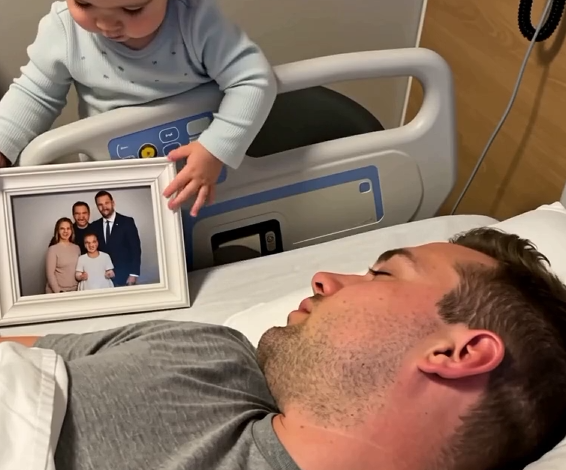
The thing nobody tells you about a head injury is how boring the recovery is, and how much of the drama happens in rooms where nothing visible occurs.
Micah’s father, Daniel, had been hit by a van at a junction two streets from his own house, on an ordinary Tuesday, carrying a bag of groceries that the police photographed and that his wife eventually threw away without opening.
He was thirty-four. He came off his bike at perhaps fifteen miles an hour, which the consultant said four separate times was the only reason they were having the conversation at all.
Nine days in, he was in that state the doctors describe with enormous care and maximum vagueness — awake sometimes, responsive sometimes, oriented rarely. He had opened his eyes for nurses. He had squeezed a hand on request. He had, twice, said something to his wife that was not quite a sentence.
What he had not done in nine days was look at anybody and know exactly who they were in the first half-second.
That is what happened when the frame got patted the third time.
He said “hey, buddy,” and his eyes went to Micah’s face and stayed there, and his hand came up off the bedding about two inches toward the baby, and he did not sit up or lift his head because he couldn’t, but something in his face did the thing a face does when it recognises somebody.
The video is forty-one seconds long. Vertical, tilted, shot by a woman in her sixties who was not really trying to film anything. There’s a thumb across the corner for the first two seconds and the audio is mostly the ventilation system.
The neurologist watched it on Thursday morning. Watched it twice. Then said, in the careful way they say these things:
“That’s a good sign. I’m not going to tell you what it means. But that’s a good sign.”
It took five months.
That’s the part the forty-one seconds doesn’t contain and the part that nobody puts in the caption. Five months of a rehabilitation ward, then a day programme, then a year of outpatient appointments on Tuesdays and Fridays.
He lost some things permanently. He can’t smell anything, which sounds minor and is not; he came home from hospital and couldn’t smell his own children, and that was the thing that finally broke him, nine weeks after an accident he’d endured without crying once.
He gets tired in a way that has no bottom to it. He went back to work at sixty percent and stayed at sixty percent, and the house is smaller now and the car is older, and his wife picked up extra shifts that she has never once described as a sacrifice in front of him.
He can’t remember the four days before the accident, or most of the nine days after it.
He has no memory at all of saying “hey, buddy.”
Micah is six now.
He doesn’t remember any of it either, obviously. He was one. What he has instead is the video, which he has watched perhaps two hundred times, and which he went through a phase of showing to absolutely everyone who came to the house, including a plumber.
He asked the usual question when he was four: “Why was Dad sleeping?”
He asked a better one when he was five and a half.
“Why did I bring the picture?”
His mother thought about that one for a while before she answered it, because she’s thought about it for years and because the honest answer is: nobody knows. He was one year old. He found a thing on a chair and carried it somewhere. You can build whatever you want on top of that and none of it is provable.
What she said was: “Because everyone in it was there. And he was the only one missing.”
Micah accepted this completely, in the way children accept things, and went off to do something else.
The frame is still in the house. Not framed again, not displayed properly, not restored.
It’s got a crack in the lower right corner of the glass from where it got knocked off the chair at some point during those five months, and the white plastic has gone slightly yellow along the top edge, and the photo inside has faded at one side from nine days of sitting on a hospital windowsill.
Daniel’s wife offered once to have it reprinted and put in something decent.
He said no.
It lives on the shelf by the front door, at about the height of a standing one-year-old, which is not where you’d put a photograph you wanted people to look at.
But it’s exactly where you’d put one you wanted a small person to be able to reach.