I Faked a Business Trip to Catch the Nanny Hurting My One Year Old Twins Then They Called Her Mama

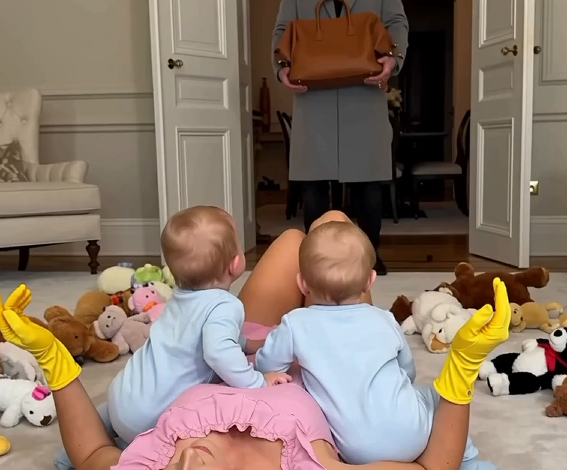
The police took Margaret at 6:40 that evening. I know the time because I have the report, and because for about three weeks afterward I read that report the way other men read scripture — looking for the line that would tell me how I missed it.
There isn’t one. That’s the thing nobody warns you about. There’s no single moment where a reasonable man should have known. There are forty small ones, and every single one of them had an explanation I accepted because accepting it was easier than the alternative.
The twins sleep through the night now. They’ve settled beautifully, Mr. Caldwell.
They’ve gone quiet when I pick them up. Children bond with their primary caregiver, sir. You’re gone eleven hours a day.
Why is the pantry locked? Chemicals. Honestly, sir, a one-year-old and a bottle of drain cleaner.
I signed off on the brass lock myself. I remember doing it. I remember thinking it was sensible.
Here is what the detective told me on the Tuesday, sitting at my kitchen island with a cup of coffee he never touched:
“Mr. Caldwell, I need you to understand something, because people in your position usually don’t, and it tends to go badly for them later. You weren’t the target.”
“They’re my sons.”
“They were the inconvenience. You were the employer.” He turned his notebook around. “She’d been with the family twenty-six years. Your father hired her. She ran that house when your wife was alive and she ran it when your wife died, and then you brought in a twenty-two-year-old from an agency and gave her authority over the only two people in the building who mattered.”
“She was drugging infants to protect her job?”
“She was drugging infants because they cried,” he said. “And because when they cried, Lena came. And when Lena came, the boys quieted. And every time that happened, Margaret watched twenty-six years of being essential to this family get handed to a girl who’d been here five weeks.”
He closed the notebook.
“The pantry wasn’t punishment. Not at first. It was so you wouldn’t hear it on the phone.”
We found the rest of it in the following weeks, piece by piece, and each piece was worse than the one before because each piece was more ordinary.
The sleep aid had been purchased eleven times from four different pharmacies across two counties. Cash. The bottles went out with the recycling, which Margaret personally handled, which nobody had ever thought was strange because Margaret personally handled everything.
The pediatrician’s notes said developmentally delayed, possible failure to progress, recommend assessment. I had read that letter in a hotel room in Singapore and forwarded it to my assistant to book the specialists.
The scratch marks weren’t new. The carpenter who came to take the door off its hinges found three distinct layers, the deepest ones sanded and painted over.
Painted over. Someone had bought matching paint.
I had to leave the room for that one.
Lena nearly left.
Not out of fear of me — out of something closer to shame, which I did not understand for a long time and which she eventually explained badly, late one night in the kitchen, with her coat already on.
“I knew in week two,” she said.
“You reported it.”
“I told Margaret.” She was looking at the floor. “I told the head of household that the head of household was hurting the children. Who else was I going to tell? Your assistant screens your calls. I’m twenty-two with an associate’s degree and she’s been here since before I was born. And she said if I made trouble she’d put it in writing that I’d done it, and who do you think they’d have believed, Mr. Caldwell?”
I didn’t have an answer for that. I still don’t.
“So I just — stayed closer,” she said. “That’s all I did. I stopped taking my breaks. I ate standing up. I never left them alone with her, except the four afternoons she sent me out for errands, and I think those were the four worst days of their lives, and I drove to a pharmacy and bought nappies while it happened.”
She started crying then, and I stood in my own kitchen with no idea what I was permitted to do about it.
What I said was: “Nico called you Mama in front of me.”
“I know. I’m so sorry. I never once—”
“Lena.” I had to stop and start again. “You were the only adult in this house they had any reason to call it.”
She stayed.
Not as a nanny — I tried to make her the nanny again and she said no, actually, which took some nerve and which I respected more than almost anything anyone’s ever said to me. She’d been in a house where the staff hierarchy was the thing that let a woman syringe sedatives into a one-year-old, and she wasn’t willing to go back into that structure.
So we built a different one. She finished her degree; I paid for it, and she made me put in writing — she insisted, twice, until the lawyer got irritable — that it carried no obligation to stay, no obligation to return, and that the boys were not a condition of any part of it.
She stayed anyway. Three years, then four.
And I cut my hours. Not nobly, not all at once, and not without the company noticing. But I came home at six instead of nine, and then at five, and I learned a fact that I find genuinely humiliating in retrospect: nothing collapsed. Four thousand employees, three continents, and it turned out the building stayed up when I left it.
I’d been using that place as a reason for two years.
The boys took a long time.
Nico stopped talking for nearly three months after that night — the “Daddy” and the “Mama” and the “bad Nana” were the last words out of him until the following spring. The new psychologist, a tired and extremely good woman in her sixties, said that was normal and told me the sentence I’ve repeated to myself more than any other since:
“They’re not damaged, Mr. Caldwell. They’re braced. Those are different things, and the second one gets better if you’re boring enough for long enough.”
So I was boring. For a year and a half I was the most boring man in Washington. I sat on floors. I said nothing. I learned not to lunge when one of them flinched, which is the hardest physical thing I have ever trained myself to do.
Noah still won’t go into a dark room. He’s five. He reaches up and holds your wrist, not your hand — your wrist, so he can feel the bones — and he says “you first,” and you go first, and you don’t make anything of it.
The pantry was taken out entirely. The whole wall came down and the kitchen opens onto the garden now, which cost a ridiculous amount of money and was worth every cent of it. There was a week where the contractors asked whether I wanted the door salvaged, it being original to the house and in good condition.
I told them to burn it. They thought I was joking.
Margaret took a plea.
Four counts. She never gave a statement, never explained herself, never once in any of it said she was sorry — not to me, not in court, not in the letter her lawyer sent that I returned unopened.
The only thing she ever said about it on the record was to the arresting officer, and it’s in the report, and it’s seven words long, and I think about it more often than I’d like:
“They would have forgotten by Christmas.”
She was right about that, actually. Nico doesn’t remember. Noah doesn’t remember. Whatever is left in them isn’t a memory, it’s a shape — a flinch at a closing door, a boy who needs your wrist in the dark.
They forgot by Christmas.
I didn’t.
Last June, Nico came and found me in the study. Five years old, holding a drawing he wanted on the fridge, and he stopped in the doorway because he’s a child who stops in doorways and waits to be noticed before he comes in.
I said, “Come here, mate.”
He came and climbed up and put the drawing on the desk and then he said, apropos of nothing at all, the way five-year-olds do:
“Lena’s coming Saturday.”
“She is.”
“Is she my mum?”
I want to be honest about this, because the version where I had something wise ready is not what happened. I sat there for probably ten seconds with my son on my knee and no idea what to say.
What I said in the end was: “No. Your mum was Anna, and she loved you more than anything in the world, and she died before she got to know you. Lena’s the person who looked after you when I didn’t know how.”
He thought about that.
“Is she still that?”
“Yeah,” I said. “She’s still that.”
He nodded and got down and went off to find his brother, entirely satisfied, and left me sitting in my study with the drawing on the desk.
I kept the drawing. It’s in the frame on the shelf where the briefcase used to go.