THE BEDSHEET THAT GAVE THE TWINS BACK THE DATE EVERYONE DREADED

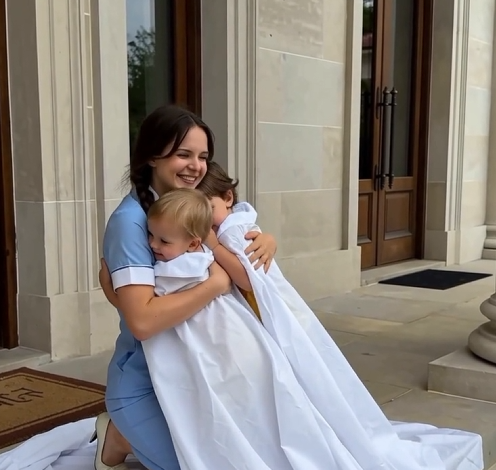
“As long as it takes.”
“That’s not an answer.”
“It’s the only one I have.”
He wanted to ask what she expected to achieve.
She seemed to understand.
“I’m not trying to make them stop being afraid tonight.”
“Then what?”
“To let them know someone can stay while they are.”
The father didn’t know whether that was an explanation or a delicate way of pointing out everything he had avoided doing.
The next morning, the sheet was folded on a chair in the breakfast room.
The second wife removed it before the children came in.
The nanny put it back without a word.
The father saw the gesture from the doorway.
“Don’t take it away.”
The second wife turned.
“The table is not a playroom.”
“Today it can be both.”
The twins came in holding a staff member’s hand.
Seeing the sheet, one of them stopped.
The other let go of the woman and walked toward the chair.
The laundry woman, who had organized the house’s linens for years, watched the movement without commenting.
The boy touched the sheet and waited.
The nanny lifted it slightly.
The little one hid behind her.
The nanny reappeared on the other side.
The boy let out a tiny laugh, so brief that the father thought he’d imagined it.
The laundry woman did hear it.
“He’s never done that,” she murmured.
The second wife went rigid.
“Let’s not turn a sound into an event.”
The father looked at the laundry woman.
“Had you ever heard him laugh?”
She shook her head.
“Neither of them.”
The comment hung over the table.
The father had spent months looking for solutions that could be measured, compared, and explained in front of other adults.
The first new sign fit inside one breath and a mouth open for less than a second.
Even so, it seemed more important to him than all the reports he kept in his study.
The nanny took the twins to the kitchen after breakfast.
Not because she wanted to break the rules of the house, but because there was fruit there, and water, cloths, and a door onto the terrace.
She washed an apple while they watched from the floor.
She cut off a piece and left it on a plate.
She didn’t push it toward them.
The more restless twin came up to the table and took the edge of the plate.
The other hid behind a basket of towels.
The nanny covered the basket with a small towel.
“The ghost doesn’t know where you are.”
The boy peeked out with one eye.
She turned her back and counted to three.
When she turned around, she left the towel on the floor instead of lifting it.
The twin came out on his own.
The father was standing in the kitchen doorway.
His hands closed by reflex.
For months, every adult had picked the children up before they could trip, answered before they could point, and chosen for them before they could change their minds.
The father took a step to help.
The nanny looked at him and shook her head slightly.
It wasn’t an order.
It was an invitation to wait.
The twin came out from behind the basket and walked to the terrace door.
He stopped at the edge of the light.
The father felt the urge to lift him before anything could frighten him.
The nanny left the sheet beside the door.
The boy touched a corner and looked outside.
“You can come back whenever you want,” she said.
The boy took a step onto the terrace.
The second twin came out behind him, slower, shoulders tense.
Nobody applauded.
Nobody called the staff.
The father forced himself not to turn that step into a ceremony.
The second wife appeared with two clean jackets.
“The terrace is cold.”
“They can come back inside,” the nanny said.
“They shouldn’t be barefoot.”
“Then we’ll bring their shoes.”
“You can’t keep answering like that.”
The nanny crouched to cover the children’s feet with the sheet.
The twin who had crossed first grabbed hold of the cloth.
The second wife pulled it away.
The boy lost his breath and began to scream.
The other twin backed up against the wall.
The father stepped between them.
“Let go of it.”
The second wife looked at him, shoes in hand.
“I was only trying to protect them.”
“You’ve seen them.”
“They’re upset because she’s getting them used to depending on her.”
The father looked at the boy still clinging to the sheet.
The phrase reminded him of every time he had called an outstretched hand “dependency” because he hadn’t known what to do with it.
“Maybe they depend on someone because someone has to stay.”
The second wife went pale.
Not at the sentence, but because he had said it in front of the nanny and the two children.
The father was not accustomed to choosing a connection he couldn’t control.
Even so, that afternoon he didn’t order the sheet removed.
The laundry woman left three more in a basket.
One was old and had a seam in the corner.
The nanny turned it into a door.
Another became a bridge between two chairs.
The third covered a low table and created a hiding place with a wide entrance.
The twins didn’t open up at the same time.
One looked for the nanny with his eyes.
The other needed to hide first and listen to her footsteps before coming out.
She learned their differences without turning them into labels.
If one laughed, she didn’t make the other repeat it.
If one touched the food, she didn’t put the plate in front of his brother.
If one crossed the terrace, she let the other watch from the door.
The father watched a house that had treated the twins as an impossible single unit begin to let them have two rhythms.
The nanny also brought ordinary life into the corners where there had only been supervision.
She washed fruit with them.
She gave them cloths to dry spoons.
She let them stir water in a plastic bowl.
She hung small socks in the laundry room and turned every clothespin into a surprise.
She took them out to the terrace at dusk, when the shadows were long and nobody could pretend the day was still perfectly under control.
The father began coming home earlier.
At first he did it to observe.
Then he stopped pretending to observe and sat down nearby.
He didn’t talk much.
The nanny asked him not to fill every silence with instructions.
“If you want to join in, join in without changing what they’re doing.”
“And if they do it wrong?”
“Then they’ll be doing something they don’t know how to do yet.”
He frowned.
“That doesn’t reassure me.”
“It doesn’t reassure them either.”
The father almost smiled, but the habit of keeping his face firm stopped him.
The twins began to recognize his footsteps.
One would raise his head when he crossed the hallway.
The other didn’t look at him, but he stopped hiding his hands.
One night, after an especially hard waking, the nanny was exhausted.
She had spent hours sitting beside the beds, humming the mother’s song and letting the sheet appear and disappear among the shadows.
The father came in with his collar open and without the watch he used to time his meetings.
“Go and rest,” he told her.
“Not yet.”
“I’ll stay.”
The nanny looked at him carefully.
“You don’t have to do it the way I do.”
“I don’t know how to do it.”
“Then start by not leaving.”
The father sat down on the floor.
One of the twins was awake, rigid and silent.
The other was breathing in small jerks.
The father took a corner of the sheet.
He raised it too fast.
The twin startled.
He lowered it at once.
“Again,” he murmured, not sure whether he was speaking to the boy or to himself.
The second time he moved the cloth more slowly.
The third time he waited for the boy to look before reappearing.
He didn’t get a smile.
He got the twin not pulling his hand away.
For the father, that was harder than closing a major deal.
He couldn’t speed the scene up.
He couldn’t buy an answer.
He couldn’t send someone else to finish it.
When dawn came, the boy was still asleep near his knee.
The nanny found the father on the floor and said nothing.
She just left a cup of coffee beside him.
On the second day, the father failed again.
He had a meeting with relatives who wanted to know why the twins never appeared in the formal dining room, and he asked for them to be dressed in identical clothes.
The second wife seized the opportunity.
“The birthday is coming up,” she said.
“I know.”
“We can’t allow another scene like last year’s.”
The previous year, the children had screamed in front of everyone, refused the cake, and ended up hidden under a table while the adults pretended the celebration was still going.
The date was the twins’ birthday, but it was also the date on which their mother’s absence became visible to the whole family.
The second wife had turned it into an annual examination in manners.
The father had turned it into a control project.
The nanny didn’t call it anything.
She only asked where the table would be.
“In the main dining room,” the second wife answered.
“And the terrace?”
“That isn’t a place for guests.”
“It can be a place for them.”
“That day they’ll be with the family.”
“They’re the family too.”
The father listened from the hallway.
The second wife turned to him.
“Tell her she can’t arrange this house to suit herself.”
He looked toward the terrace.
The twins were under the low table, covered by a sheet that let the light in through one corner.
The nanny sat outside it, humming the three notes.
The father remembered his own voice giving instructions for years.
He had asked that the children sleep at the same hour, eat at the same hour, and receive the same people, so the house would look stable.
Stability had ended up looking far too much like a cage.
“The celebration can be on the terrace,” he said.
The second wife’s eyes widened.
“There will be guests.”
“Then they’ll know where the children are.”
“There will be photographs.”
“They don’t have to pose.”
“The family expects something different.”
“The family can wait.”
The father didn’t say it forcefully.
He said it wearily.
That weariness was the first crack in the order he had protected for years.
The second wife began reviewing the birthday purchases with almost ferocious precision.
She chose pale tablecloths, glasses that couldn’t break, clothes without patterns, and a small cake to avoid stains.
The nanny asked for washable paints, a basket of fruit, and several sheets that weren’t white.
“I am not going to have colors on the walls,” the second wife said.
“We won’t put them on the walls.”
“Nor on their clothes.”
“They can wear aprons.”
“I don’t want to turn the date into a nursery.”
The nanny folded a blue apron.
“Maybe they need a date that looks lived in.”
The father heard the sentence and didn’t correct it.
The night before the birthday, the twins woke screaming before midnight.
One sat up in bed with his back straight and his eyes open, seeing nothing.
The other beat his hands against his chest and refused the water offered to him.
The second wife asked for all the lights to be turned on.
The father reached the bedroom a few seconds after the nanny.
She was already on the floor with a sheet over her shoulders.
She didn’t try to take the children out of the room.
She let them hear the same rhythm, the same cloth, and the same three notes.
The father knelt by the door.
“I’m here.”
The twin who was screaming looked at him for the first time during an episode.
The father didn’t move closer.
“I’m not going to lift you up.”
The second wife looked at him in alarm.
“What are you doing?”
“Waiting.”
The boy was still rigid.
The nanny made the sheet travel slowly across the floor.
The father copied the movement with another pillowcase.
The two ghosts advanced from opposite sides of the room.
The twin who had been beating his hands stopped.
The other stretched a foot toward the edge of the bed.
Nobody picked him up.
Nobody asked him to calm down.
The father understood that being present wasn’t about producing a solution, but about bearing the wait without leaving the room.
At dawn, the twins were still tired, but they agreed to eat a piece of bread in the kitchen.
The birthday began without music.
The house was full of adults speaking quietly so as not to disturb the image of calm.
The second wife had arranged the gifts on an immaculate table.
The nanny spread a blue sheet across the terrace floor.
She set small bowls of washable paint beside the aprons.
The laundry woman brought another cloth with a mended corner.
“This one was from the old room,” she said.
The nanny recognized it.
The twins’ mother had used that cloth to cover a window back when the house still had open windows.
She didn’t explain how she knew.
She just left it near the children.
The first twin touched the yellow paint.
The second sank a finger into the blue.
The second wife came over quickly with a towel.
“Not on the sheet.”
The boy pulled his hand back.
The father stopped her before she could wipe the stain.
“Leave it.”
She lowered the towel.
“It’s their birthday.”
“Precisely.”
The nanny painted a small circle on the cloth.
Then she covered it with her palm and disappeared behind the sheet.
The first twin lifted the cloth.
She reappeared with a yellow smear on her nose.
The boy let out a laugh.
It wasn’t a polite or brief laugh.
It was an open sound, startled, clumsy, and so new that several guests stopped talking.
The second wife stood motionless beside the table.
The father felt his body empty out from the inside.
The second twin looked at his brother, touched the blue, and struck the sheet with both hands.
The nanny hid again.
This time both children chased her.
The terrace filled with small footprints, paint stains, and a sheet that was no longer white.
The father took a step toward them.
Not to stop them.
To sit down.
The first twin came over and left a yellow hand on his shirt.
The father looked at the mark.
The second wife expected him to order the cloth cleaned, his clothes changed, and the celebration resumed.
He didn’t.
“Can I play?”
The twins didn’t answer in words.
The second held out the blue corner of the sheet to him.
The father took it.
The nanny stepped back and pointed to a chair.
He covered himself with the cloth.
For an instant, he didn’t know how to move.
The children waited.
The father came out on the wrong side.
The first twin laughed again.
The second wife closed her eyes.
The laundry woman turned away to hide a smile.
The guests began talking about something else, uncomfortable because the scene couldn’t be translated into a toast or a formal photograph.
The father stayed on the floor.
He let the twins stain his sleeves.
He let the cake be served on small plates at a low table.
He let one of them eat with his fingers and the other wait until he felt ready.
The second wife didn’t wipe away any more paint.
She sat farther off, back straight, hands folded.
She didn’t apologize.
But she didn’t call the mess shameful again either.
The birthday ended at dusk, when the guests had gone and the terrace was covered in faded colors.
The father didn’t order it cleaned right away.
He helped fold a corner of the sheet while the twins were still holding on to it.
The date hadn’t stopped hurting.
But it no longer belonged only to their mother’s absence.
Now it also held a laugh.
That night, the twins fell asleep earlier than usual.
The father stayed sitting between their beds.
The nanny left a white pillowcase in his hands.
“You don’t have to play the ghost,” she said.
“I know.”
“Then what are you going to do?”
He looked at the sleeping children.
“Stay.”
The word didn’t sound heroic.
It sounded difficult.
The first time one of the twins woke after the birthday, it was the father who got up.
He didn’t call the nanny.
He didn’t turn on all the lights.
He didn’t reach for the little spoon or the clock.
He sat on the floor with the sheet over his shoulders.
The boy screamed for a few seconds.
The father waited without touching him.
Then he let the cloth move forward a hand’s width.
The boy looked.
The father drew back.
The boy breathed.
The father reappeared.
The boy got out of bed and laid a hand on his knee.
The second twin woke afterward, quieter and more wary.
The father didn’t ask him to come closer.
He left the other corner of the sheet on the rug.
The boy took it and stayed beside the bed.
The three of them remained like that until the breathing was steady again.
In the morning, the father canceled a meeting to have breakfast with them.
He made no announcement.
He didn’t ask anyone to record the change.
He washed fruit, dried a spoon, and let the twins choose between two cups.
One chose the blue one.
The other chose the one with a small crack in the rim.
The second wife watched from the doorway.
“You can’t let them decide everything.”
The father put the fruit on the plate.
“They’re not deciding everything.”
“Then what are they deciding?”
“Whether they’re allowed to be here.”
The second wife couldn’t find a quick answer.
The house had been built around decisions made by adults.
Nobody had considered that a child might need to choose the exact moment of crossing a doorway.
Over the following weeks, ordinary life settled in little by little.
The nanny went on taking the twins to the kitchen to wash fruit and to the laundry room to hang small cloths.
The father began taking part without turning every task into an exercise.
Sometimes he came home late and found the children asleep.
He no longer made up for the absence with gifts or instructions.
He sat beside the bed and waited for morning.
Sometimes the second wife came in with a tray and corrected the position of the glasses.
The nanny didn’t argue.
The father didn’t raise his voice either.
He simply moved the tray to the low table and let the children touch the fruit.
The second wife began leaving a clean towel by the terrace door.
Then she left two aprons.
One day she brought a yellow sheet from a room that was almost never used.
She left it on a chair without saying what it was for.
The first twin saw it.
The nanny picked it up.
The second wife didn’t move away.
The boy hid behind her for a second.
Then he came back out.
The second wife looked at the father.
He didn’t congratulate her.
He didn’t turn the gesture into an absolution either.
He only let the sheet stay on the terrace.
The repair didn’t arrive as a shared promise.
It arrived as a series of objects that stopped being taken away.
A cup that was no longer hidden.
A stain that wasn’t wiped up immediately.
A door that stayed open during naptime.
A dinner at which nobody demanded that the twins finish at the same time.
The laundry woman began setting aside cloths for them.
She didn’t call them toys.
She called them “the ones that come back.”
The father heard the name and asked why.
“Because they always return,” she answered.
The twins could now cross on their own from the kitchen to the terrace.
One still needed to touch the corner of the sheet before moving forward.
The other preferred to hide under the table and wait to be found.
The nanny respected both routes.
The father learned to do the same.
The fear didn’t go away.
Some nights they still woke screaming.
The difference was that the house no longer responded as if the noise were a shame to be covered up.
The lights stayed low.
Hands didn’t take hold of them without warning.
The nanny stayed.
The father learned to stay with her.
On a rainy night, one of the twins woke before the other and walked to the bedroom door.
The father was there with a sheet folded over his arm.
The boy didn’t scream.
He simply raised a hand.
The father covered his head.
The boy came forward.
The father reappeared.
The boy smiled.
The second twin appeared from behind the bed and joined the game without anyone calling him.
The nanny watched from the floor.
She didn’t correct the father when he came out too fast again.
She just waited for him to understand from the children’s reaction and try again.
The father slowed his rhythm.
The twins came closer.
That was the first time he stopped directing the scene entirely.
The house was still large, expensive, and too silent in some hallways.
But not all of the silence meant absence anymore.
Sometimes it was the space between one laugh and the next.
Sometimes it was the wait before a child decided to come out from under a table.
Sometimes it was the father sitting on the floor, with no phone, no watch, and no answer prepared.
The second wife kept her impeccable dresses and her way of noticing every detail.
She didn’t become another person overnight.
But she stopped pulling the cloths out of the children’s hands.
When the date came around again the following year, she didn’t prepare a celebration to prove that everything was fine.
She asked where they wanted to put the table.
The first twin pointed to the terrace.
The second carried a blue sheet out there.
The father left the table without a cloth.
The nanny set out fruit, bread, and two bowls of paint.
The second wife brought a small cake and left it by the door.
Nobody spoke about the loss at first.
Not because it had been forgotten.
But because it no longer needed to fill every corner to prove that it had happened.
The father sat between the twins.
One painted a red line on his wrist.
The other covered himself with the sheet and waited.
The father stood up, gave a clumsy bow, and disappeared behind a chair.
The children ran after him.
The second wife stayed by the table, holding the plates.
The laundry woman opened the terrace door to let in the afternoon air.
The nanny hummed the three notes the mother had left in the memory of the house.
The father reappeared with the sheet over his shoulders.
The twins laughed at the same time.
He didn’t try to capture the moment or turn it into proof.
He just hid again.
And when the children shouted “again,” he came back.