The Day a Yellow Chick Walked Onto His Blanket and Picked Him

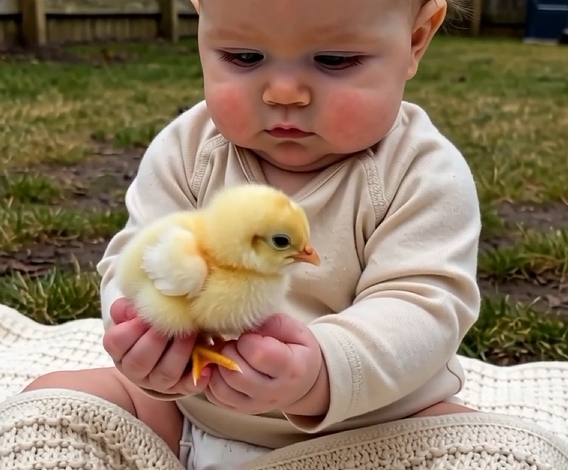
Everyone who watches that video sees the same thing, which is a baby almost grabbing a chick.
What nobody sees, because it’s too small and too fast and happens in about a third of a second, is the reason the hand came down.
The chick froze.
Not moved away — froze. Every muscle in it locked, the way prey animals do when something large comes at them, and it stood there on the blanket absolutely rigid.
And the baby, who had no words, no concept of fragility, no experience of any living thing smaller than himself, put his hand back down.
His mother has watched it four hundred times. She still can’t tell you whether he understood anything or whether it was pure coincidence — a wobble, a lost balance, an eight-month-old doing what eight-month-olds do, which is lose interest in their own intentions halfway through.
Probably it was that. Probably.
But she has two children, and she had spent eight months being told, by books and by her own mother and by the internet, that babies are little engines of grabbing, that they learn gentleness by being taught it, that you have to show them.
And she watched her son stop, unprompted, because something smaller than him got scared.
Butter lived three years, which is nothing for a hen and quite a lot for a hen that spends its entire life refusing to stay in the coop.
She followed the baby. That became the thing — the family joke, and then not a joke, because it went on so long it stopped being funny and became just a fact about the garden. He’d come out the back door and within about ninety seconds she’d come round the side of the shed at speed.
She was not affectionate. Chickens aren’t. She did not want to be held, ever, and let you know. But wherever he sat, she was eventually three feet away, scratching at the ground with one eye on him.
He learned to walk partly by chasing her, which was almost entirely unsuccessful, and which taught him far more about falling over than about catching chickens.
His first word was not “Mama” and it was not “Dada.” It was “buh,” said at the back door with his hand against the glass, and his parents argued for a week about whether it counted before conceding that it obviously did.
She died in the spring when he was three and a half.
Nothing dramatic. Chickens get old quickly; she was slow for about a fortnight and then she stopped coming round the side of the shed, and his father found her in the morning under the hedge she liked.
They told him the truth, because the alternative was a story they’d have to retract later, and because his mother had read somewhere that small deaths are how you learn about large ones and you don’t get to pick the timing.
He cried for a long time and then asked three very hard questions in a row, and then asked for a biscuit, which is how grief works when you are three.
They buried her at the bottom of the garden. He put a stone on it, and then another stone, and then eleven more stones, because at that age quantity is how you show you mean it.
He is nine now, and he keeps chickens.
Six of them, at the bottom of the same garden, in a coop he helped his father rebuild the summer he turned eight. He does the feed. He does the water. He does the part nobody enjoys, which is the cleaning out, and he does it without being asked more often than he doesn’t, which is roughly the best you can hope for from a nine-year-old.
He is extremely good with them in a way his parents find slightly uncanny. He moves slowly near them without appearing to think about it. He crouches rather than leans over. When one of them freezes, he stops dead and waits, and he has never been able to explain why, because it isn’t knowledge — it’s just what his body does.
The photo from that afternoon is in the hallway. It’s a still pulled from the video, so it’s soft and slightly blurred: a baby on a knitted blanket with his mouth open, and three ounces of yellow standing a hand’s width away, and one small palm flat on the fabric where it had just come back down.
His mother was asked once, by a visitor, whether it was the moment he first touched an animal.
“No,” she said. “It’s the moment he didn’t.”