The Second Her Eyes Were Full, He Was Already Reaching

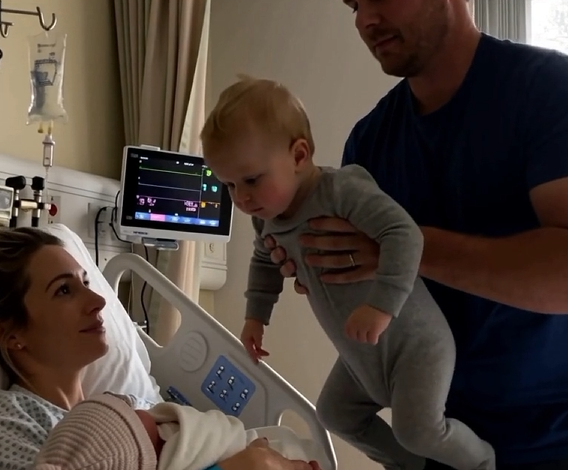
Here’s the part the video doesn’t show, because the grandmother stopped filming when her arm got tired.
Ollie didn’t reach for the baby.
That surprised everyone. They’d spent weeks preparing him — the picture books about being a big brother, the doll he’d been given to practise on and had immediately thrown off the sofa, the eleven conversations with a child who understood approximately none of it. The received wisdom said he’d want to touch, grab, poke, possibly hit.
He didn’t do any of it.
He hung there in his father’s hands with his mouth open and he looked, and then he turned his head and looked at his mother’s face instead.
That was what he was checking. Not what the thing was. Whether she was all right.
He’d been in a strange house for two days with his grandmother. His routine had come apart. Someone had taken him in a car to a building that smelled wrong, and here was his mother in a bed that wasn’t her bed, in clothes that weren’t her clothes, with a tube taped to the back of her hand.
The baby was the fourth or fifth most confusing thing in that room.
His mother understood it about a half-second before anyone else did. She said, “I’m all right, love. Mama’s all right.” And Ollie’s whole body went loose in his father’s grip, and he put his head down on his father’s shoulder and stayed there for the rest of the visit.
His name was Theo, the small one in the knitted hat. Six pounds eleven, arrived at 4:12 in the morning after a long and fairly frightening night that nobody has ever described to Ollie in any detail.
They came home on the Thursday.
The first week was exactly as bad as everyone had warned. Ollie regressed — stopped using the four words he had, went back to being carried up the stairs when he’d been walking them for a month, woke twice a night for the first time since July. The health visitor said it was textbook and would pass in a fortnight and it passed in about five weeks, which felt a great deal longer than a fortnight at the time.
What his parents got right, and they got it right by accident rather than by wisdom, was this: nobody made him love the baby.
Nobody put Theo in his arms for a photo. Nobody said give your brother a kiss in that bright voice that makes a toddler immediately not want to. Nobody said you’re a big boy now, which is a sentence that has never once in human history made a fourteen-month-old feel better about anything.
They just let him be in the room.
For about three weeks he ignored the baby completely and was furious with his mother specifically — which is the usual way round, and which hurt her far more than she expected and more than she admitted to anyone except her own mother, on the phone, at one in the morning, crying in a dark kitchen.
Then one afternoon Theo was on the mat doing his jerky newborn arm thing, and Ollie walked over, sat down about a foot away, and watched him for nearly four minutes without touching him.
He got up. He went and got his own blanket — the grey one, the one that goes everywhere, the one he screams about if it’s in the wash — and he came back and dropped it on his brother’s legs.
Then he walked off to do something else entirely.
His mother sat on the floor of the living room and cried for ten solid minutes and couldn’t have told you precisely why.
They’re four and five now.
Theo is the loud one, which nobody saw coming. Ollie is the one who stops in doorways and waits to be noticed before he comes into a room, and who still — still, at five — checks his mother’s face first when something goes wrong. A dropped glass, a raised voice on the telly, a stumble on the stairs: his head goes to her before it goes to the thing that happened.
The photograph lives in the hallway, printed from a frame of that video. It’s blurry. It’s badly composed. Theo’s face is barely visible and their mother’s eyes are shut because she was mid-blink.
Guests sometimes ask why they didn’t use one of the proper ones — the ones from the professional newborn shoot two weeks later, where everyone’s lit beautifully and nobody is crying.
Their father has an answer he’s given so many times it’s become a sort of family liturgy.
“Because in the good photos, everybody’s pretending to be fine,” he says. “In that one, nobody was. And look at him.”
And people look at it properly then, instead of politely, and they see what he means — a boy hanging in the air by his armpits, legs dangling, mouth open, not looking at the new baby at all.
Looking at his mother.