WHEN THE RICH MANS SILENT SON CROSSED THE KITCHEN DOOR FOR THE NANNY EVERYONE THOUGHT WAS TOO MESSY

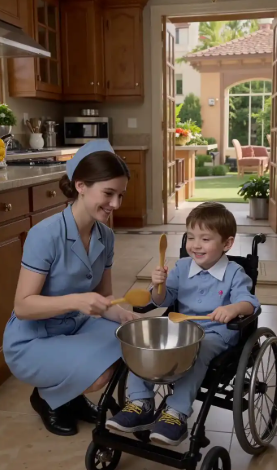
The kitchen went dead quiet.
Samuel stood in the hall, one hand still on his phone, but he wasn’t seeing emails anymore. He was seeing his son strain.
Jack’s face tightened. One foot on tile. One hand clamped around the wheelchair arm. The garden light hit the floor beyond the doorway like another world.
Emma didn’t touch him.
That was what shocked Samuel most.
Every therapist had touched, guided, corrected, supported, positioned. Every adult in that house had rushed in the second Jack showed distress.
Emma only held the bowl low by her knee and gave the same answer.
Tap-tap.
Jack breathed hard through his nose. His body shook with effort. He didn’t make it through the doorway. After two seconds, maybe three, he dropped back into the chair.
Mrs. Dallow exhaled like she had been waiting to be proven right.
“This is exactly why he isn’t brought in here,” she said sharply. “He gets dysregulated.”
Emma finally looked up. “He tried.”
Samuel should have stopped it right there. He should have told the staff to take Jack back to the nursery suite, to the speech cards, the soft mat, the carefully approved toys lined on low white shelves.
Instead, he heard himself ask, “Why this?”
Emma set the bowl down. “Because it ends.”
He frowned.
She nodded toward Jack, who was still staring at the spoon in his lap. “Everything around him has become too big. Too much. Too many voices, too many prompts, too much watching. This doesn’t ask for language first. It doesn’t ask him to perform. It’s one sound. Then silence. He knows when it starts. He knows when it stops. He can answer or not answer.”
She glanced toward the garden. “And he remembers that door.”
Samuel said nothing.
Because she was right, and he hated that she was right.
His wife, Claire, had lived in that kitchen during the years she was still strong enough. She cooked barefoot, sang under her breath, let herbs overflow in the garden, and carried Jack on her hip between sunlight and warmth and noise. After she got sick, the house became controlled. Then sterile. Then obedient to grief.
Samuel had called that stability.
Maybe to a child, it felt like disappearance.
Emma didn’t make a speech about healing. She came back the next morning and did the same thing.
Not a performance. A ritual.
Tap-tap at the kitchen doorway.
Pause.
Wait.
If Jack turned his face away, she waited.
If he lifted the spoon, she answered.
If he hit the bowl once, she hit it once back.
The third day, he touched the threshold with one shoe.
The fourth day, he leaned far enough forward to catch himself with both hands.
The fifth day, he made it halfway out of the chair before panic took him and he folded into himself so hard the old fear returned all at once.
That was the beginning of the resistance.
Because healing in real life didn’t move in a straight line. It scared people.
On day six, Jack wouldn’t even hold the spoon.
He sat rigid again. Blank-faced. Silent. Refused the kitchen. Refused the hallway. Refused Emma’s eye line.
Mrs. Dallow, who had tolerated the experiment only because Samuel had not shut it down, moved fast.
“I said this would happen,” she told him in his study. “You let a temporary employee turn the service area into a circus, and now he is worse. His pediatric follow-up is in four days. He needs consistency, not kitchen games.”
Samuel looked at the printed update from Jack’s therapist, then at the paused security image on his desktop. It showed Emma seated cross-legged on the kitchen floor the day before, saying nothing while Jack held the spoon and watched her.
He hated how uncertain he felt.
Control had always worked for him. More research. More specialists. Better equipment. Better systems. Better staff. If something broke, Samuel solved it.
But his son wasn’t a deal. He wasn’t a damaged structure to shore up with enough money.
And Samuel still didn’t know how to be with him when nothing worked.
That afternoon he did what he always did when he felt helpless. He withdrew into decisions.
He told Emma they would pause the kitchen sessions until after the pediatric review.
She stood still for a moment. Not angry. Just disappointed in a way that made him feel smaller than open anger would have.
“He’s not failing,” she said. “He’s scared.”
“I understand that.”
“No,” she said quietly. “He gets close, everybody gets scared, and then his world shrinks again. That’s what he understands.”
Samuel stiffened. No employee had ever spoken to him like that.
But she wasn’t wrong.
Jack’s room that evening looked expensive and dead. A custom sensory wall. Imported rocker. Hand-stitched animals untouched in a basket. His little body folded inward in the chair like he was trying to take up less space in his own life.
Samuel sat across from him and tried to do what the therapists did.
“Jack, can you tap the block? Can you show Daddy your foot? Can you look at me?”
Nothing.
After a minute, Samuel heard a faint metallic sound from his own memory.
Tap-tap.
He looked toward the closed door, then back at his son.
Feeling foolish, he took his wedding band off and hit it lightly against the arm of the chair.
Tap-tap.
Jack’s eyelids flickered.
Samuel froze.
He did it again, same rhythm, same pause.
Tap-tap.
Jack’s fingers twitched against the blanket.
Not a miracle. Not a breakthrough. Just a thread.
But it was the first thread Samuel had touched himself.
He swallowed hard and didn’t call for anyone.
At Jack’s pediatric follow-up two days later, the whole thing almost collapsed.
The clinic was bright, polished, and efficient. A private coastal pediatric center where everyone knew the family’s name, where appointments happened on time and toys were sanitized between visits.
Jack hated it immediately.
He locked down in the waiting area the second the nurse bent to greet him. His legs stiffened. His chin dropped. He refused even to turn his head toward the exam room.
Mrs. Dallow had insisted on accompanying them because “someone needs to present his routine accurately.”
Emma came because Samuel said she should.
That alone changed the air in the room.
Mrs. Dallow stood with her clipboard and careful summaries. Emma sat on the carpet near the wall in plain clothes, quiet, as if she were not competing with anyone. Samuel stood between both worlds and felt the split in himself.
The pediatric specialist, Dr. Reeves, reviewed notes in a calm voice. “Any new language? Any spontaneous motor initiation? Any transitions attempted without full assist?”
Mrs. Dallow answered first. “One isolated incident at home, but it was likely accidental and has not remained consistent.”
Emma didn’t interrupt.
Samuel looked at Jack.
His son had gone fully inward. Hands clenched. Breath fast. Eyes fixed on the threshold strip between waiting room and exam room, as if that tiny raised line were a cliff.
Dr. Reeves crouched and held out a toy car….