He Faked a Business Trip to Test the New Nanny

A House Built Around Fear
Richard’s wife, Elena, had died a year earlier in a sudden roadside accident that left him with two infant sons, Owen and Ellis, and no sense of how to live inside the life they had planned together.
He responded the only way he knew how: by tightening everything.
The photographs came down. The rooms lost their warmth. The boys’ routines became strict. Even laughter felt like a threat because it reminded him of what the house had lost.
In six months, four nannies had come and gone. One was late. One checked her phone at the wrong moment. One wore perfume he decided he could not tolerate. Another laughed at a television show, and that small sound was enough for him to decide she did not belong there.
The newest nanny, Marin, did not fit the polished profile Richard usually expected. She was young, from Vermont, and did not have the kind of impressive résumé elite agencies liked to present. But she was patient with the boys, gentle in her manner, and steady in a way that was difficult to measure on paper.
Richard’s longtime housekeeper, Marlene Pike, disliked her almost immediately.
On the morning of the fake trip, Marlene leaned toward him at breakfast and warned him that something was wrong. She said the boys were too quiet when he was gone. She suggested Marin might be intimidating them or even giving them something to keep them calm.
There was no proof. But Richard was already a father living in fear, and fear rarely asks for evidence before it believes the worst.
That was why he staged the trip.
What He Found in the Living Room
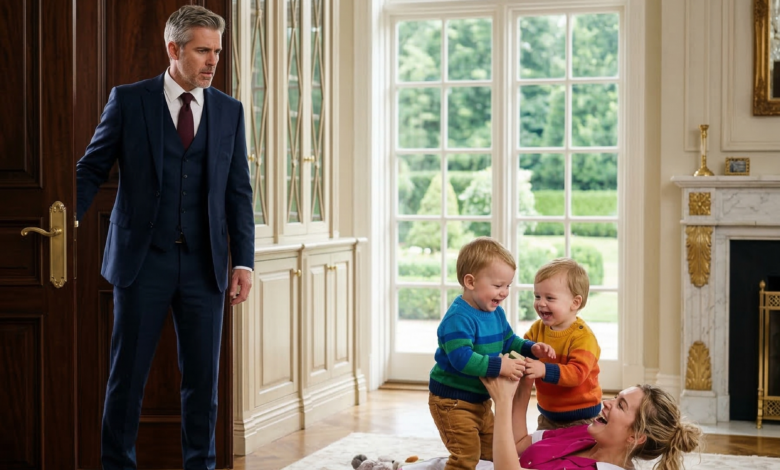
Richard slipped back into the house through a side entrance, expecting to uncover neglect or danger.
Instead, he heard laughter.
Not a small giggle. Not the kind of uncertain sound babies make when they are tired or startled. This was full, breathless laughter, the kind that filled the downstairs rooms and made the silent house feel alive again.
He followed the sound to the living room and stopped at the doorway.
The perfect room he had tried so hard to preserve was no longer perfect. Sunlight poured through open curtains. Cushions were on the rug. Blocks were scattered across the floor. One of Elena’s old woven throws had reappeared on a chair.
In the middle of it all, Marin was lying on her back wearing bright yellow dishwashing gloves, moving her hands like airplane wings while the boys squealed above her.
Ellis was delighted. But what stunned Richard most was Owen.
Owen had always been the more fragile twin. He struggled with balance and confidence. Specialists had spoken carefully about his progress, never promising too much. Yet there he was, standing on Marin’s stomach, unsteady but upright, laughing as if the world felt safe beneath his feet.
A calmer man might have seen a breakthrough. Richard saw disorder.
He saw a hard floor. He saw rubber gloves. He saw a game he had not approved. Most painfully, he saw his sons happier with Marin than they had ever seemed with him.
He said her name sharply.
Marin turned pale. Owen twisted toward the sound, lost his balance, and began to fall. Before Richard could reach him, Marin caught him with one arm while securing Ellis with the other. Both boys were safe within seconds.
That should have been enough.
But Richard’s anger had already taken over.
He accused Marin of turning the house into a circus. She tried to explain that Owen had been practicing balance and had done well. She said the yellow gloves made him laugh.
Richard did not want to hear it.
When she told him the boys needed joy more than another silent room, the words landed too close to the truth. He fired her on the spot.
Marlene appeared in the doorway soon after, acting as if her warning had been confirmed. The boys cried harder when Richard took them from Marin. Ellis even reached back toward her.
It was a sign Richard should have noticed.
The Missing Pin
As Marin packed, Marlene brought Richard another accusation. A drawer in his study was open, she said, and Elena’s sapphire butterfly pin was missing.
The pin had belonged to Elena’s grandmother. For Richard, it was more than jewelry. It was one of the few objects he still allowed himself to touch when grief felt unbearable.
Because he was already angry, he believed the worst again.
He confronted Marin in the front hall and demanded that she open her suitcase. She denied taking anything, then stepped back and told him to search it himself.
Inside, he found worn clothes, a paperback, a framed photograph of an older woman, pharmacy receipts, and notes about medication schedules. There was no pin. No hidden jewelry. Nothing that supported Marlene’s claim.
Then Marlene suggested Marin might have hidden it on herself.
For the first time, the accusation sounded too convenient, too cruel, and too eager.
Richard went to the study. The drawer was open, just as Marlene had said. The pin was gone. But near the back of the drawer, he noticed a sticky smear on the wood.
Peach preserves.
Marlene brought Richard toast with peach preserves every morning. Marin did not handle his breakfast. That routine was one of Marlene’s guarded household duties.
When Richard questioned her, Marlene’s confidence collapsed.
She admitted the pin was hidden in the service wing, behind an old box fan. She had wanted Marin gone before the boys became too attached to her. She resented the way the house seemed to soften around the young nanny. She wanted things restored to the quiet, controlled order that had existed before Marin arrived.
But Richard finally understood what that meant.
Marlene had not been protecting his children. She had been protecting her place inside his grief.
Richard returned to the front hall, where Marin was repacking the last of her things. He told her the truth: the pin had never been in her bag.
Then he apologized, not with polished business language, but plainly. He admitted he had been wrong about her, wrong about his sons, and wrong about what the house needed.
From upstairs, Owen cried out for Marin.
Richard told her the boys were calmer with her, and he had punished her for it instead of asking why.
Marin’s answer was simple. She said the boys were calmer because she let them be children. Richard loved them, she said, but he held that love so tightly it frightened everyone around it.
He asked her to stay for the boys and help him do better.
Marin agreed, but with one condition in spirit: the next time he heard laughter in his house, he was not to sneak in like a detective. He was to take off his shoes and join them.
Why This Matters
At its heart, this story is not only about a nanny falsely accused. It is about how grief can reshape a family home, and how fear can make even loving parents mistake control for safety.
Childcare is one of the most personal employment decisions a family can make. Trust matters, but so does fairness. A caregiver should be observed, questioned, and held to clear standards when needed, but accusations can carry real emotional and professional consequences. In Richard’s case, suspicion almost cost his sons the person helping them feel secure.
After Marlene left, the house changed gradually. Curtains opened. Elena’s photographs returned to the rooms. Toys stayed visible. Blankets were within reach. The boys were allowed to make noise, mess, and progress.
At first, Richard watched from doorways. Then, one rainy afternoon, Marin told him the boys would rather have his hands than his supervision. He loosened his tie, took off his shoes, and sat on the floor.
Owen crawled into his lap as if he had been waiting for exactly that.
Three months later, during a small birthday gathering for the twins, Owen stood alone in the family room. The room went quiet, not from fear, but from the weight of the moment.
He looked at Marin, then at his father. He steadied himself and took one step, then another, then a third, straight into Richard’s legs.
Richard lifted him and laughed freely for the first time in a long time.
Marin said Owen only needed to believe that falling would not be the end of the world.
By then, Richard understood she was not speaking only about his son.
The house was no longer immaculate. It was louder, messier, warmer, and full of signs that people were living there again.
Sometimes the thing a family needs most is not tighter control, but enough trust to let joy back in.