I Was Asked to Train My Higher-Paid Replacement, So I Taught My Boss an Unexpected Lesson!! –

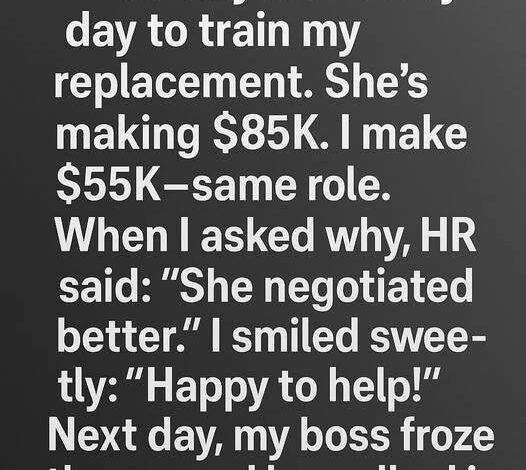
When I asked why there was a $30,000 gap, HR didn’t blink.
“She negotiated better,” they said, like that ended the conversation.
It didn’t. But it did clarify something important: the company wasn’t confused about my value—they were comfortable underpaying me for it.
The Shift: From Frustration to Strategy
I didn’t argue. I didn’t raise my voice. I didn’t threaten to quit.
I smiled and said, “Absolutely. I’ll make sure she’s fully trained.”
My boss visibly relaxed, assuming I’d keep doing what I always did—carry the weight quietly and make management’s life easier.
But this time, I decided to do something different: I would train her exactly according to what the company was paying for—nothing more.
Two Stacks of Paper That Said Everything
The next morning, I walked into the training room early and set two stacks of documents on the table.
- Official Job Description — a thin packet listing the duties tied to my position on paper.
- Additional Responsibilities I’ve Been Handling — a much thicker stack detailing everything else I’d absorbed over time.
That second pile included the real work: emergency fixes, after-hours troubleshooting, patching broken workflows, preventing costly mistakes, handling vendor conflicts, smoothing over internal escalations, and all the behind-the-scenes problem-solving that kept the department looking “stable.”
My replacement stared at the two stacks. My boss’s expression changed instantly.
And right there, without a single argument, the truth became visible: the role wasn’t one job—it was several jobs bundled into one salary.
Training by the Book—Literally
From that moment on, I trained her using only the official job description.
No “unwritten processes.” No shortcuts I’d created to keep things from falling apart. No advanced troubleshooting routines I’d built during unpaid overtime. No extra systems I’d designed because no one else had the time—or the incentive—to do it.
Just the tasks the company had formally assigned and compensated.
So when she asked questions like:
- “What do I do when a vendor misses a delivery?”
- “How do you handle escalations from other departments?”
- “What’s the process when the system fails at the worst possible time?”
I answered calmly and consistently:
“You’ll need to check with management. That wasn’t part of my official responsibilities.”
And each time, I watched the pressure shift—right back to where it belonged.
When “Invisible Work” Becomes Very Visible
By day two, my replacement understood what she’d walked into. She wasn’t taking over a clean, well-defined position. She was inheriting years of extra labor that had never been properly documented, staffed, or paid for.
To her credit, she didn’t blame me. She thanked me for being upfront.
She’d been sold a role with clear expectations and strong compensation—something many professionals actively seek when evaluating a new job opportunity. No one had told her the operation depended on one person consistently doing more than the job required.
Meanwhile, my boss started making tense hallway calls. HR began sending careful follow-up questions. I was asked to “walk through” advanced processes.
I used the same response again:
“That falls outside my responsibilities.”
For once, the company had to confront the full workload of the role—before I was gone.
A Professional Exit—On My Terms
On my final day, I completed the last task listed in the official job description. Then I printed a short resignation letter—polite, direct, and effective immediately.
No dramatic speech. No emotional meeting. No long explanation.
Just a clean exit.
My boss looked stunned. My replacement wished me well and thanked me again. She wasn’t the problem—she was a professional trying to succeed, just like I had been. She deserved honesty, and I gave it to her.
What management faced next was the reality I’d been shielding them from for years: the work didn’t magically “handle itself.” The crises didn’t prevent themselves. The department didn’t run smoothly by accident.
It had been held together by unrecognized labor—and now that labor was gone.
The Best Part: What Happened After
I left feeling lighter than I had in years. Not because I “won,” but because I stopped participating in a system that depended on me accepting less than I’d earned.
Two weeks later, I accepted a new role with an organization that valued my experience and results. This time, I negotiated with confidence—using evidence, not emotion. I presented my impact clearly and discussed compensation like a professional.
They agreed without hesitation.
The Lesson I’ll Never Forget
When you know your value, you stop donating extra effort to employers who treat dedication like free labor. You stop confusing loyalty with obligation. You stop believing you’re replaceable just because someone else gets a higher salary.
Replacing a job title is easy. Replacing real contribution is not.
Want more real-world workplace stories and practical career moves? Share your thoughts in the comments—have you ever been asked to train someone while being underpaid? And if you found this helpful, bookmark the page and come back for more.