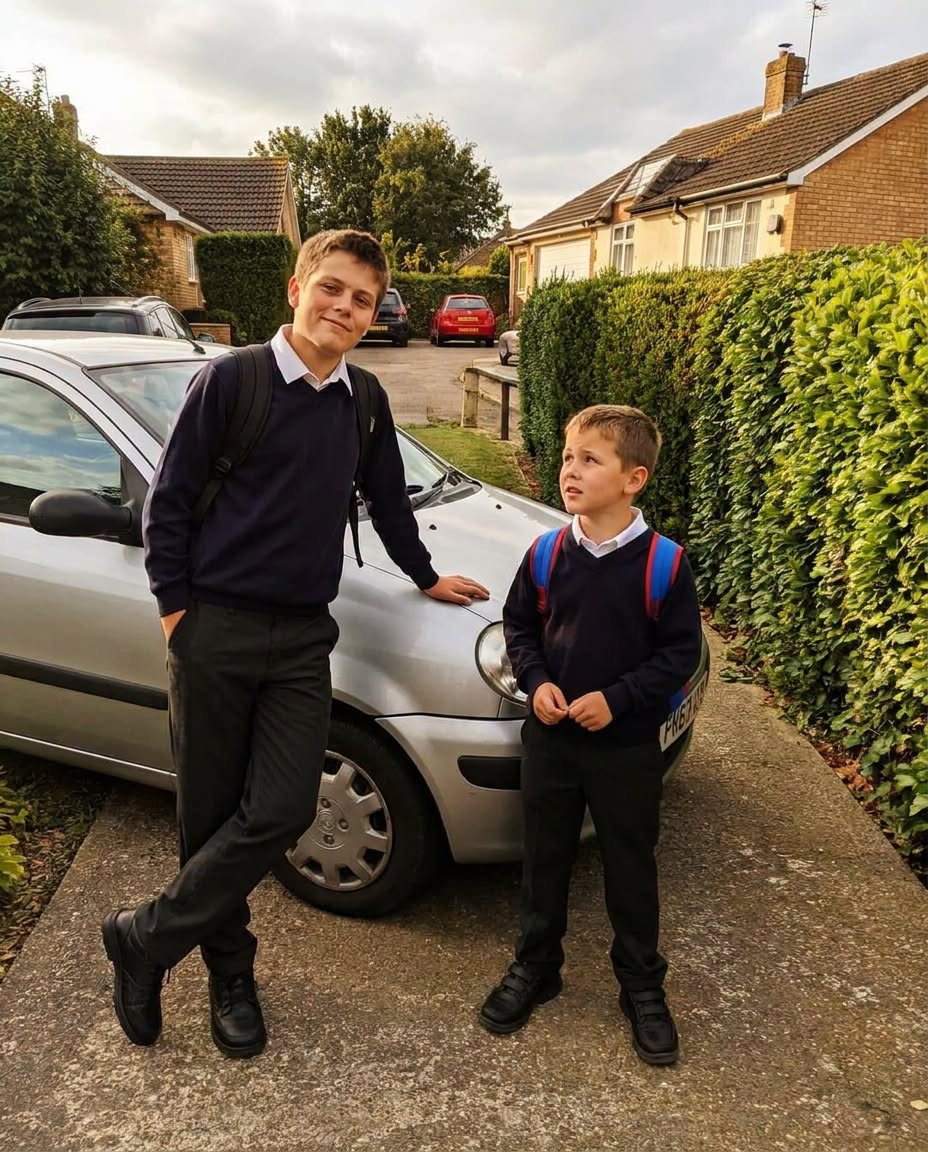
I didn’t post the photographs online.
I didn’t confront her every morning.
I simply kept records.
Eventually, I reviewed the local authority’s guidance on vehicle obstruction.
That’s when I realized something important.
I didn’t need Denise to agree with me.
I needed to follow the proper process.
So when I saw the Corsa blocking our driveway again at 5:20 that morning, I made the call.
At 6:18, the recovery truck arrived.
Denise Finally Came Outside
The moment Denise saw the equipment, she came rushing out of her house wearing slippers and a dressing gown.
“What are you doing?”
She immediately began protesting.
She said I could have knocked on her door.
She insisted she hadn’t been blocking us repeatedly.
Then she noticed the photographs.
“You’ve been taking pictures of my car?”
I explained that I had been documenting the obstructions.
She accused me of harassing her.
The enforcement officer calmly explained that recording details of a vehicle obstructing access was not harassment.
I opened the gallery on my phone.
Twenty-two photographs.
Twenty-two separate mornings.
All timestamped.
All showing the same basic problem.
Denise became increasingly frustrated.
She complained about the penalty.
She questioned why I hadn’t simply spoken to her again.
For a moment, I almost laughed.
Instead, I remembered the words she had given me weeks earlier.
“You’ll survive.”
So I repeated them.
“You’ll survive.”
The officer continued with the formal procedure.
Eventually, Denise moved the Corsa and accepted the penalty notice.
I honestly believed the matter was finally finished.
I was wrong.
One Week Later, It Happened Again
Seven days later, I woke up to the same problem.
The silver Corsa was across our driveway again.
I didn’t knock on Denise’s door.
I didn’t argue.
I didn’t take twenty photographs.
This time, I took one.
Then I attached it to the existing case.
The same enforcement officer returned.
He recognized the address immediately.
When Denise came outside, he asked her a simple question.
Why had she repeated the exact behavior after receiving the previous penalty?
She had no clear answer.
Another notice followed.
And from that morning onward, our driveway stayed clear.
But then, something unexpected happened.
The real reason behind Denise’s behavior finally came to light.
It Wasn’t Really About Parking
A few days later, Paul came over.
He apologized.
Then he admitted something Denise hadn’t told me.
Their own driveway was difficult to use.
The hedge and turning angle made entering and exiting awkward, especially when Denise was in a hurry.
Our driveway was easier.
So she had convinced herself that blocking it for “just a few minutes” wasn’t a big deal.
But Paul also admitted something more uncomfortable.
After I first asked her to stop, the situation had become personal for Denise.
Being told what to do reminded her of her difficult relationship with her father.
Instead of reconsidering her behavior, she became more determined not to give in.
Hearing that made me feel something I hadn’t expected.
I felt sympathy.
But sympathy didn’t erase the consequences.
My children had still been late to school.
I had still missed time at work.
Our routine had still been disrupted.
Understanding why someone behaves badly doesn’t mean you have to accept the behavior.
Paul eventually decided to solve the practical problem.
He arranged for their driveway to be widened.
It made access to their property much easier.
For the first time in months, things became quiet.
Then Denise Came to My Door
Several months later, Denise appeared at my hedge carrying a letter.
She looked different.
There was no argument.
No defensiveness.
No explanation about why she had been right.
She told me about a situation at the school where she had started working.
One child had accumulated six late marks because of an unreliable bus.
After the child’s mother provided documentation explaining what had happened, the school removed the marks.
Denise told me that the situation made her think about Ben and Oliver.
Then she looked at me.
“I should have listened the first time,” she said.
“I’m sorry.”
That apology meant more than I expected.
Not because it erased everything.
It didn’t.
But because, for the first time, Denise acknowledged what her actions had actually caused.
I accepted her apology.
We didn’t suddenly become close friends.
We didn’t start visiting each other’s homes.
And I didn’t expect us to.
Sometimes a healthy resolution doesn’t mean becoming best friends with someone.
Sometimes it simply means reaching a point where everyone can move forward peacefully.
What I Learned
Looking back, the recovery truck wasn’t the most important part of the story.
Neither was the penalty notice.
What stayed with me was the evening I spent reading the local authority’s guidance before making that first call.
For weeks, I had been searching for the perfect words.
I thought maybe there was a better way to explain the situation.
Maybe Denise would finally understand if I described how much stress it was causing.
Maybe another conversation would work.
But six calm conversations had already produced the same result.
Nothing changed.
The formal process was different.
It didn’t depend on Denise agreeing with me.
It depended on evidence, procedure, and a documented pattern.
The photographs weren’t about revenge.
They were about establishing facts.
The case number wasn’t about winning.
It was about creating accountability.
And once the proper process was followed, the situation finally changed.
Our Mornings Became Ordinary Again
Before Christmas, the driveway widening at Denise and Paul’s home was completed.
The Corsa stopped appearing across our entrance.
Our mornings returned to normal.
No waiting.
No rushing.
No wondering whether we would make it out on time.
One morning, I was reversing onto Cleaver Road when my youngest looked through the window.
He glanced at the driveway and smiled.
“The way is clear.”
I smiled back.
He barely remembered the months when it wasn’t.
That was the outcome I had wanted all along.
Not revenge.
Not embarrassment.
Not a victory over a difficult neighbor.
Just a clear driveway and the ability to get my children where they needed to go.
The experience taught me something I wish I had understood sooner.
You don’t always need a louder argument.
Sometimes you need a calmer approach.
When repeated conversations aren’t solving a practical problem, documenting the facts and using the appropriate official process can be far more effective than continuing the same disagreement.
And even when someone else’s behavior has a personal explanation, you can understand their circumstances without allowing those circumstances to control your life.
Denise eventually understood that.
I understood something too.
Standing your ground doesn’t always require anger.
Sometimes the strongest response is simply knowing the rules, keeping your records, and allowing the proper process to do its job.
And sometimes, after months of frustration, the best ending isn’t dramatic at all.
It’s waking up one ordinary morning, looking through the window, and realizing the way is finally clear.
Have you ever dealt with a difficult neighbor or a situation that only improved after you stopped arguing and started documenting the facts? Share your experience in the comments.