The Billionaire Came Home After 3 Months Overseas And Broke Down When He Saw What His Daughter Was Forced To Do

Instead, the air hit me like a warning.
No warm smell of cookies or crayons. No scattered toys. No familiar family photo above the entry table.
That photo—Hannah, her late mother, and me laughing on a beach—was gone.
In its place hung a large, dramatic portrait of my new wife, Vanessa, posed like royalty in a designer gown. Cold. Controlled. Untouchable.
We’d married eight months earlier. Vanessa was a successful corporate attorney—sharp, polished, and convincing. She’d promised she could bring stability to our home while I handled the demands of running a global company.
I believed her.
“Hannah?” I called, stepping farther inside. “Daddy’s home!”
Silence.
Then Diane—our longtime housekeeper, the woman who had been a steady presence in Hannah’s life since she was a toddler—appeared in the hallway. Her face was pale, her hands shaking against her apron.
She didn’t smile. She didn’t move closer.
She just looked at me like she’d been holding her breath for weeks.
“Diane,” I said, forcing calm into my voice. “Where’s Hannah?”
Her eyes filled with tears. She glanced toward the back of the house, toward the patio doors, and lifted a trembling finger.
I walked faster than I meant to. The silence in that hallway felt loud—like something was being hidden in it.
And then I stepped outside.
What I Saw in the Backyard Stopped Me Cold
The August heat was brutal—humid, heavy, and unforgiving. The sun made the stone patio shimmer.
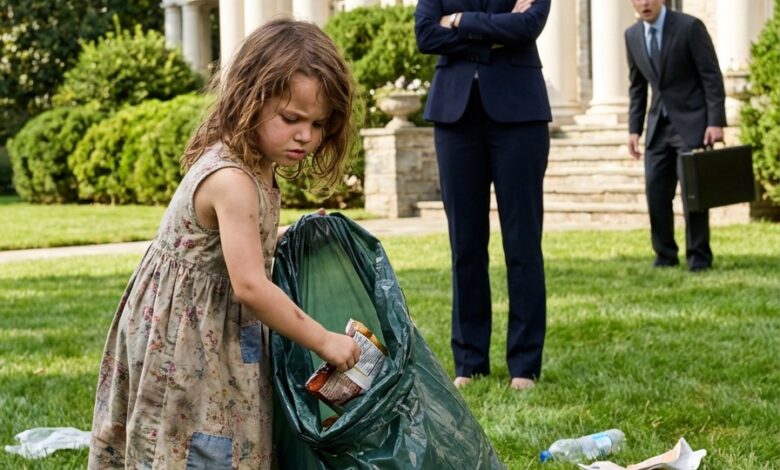
Out near the service gate, my daughter was dragging a large industrial trash bag across the rough ground. Not playing. Not pretending.
Working.
Her clothes hung loose on her small frame, like they didn’t belong to her anymore. Dust clung to her skin. Her arms shook from the effort.
“Hannah!” I shouted.
She startled so hard she fell. Her knees hit the stone, and she immediately curled inward—hands over her head—like she was bracing for impact.
That reflex didn’t come from being clumsy.
It came from fear.
I ran to her and dropped to my knees. “Sweetheart, it’s me. It’s Dad. You’re okay.”
Her eyes lifted to mine—wide, exhausted, and heartbreakingly empty.
“I’m sorry,” she sobbed, words rushing out like she’d been holding them in. “I just wanted milk. She said I have to earn it. Please don’t be mad. Please don’t tell her I stopped.”
I pulled her into my arms and felt it instantly—how light she was. Too light.
My stomach turned. My throat burned.
“Who did this?” I whispered, already knowing the answer.
That’s when a voice cut through the heat like ice.
“Adrian, don’t be dramatic.”
Vanessa sat under a shaded umbrella, relaxed on an outdoor sofa, an iced coffee sweating beside her like it was just another weekday.
She stood and walked toward us, unbothered by the sight of my child shaking in my arms.
“She’s fine,” she said evenly. “You spoiled her. I’m teaching discipline. Structure. Responsibility.”
I stared at her—at the calm certainty in her posture—and something in me went still.
This wasn’t strict parenting.
This was cruelty dressed up as “character building.”
I held Hannah closer. “You made an eight-year-old work in this heat for a glass of milk.”
Vanessa’s mouth curved into a small, confident smile. “I’m her stepmother. I set the rules while you were gone. And if you think you can come back and undo everything…”
She paused, letting the threat hang in the air.
“…you’re going to be surprised.”
I Stopped Arguing—and Started Paying Attention
I didn’t yell back. I didn’t give her the reaction she wanted.
I carried Hannah inside and went straight to the one place Vanessa couldn’t access: my locked suite.
I fed my daughter. I wrapped her in blankets. I sat beside her until her breathing slowed and she finally fell asleep—safe for the first time in months.
Then I walked into my office and shut the door.
The father in me was furious.
But the executive in me recognized something else: Vanessa wasn’t just being abusive. She was acting like someone following a plan.
And plans leave paperwork.
Within minutes, I was reviewing what she’d been doing while I was out of the country: messages, documents, records, drafts, and files she clearly assumed no one would ever see.
What I found made my blood run cold.
The “Discipline” Was a Cover for Something Worse
There were reports—detailed psychological evaluations claiming Hannah was unstable, dangerous, and in need of immediate institutional care.
But the language didn’t match reality. The dates didn’t line up. The “evidence” read like something produced to convince a judge, not help a child.
Then I found a contract with a private behavioral facility out of state.
And attached to that was an emergency guardianship filing—submitted while I was overseas—arguing I was an absent parent and that Vanessa needed full authority to make medical decisions.
The schedule was already set.
A transport team was due to arrive the next morning.
Vanessa wasn’t trying to “fix” my daughter.
She was trying to remove her.
Because Hannah had a trust fund—significant assets left by her mother and protected under my estate planning. If Hannah could be declared incompetent and placed under someone else’s control, the money would be easier to reach.
It wasn’t discipline.
It was a financial play.
She Expected an Easy Win—She Didn’t Expect a Countermove
I made a call to my legal team and initiated an emergency response—one that treated this like what it was: fraud, child endangerment, and an attempted abuse of the system.
By morning, Vanessa was standing by the front door with her folder of documents, dressed like a concerned professional, ready to perform her role.
The doorbell rang.
She opened it, expecting a private transport crew.
Instead, federal agents stood on my porch.
Her face went blank. “Who are you? This is a private matter!”
I stepped into view from the staircase. “Not anymore.”
The agents entered, calm and direct. They addressed her by her legal name and placed her in handcuffs.
Vanessa tried to pivot—tears, excuses, the sudden performance of love and concern.
But paperwork doesn’t cry.
Digital records don’t forget.
And the truth doesn’t disappear just because someone speaks confidently.
What Happened Next Changed Everything
In the months that followed, the case unfolded the way these cases always do when evidence is solid: quickly, decisively, and without room for spin.
Vanessa lost the life she’d been trying to steal. The legal system saw the pattern—fraud, manipulation, and deliberate harm toward a child.
And Hannah?
Hannah came back to herself.
Not overnight. Not like magic. Healing doesn’t work that way.
But slowly—meal by meal, bedtime by bedtime, safe day after safe day—she started laughing again. She gained weight. Her shoulders relaxed. The fear in her eyes faded.
I made changes too.
I restructured my work and stepped back from the kind of schedule that keeps you “successful” while your real life quietly falls apart at home.
The biggest lesson wasn’t about money, or power, or even the law.
It was about presence.
You can build a beautiful home. You can hire the best people. You can create a secure financial future.
But if you’re not paying attention to what’s happening inside your own walls, someone else will take control of the story.
And not everyone who smiles at your family is safe.
Final Thought
Today, when Hannah runs across the yard laughing—healthy, confident, and free—I don’t see my company’s growth charts or my business awards.
I see what actually matters.
I’m not just a CEO.
I’m her dad.
If this story hit home for you, share your thoughts in the comments: What’s one boundary you believe every parent should set to protect their child’s peace? And if you want more real-life-inspired stories about family, resilience, and hard lessons, bookmark this page and come back soon.