The boss followed his housekeeper in secret, convinced she was stealing food … but the discovery waiting at the dirt road ruined everything he believed forever …

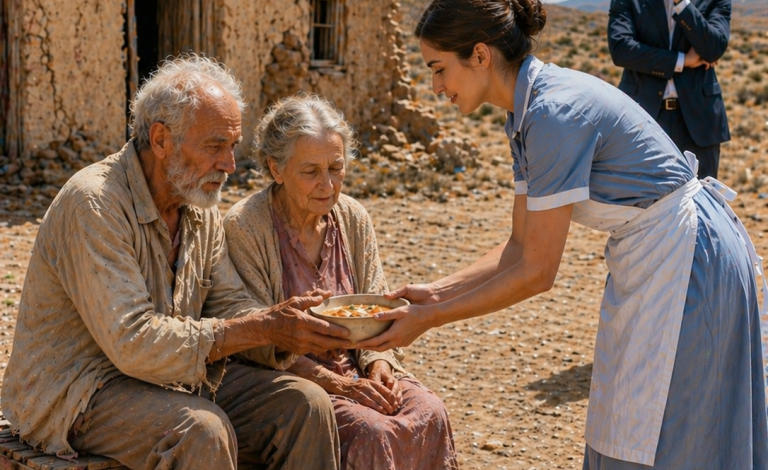
## He Thought His Housekeeper Was Stealing Food—So He Followed Her. What He Found on a Dusty Road Changed Everything.
The night I decided to follow my housekeeper, I convinced myself it was about *boundaries*.
In my world, rules are what keep life smooth. Quiet. Predictable. When you work hard for comfort, you start believing comfort is something you must protect—sometimes even from the people who serve it to you.
That’s what I told myself, anyway.
It started at dinner.
My wife, Vanessa Carter, mentioned it like it was a minor inconvenience—no different than a late delivery or a noisy neighbor.
“She’s taking food,” she said, cutting into her salmon without even glancing up. “Not enough to make it obvious. Just… little amounts. Missing portions. I’ve noticed it for weeks.”
Weeks.
Across the table, our son Ethan didn’t look up from his phone. The room had that polished silence expensive homes are known for—soft lighting, clean lines, everything in its place. A house that always seemed to whisper *control*.
And yet something had moved inside it without permission.
Maria had worked for us for almost a year. She was the kind of employee people like me tend to prefer: efficient, quiet, invisible when you want them to be. She didn’t ask personal questions. She didn’t bring her problems into our space. She did her job and disappeared.
But lately, food had been disappearing too.
Not the kind of theft that screams for attention. Nothing dramatic. Just leftovers. A few pieces of fruit. Bread. A container of soup. Always packed neatly into containers she brought from home—like she had done it so many times it had become routine.
I told myself I needed to address it properly. Professionally.
But the truth was uglier: I hated not knowing *why*.
I hated the idea that she had a life outside my walls that I couldn’t see or measure.
So the next afternoon, I watched.
At 4:07, from my office window, I saw Maria cross the service hallway.
At 4:15, she slipped into the kitchen like she’d done nothing wrong, packed the food with calm hands, and walked out through the side door.
I waited a moment, then followed.
At first, everything looked familiar—traffic, storefronts, stoplights, the city I recognized. But then the scenery began to thin out. The buildings lost their shine. Paint peeled off walls like old paper. Sidewalks cracked. The air felt hotter, heavier, less forgiving.
Maria reached a bus stop with no shade and no bench, like whoever planned the city forgot this part of it existed.
She boarded.
I stayed back, keeping distance, telling myself this was about accountability. About making sure an employee didn’t “cross lines,” because people who cross one line will cross another.
That was the story I fed myself.
But underneath it sat something else—something I didn’t want to admit:
I didn’t like feeling excluded from the truth.
The bus carried her farther out than I expected. Away from the clean neighborhoods and into stretches of road that looked unfinished. The kind of route that makes you wonder if you missed a turn—or if you’re following someone into a place you were never meant to enter.
When the bus finally stopped, it didn’t stop at a station.
It stopped in the middle of heat and dust.
No shops. No crowds. No comfort.
Just silence.
I parked farther back and followed on foot.
It took nearly twenty minutes before I saw it: a cluster of structures that barely qualified as homes. Rusted roofing. Crumbling walls. Makeshift repairs. No paint. No neat lawns. No illusion that everything was fine.
Maria walked straight toward one of the houses.
Two elderly people sat outside, motionless in the shade like they didn’t have the energy to do anything else.
Something in my chest tightened before my mind caught up.
Maria didn’t rush. She didn’t act like someone hiding a crime.
She acted like someone arriving where she was needed.
She greeted them softly, then set the containers down with care. She knelt beside the older man first, opening the soup and blowing on it to cool it before lifting the spoon to his mouth.
The way you feed someone when they can’t feed themselves.
The older woman sat nearby, hands moving slowly in the air, as if she was tracing memories she couldn’t hold onto anymore. Maria spoke to her gently, the way people speak when they’re trying to keep someone anchored to the present.
I stood there, stunned, watching a “theft” turn into something else entirely.
And then I saw it—through the doorway, inside the dim room.
A photograph on the wall.
Old. Faded. But familiar enough to make my stomach drop.
Memory doesn’t always arrive as a thought. Sometimes it hits like impact.
By the next morning, I was irritable, snapping at people over nothing, like my body was trying to protect me from what my mind already knew. I couldn’t stop seeing that photograph, couldn’t stop hearing the quiet way Maria spoke, couldn’t stop replaying the moment she lifted the spoon to the old man’s lips.
Later, when I returned—this time not hiding—I didn’t need long to confirm it.
The man lying on the cot had the same jawline I’d seen in the mirror my whole life, only hollowed by time. The same heavy brow. The same uneven rise of his chest when he breathed.
The woman’s hair was thinner, her face softened and worn by years. But the way her lips moved when she whispered to herself—the rhythm of it—was a rhythm I had once known before I buried it under ambition and distance and excuses.
I stepped back as if the truth had heat.
My pulse hammered so hard it made me dizzy.
Every justification I had built over decades—every story about why certain people were “left behind,” why life “moved on,” why the past “couldn’t be helped”—collapsed under the simplest fact standing in front of me:
The people I’d been taught to forget were still alive.
And my housekeeper wasn’t stealing.
She was surviving.
She was caring for someone when nobody else would.
And the discovery waiting at the end of that dirt road didn’t just change what I believed about her.
It ruined what I believed about myself.
—
### Want Part 2?
If you’d like me to continue the story and reveal what happened after he stepped inside—leave a comment with what you think the connection is, and share this with someone who loves powerful real-life style twists.