THE LITTLE GIRL WHO HID IN A TOY CABINET FINALLY REACHED OUT ON THE STAIR MAT IN FRONT OF THE WHOLE FAMILY

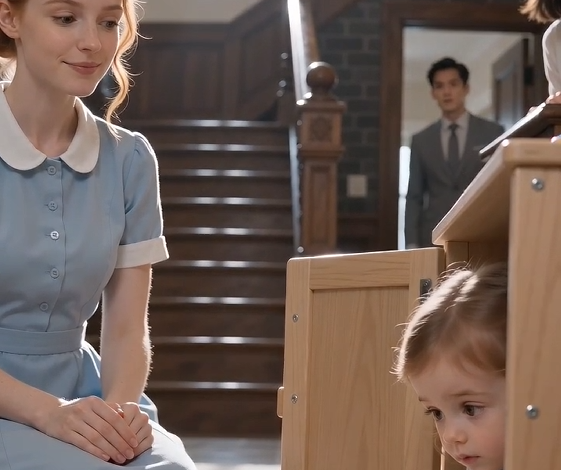
Henry did not move for a full second.
In that house, one second of stillness could pass unnoticed. But this one changed the room.Vanessa was still crouched at the cabinet door, hand extended, smile pulled too tight. Henry’s aunt stood near the archway with a crystal dish in her hands. Someone in the foyer was laughing too loudly about traffic. The dining staff kept pretending not to look.
Lucy had one hand on the stair mat.
Not on Vanessa.
Not on her father.
On the ugly practical thing that did not belong in a polished playroom, because that mat meant Emma would not drag her into the day before she was ready.
Emma stayed where she was.
She did not turn it into a triumph. She did not say, “See?” She just rested one palm on the mat and rolled the little blue car between two seams in the fabric.
Back and forth.
Back and forth.
Lucy watched the car. Her shoulders were still high around her ears, but her breathing changed first. Then one knee unfolded. Then the other. She slid forward on the cabinet floor until one sock touched the mat.
Vanessa stood up sharply. “She can’t hide every time someone rings a bell.”
Emma kept her eyes on Lucy. “She’s not hiding right now.”
That line landed harder than anyone expected.
Because Lucy wasn’t disappearing. She was choosing.
Henry saw it with a kind of shame that made his throat tighten. Every expert he’d hired had framed progress like a task to complete. Tolerate the noise. Stay at the table. Use the words. Transition cleanly. He had approved all of it because it sounded responsible. Organized. Helpful.
But Emma had spent a week learning something simpler.
Lucy was not fighting life. She was fighting impact.
The bell. The footsteps. The sudden hand at her arm. The corrected posture at the table. The napkin tucked too fast under her chin. The spoon placed in the “proper” hand. The room deciding for her before she could find herself in it.
Emma had not cured anything. She had removed the chase.
She gave Lucy a pattern she could predict: bell, cabinet, mat, car, wait.
That tiny rhythm had become a bridge.
Vanessa folded her arms. “Everyone is waiting.”
Emma finally looked up. “Then they can wait one more minute.”
In most houses, that would have sounded bold. In Henry’s, with family arriving for the weekly lunch his mother had once run like a ceremony, it sounded almost offensive.
But Henry did not correct her.
Instead, he lowered himself onto one knee several feet away, careful not to crowd the mat. It was the first time Emma had seen him place himself inside Lucy’s fear instead of managing it from the edge.
Lucy noticed him and froze again.
Emma said quietly, “No closer.”
She wasn’t speaking to Lucy.
Henry nodded once and stayed still.
Another few seconds passed. Lucy put both feet on the mat now, then crawled onto it and sat with her legs tucked under her, one hand still holding the cabinet frame. She was still ready to bolt. But she was out.
The room had seen enough to start whispering.
Vanessa’s face changed first. Not anger yet. Something worse. Exposure.
She had spent months performing the role of future fixer in Henry’s life. She brought order, suggested schools, corrected the flower arrangements before dinner, sent articles about executive parenting, and spoke of Lucy as a problem that could be managed with consistency. It looked useful from a distance. But the child herself had never once walked toward her.
Now that failure was public.
Henry’s uncle stepped into the playroom doorway and muttered, “Should we delay lunch?”
Before Henry could answer, Lucy did something no one in that family expected.
She looked at Emma, then at Henry, and reached one small hand toward him without leaving the mat.
Not a full invitation. Not trust without fear. But not rejection either.
Henry’s eyes filled before he could hide it.
Emma picked up the blue car, set it near Lucy’s sock, and rolled it gently toward Henry’s polished shoe.
The car tapped leather.
Henry stared at it like it was a command written in plain language after a year of noise.
He picked it up. His hand actually shook.
“Back?” Emma asked.
Henry rolled the car toward Lucy.
It veered off crooked, bumped the mat seam, and tipped.
Lucy flinched first.
Then she fixed it.
She set the car upright with two fingers and pushed it back.
That was the first game Henry had played with his daughter since the funeral.
No speech therapist had gotten him there. No consultant had written him into the moment. It happened because Emma had built a pattern strong enough to hold one more person.
Lucy looked from the car to Emma again, then reached out and caught the sleeve of Henry’s jacket.
The whole room went silent.
Vanessa turned away before anyone could fully read her face.
Sunday lunch started twenty-three minutes late.
No one complained to Henry.
Not after seeing Lucy walk into the dining room with the stair mat dragged behind her like a blanket and the blue car in her fist.
Emma did not sit at the table, of course. The household rules were still the household rules. But Henry did something else no one expected. He told the staff to leave the side chair at the end open and asked Emma to remain nearby.
Vanessa smiled at that in a way that meant she would discuss it later.
Lucy climbed into her seat, saw the rows of silver, and stopped breathing again.
Henry saw it immediately now.
This was what Emma had been trying to show him from the beginning. The problem wasn’t lunch. It was the assault of perfection.
He reached over, moved the extra utensils away, folded the napkin once instead of fanning it across her lap, and set one piece of warm bread directly on her small plate.
Vanessa gave a soft laugh. “She should use her fork.”
Henry answered without looking at her. “She can use her hands.”
Half the table looked stunned.
That one sentence quietly broke a rule older than Emma’s employment file, older than Vanessa’s place in the house, maybe even older than Henry’s confidence in his own upbringing.
Lucy touched the bread.
Then she tore it.
Then she ate.
The room changed around that bite.
Not in some magical all-at-once way. Lucy still startled when glasses clinked. She still tucked her chin when too many people looked at her. But she was there. Eating. Not frozen. Not gone.
Vanessa lasted through the main course before the strain showed. She leaned toward Henry and said, low enough to pretend privacy and loud enough for Emma to hear, “This is becoming unhealthy. She is attaching to an employee.”
Henry had spent most of the past year avoiding direct conflict. It was easier to sign checks and delegate pain. Easier to let efficient adults define what was best for his daughter while he hid inside work and grief.
But watching Lucy eat with bread in one fist and the blue car in the other had burned through something in him.
“She is attaching to someone who makes her feel safe,” he said.
Vanessa’s jaw tightened. “And what happens when the agency sends her somewhere else?”
Emma looked down at the serving dishes. She had asked herself the same question every night that week.
She knew the answer agency girls were supposed to live with: don’t get too attached, don’t overstep, don’t imagine permanence in somebody else’s house.
But Lucy was no longer looking at Emma like a temporary worker.
Henry turned toward Emma fully. “It won’t.”
Vanessa stared at him. “Henry.”
He didn’t soften it. “It won’t.”
That conversation did not explode at the table. Old-money families were too trained for scenes in public. But the war moved upstairs as soon as the last guest left.
From the hallway, Emma heard enough to understand the shape of it.
Vanessa accused him of being manipulated by guilt. She said Emma was blurring boundaries. She said routines existed for a reason, that Lucy needed professionals, not improvised games with stair mats and toy cars. She asked if he really wanted his daughter dictating the house.
Henry’s answer came low and flat. “My daughter has dictated nothing. She has endured this house.”
Emma stood outside the nursery with Lucy asleep against her shoulder and felt her own eyes sting.
That night, Henry did not ask Emma to leave after the shift.
He asked if she would sit with him in the kitchen and explain everything from the beginning.
It was after eleven. The grand rooms were dark. The kitchen, finally stripped of staff and polished voices, looked almost ordinary.
Emma told him what she had seen.
How Lucy listened before she moved.
How the bell was not just a sound anymore; it predicted disruption.
How every adult had been trying to pull her outward faster than she could organize herself.
How the table rules made a meal feel like a test.
How waiting in place told Lucy something no one else had managed to tell her since her mother died: nobody was going to force her through fear.
Henry sat there with his hands around a cup of coffee gone cold.
Then he said the ugliest truth in the cleanest possible way. “I made her life into a managed project because I didn’t know how to survive being in it.”
Emma did not rush to comfort him.
That was one of the reasons he trusted her. She never tried to smooth over what should remain sharp.
He went on in pieces.
When his wife died, the house filled with people who knew what to do: lawyers, assistants, doctors, school consultants, family members offering schedules, menus, plans. He had accepted all of it because motion felt safer than grief. If every box was checked, then maybe he was still being a father.
But Lucy had not needed management.
She had needed someone to stay.
The next week, Henry changed the schedule himself.
He blocked five fixed windows in his calendar that could not be moved for calls, dinners, or travel. The staff thought it was business restructuring. In a way, it was. He had finally decided what the core holding of his life was.
The first of those windows was awkward.
Emma spread an old sheet by the back terrace after a morning rain, set out plastic bowls, spoons, and a patch of wet dirt from the garden bed. Not a therapy activity. Just mud.
A month earlier, that house would have treated the idea as contamination.
Lucy stood at the open terrace door, watching.
Henry stood beside her in pressed slacks, looking like a man who had spent forty-two years being told not to kneel in mud.
Emma sat first.
She tapped a spoon against a bowl. Soft. Predictable. Then dragged it through the mud with a scraping sound Lucy already liked from the toy car wheels on the stair mat.
Lucy took one step outside.
Then another.
She crouched, touched the mud, and pulled her hand back fast.
Emma did not celebrate.
She pressed her own palm into it and left the print there.
Henry watched Lucy notice the handprint, then place her smaller hand beside it.
Not on top.
Beside.
An offer, not an imitation.
Emma looked at Henry once. “Your turn.”
He hesitated just long enough to reveal how foreign the whole thing still was.
Then he took off his watch, rolled up his sleeves, and sank his hand into the mud.
Lucy made a small sound.
Not a word. But not silence either.
A breathy burst, almost like she had laughed by accident.
Henry looked at Emma, startled. She shook her head once, warning him without words not to pounce on it.
So he stayed calm. Kept his hand there. Let Lucy decide what it meant.
She pressed her muddy fingers against his wrist and left five crooked brown marks on his skin.
That became the new ritual.
Not every day. Not always mud. Sometimes dough in the kitchen, with Emma letting Lucy punch the center while Henry learned not to wipe her hands every ten seconds. Sometimes bubbles on the terrace, with Henry discovering that his daughter would chase them if no one shouted, “Careful!” every three feet. Sometimes the stair mat itself, still kept by the playroom even after Vanessa called it an eyesore.
Most importantly, the pattern stayed stable.
When the bell rang, no one dragged Lucy out of hiding.
When Sunday lunch came, the table no longer looked like a museum exhibit.
Utensils were reduced. Voices softened. One family rule was literally rewritten by Henry and handed to the staff: Lucy may try, refuse, touch, spill, pause, and begin again without correction unless safety requires it.
The fourth family rule had once been about proper place settings for children.
Now it was about room for mistakes.
Vanessa lasted three more weeks.
She tried, in her way, to recover ground. She brought in a child development book with passages highlighted. She suggested a different nanny from a “more professional” background. She complained that Emma was becoming emotionally central. She said it with a careful smile, like concern, but no one in the house heard it the same way anymore.
Because Lucy had started making choices everyone could see.
She looked for Emma at breakfast.
She waited by the terrace door on mud days.
And on the Thursday that finally ended Vanessa’s position in the house, Lucy did something so simple it couldn’t be argued with.
Vanessa arrived early from a charity lunch and found Emma and Lucy on the kitchen floor making biscuit dough from a cheap metal bowl. Flour dusted the cabinets. The counters were not immaculate. Henry was home, jacket off, kneeling beside them badly measuring milk.
Vanessa stood in the doorway and said, “This is exactly the loss of structure I’ve been talking about.”
Lucy froze.
Henry saw the old fear flicker back into her body.
Before Emma could reset the rhythm, Vanessa stepped closer and said, “Come on, Lucy, up now. We wash hands first, then sit properly.”
Lucy turned away from her and pressed both sticky palms onto Henry’s knee.
It was not dramatic. It was clearer than dramatic.
She had chosen who felt safe.
Henry rose slowly, dough on his cuff, and looked at Vanessa with a levelness Emma had not yet heard from him.
“This isn’t your home anymore.”
Vanessa’s face went blank. “You’re ending this over a nanny?”
“No,” he said. “Over my daughter.”
She left that evening with a hard suitcase and a harder expression. There was no shouting. There didn’t need to be. She had lost the right to define the house.
After that, the change in Emma’s position was gradual on paper and immediate in truth.
Henry terminated the agency arrangement and hired her directly with terms no one could call charity: salary, health coverage, paid classes in early childhood support if she wanted them, and one thing that mattered more than the rest.
A voice in decisions.
Not about linen or flowers. About Lucy.
Emma almost said no out of instinct. Girls in her position were taught to be useful, not foundational. But then Lucy came in carrying the blue car and dropped it into Emma’s lap before climbing beside Henry on the kitchen bench.
That was Lucy’s way of voting.
So Emma stayed.
What happened next was not smooth or fast. It was real.
Lucy did not wake healed. Some mornings the bell still sent her running. Some lunches still failed. Some nights she still slept curled against the wall with one shoe on because grief had strange habits in small bodies.
But now there was a rhythm around her instead of pressure.
Henry kept his fifth weekly time, even when investors complained.
He sat on the stair mat when she hid.
He learned to wait through silence.
He learned that eye contact offered mattered more than eye contact required.
He learned how often he had mistaken obedience for security.
Months later, on the first Sunday of spring, the family gathered again for lunch.
This time no one rushed Lucy.
The playroom cabinet door was open, not as a hiding trap, but as part of a game. The stair mat was rolled near the wall on purpose. There was mud drying in a tray by the terrace from that morning’s handprints. The dining room still looked grand, but it no longer felt like a place where a child had to disappear to survive it.
Lucy walked to the table by herself.
Halfway there, she turned back.
For one heartbeat, Henry’s chest tightened. Old fear. Old anticipation.
Then Lucy did the thing that settled the future better than any speech between adults ever could.
She took Emma’s hand.
Then she took Henry’s.
And she tugged both of them forward together.
No one at that table misunderstood it.
The family lunch that used to expose everything broken in the house became the first one that looked like a beginning.
Henry did not propose that day. He was too careful now to build a life out of gratitude or crisis. What he and Emma built came slower than that, which is why it lasted.
It began with decisions.
Shared schedules.
Shared mornings.
Shared authority around Lucy.
A spare drawer for Emma became a closet. The closet became rooms no one pretended were temporary. The staff stopped calling her “the nanny” when speaking to Lucy and started using her name. Henry’s relatives, who had once measured belonging by blood, began measuring by who the child reached for when frightened and who she relaxed beside when the house got loud.
About a year after the Sunday lunch with the stair mat, Henry married Emma in the garden behind the house.
Not a spectacle. No magazine flowers. No performance of rescue.
Lucy stood between them in a pale dress with muddy fingerprints on the hem because she had been playing by the roses fifteen minutes before the ceremony and nobody had the heart to stop her.
When the officiant asked who was giving this family their blessing, Lucy lifted the old blue toy car in one hand and said, clear enough for everyone to hear, “Me.”
It was not her first word by then.
But it was the one nobody forgot.
The little girl who used to vanish into a cabinet when the bell rang still kept the stair mat in her room. Some nights she slept with one foot on it. Some afternoons she used it as a road for the blue car. Sometimes she pulled it to the doorway and sat on it when she needed quiet.
It remained because nobody was interested anymore in pretending the house had always known how to love her.
It had to learn.
Emma taught them the first lesson by sitting down and not dragging a frightened child into someone else’s idea of normal.
Lucy taught the rest by choosing, again and again, the people who could finally stay still long enough to reach her.
And Henry, who once mistook resources for presence, learned to get on the floor, ruin his cuffs, miss a call, break a rule, and become the father his daughter could actually touch.
That was how the old house changed.
Not by becoming less wealthy.
By becoming livable for the child inside it.