A Boy, a Wooden Box, and the Secret That Reached Court

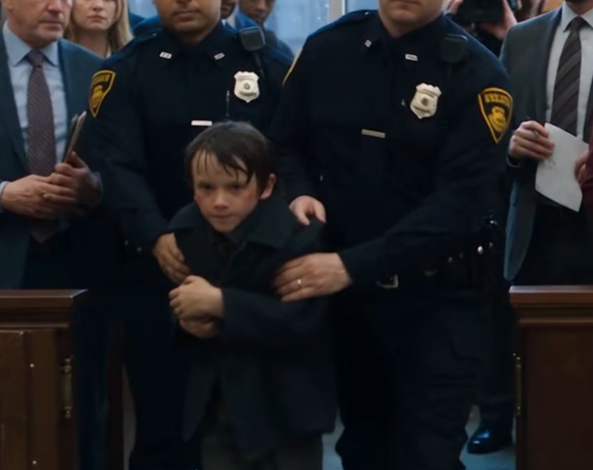
The Necklace That Changed the Case
Claire’s disappearance had haunted Eleanor for more than a decade. Claire had left after arguing with her mother over the man she was dating and Eleanor’s need to control her choices. The necklace had supposedly been left behind on the kitchen counter that night.
But Noah knew details only Claire would have known, including the broken kitchen window Claire used as a teenager. He also carried a rain-stained letter in Claire’s handwriting. The message began with words that broke Eleanor’s composure: if Noah had reached her, Claire had run out of time.
In the letter, Claire explained that she had wanted to come home many times but feared being followed. She wrote that Noah’s father had ties to people involved in bribery, fake contracts, shell companies, and hidden money transfers. She also warned that the child should not be left alone.
Noah then revealed a small flash drive attached to a plastic key. Claire had told him it could help send dangerous people away. For a judge already handling corruption cases, the device immediately raised legal and security concerns. Evidence like that could affect criminal investigations, court proceedings, public agencies, and financial records stretching back years.
Before Eleanor could fully process the letter, Noah warned her that Claire had told him to deliver it before “the man in your office” knew he was there. Moments later, Eleanor’s longtime clerk, Martin Vale, stepped from her chambers.
Martin had worked beside Eleanor for seventeen years. He had attended her husband’s funeral and supported her after Claire vanished. Yet his reaction made it clear he understood the significance of the box and the files. He was taken into custody as the courthouse became a sealed crime scene.
A Trail of Fraud, Family Secrets, and Missing Evidence
Investigators later examined the flash drive and found financial spreadsheets and records copied years earlier. The files connected companies, transfers, and a network of bribery and fraudulent contracts. One discovery was especially personal: Eleanor’s late husband, Thomas Whitmore, appeared to have signed transfers linked to nearly twelve million dollars.
At first, the records seemed to show that Thomas had been involved in wrongdoing. But another file suggested a more complicated history. He had reportedly been cooperating with federal investigators before his sudden heart attack, and the case had collapsed after key files disappeared.
For years, Eleanor believed Claire had walked away from the family because of one painful argument. The evidence suggested something else: Claire had taken records that powerful people wanted buried, and returning home may have put Eleanor in danger.
The investigation led Eleanor and federal agents to Baltimore, where they found Claire and Noah’s former apartment. It was nearly empty, except for children’s drawings on the wall. One picture showed three people under a sun, including an older woman with silver hair. Claire had kept Eleanor present in Noah’s life, even while staying hidden.
From there, the trail led to a farmhouse and to Marcus, the man connected to Claire’s past. He claimed he had once been part of the financial network and later wanted to expose it. Agents found a hidden room beneath the pantry containing evidence they believed could dismantle a major municipal bribery operation.
But the story shifted again when Claire contacted Eleanor by phone. She was alive. Noah had been told to say she was gone so those searching for her would stop. Claire warned that Marcus was not the ally he claimed to be. According to her, he wanted access to the evidence and planned to corrupt or erase key files once investigators opened the hidden room.
The Bigger Picture
The case grew beyond one missing daughter and one frightened child. It touched on public corruption, financial controls, court security, and the damage caused when trusted insiders misuse access. The records pointed to shell companies, political donations, property purchases, and a trust linked to Eleanor’s family.
Claire eventually revealed the most devastating truth: Thomas was not dead. He had staged his own death after taking control of the corrupt network he once claimed to be investigating. He had manipulated people from abroad, while Martin Vale followed orders out of fear.
Three months later, Thomas Whitmore was arrested at a private airfield in Portugal. Eleanor watched the footage of the man she had mourned for years, now exposed as someone who had hidden behind lies, money, and influence.
Claire came home with Noah. The reunion was not simple. Eleven years cannot be repaired with one embrace. Still, the wooden box returned to the same kitchen table where the necklace had once been left behind, and for the first time in years, laughter did not feel like grief.
Then the final twist arrived from inside the pendant itself. A tiny compartment held a micro memory card. On it was a recording from Thomas, warning that the network had not begun with Eleanor’s mother as they had believed. He said the true creator was still alive and pointed them toward an old courthouse file from 1964.
When Eleanor and Claire opened the archived record, they found a photograph that connected the past to someone Eleanor had trusted for nearly her entire judicial career. As Eleanor’s phone rang, a familiar voice admitted what she was only beginning to understand.
The boy’s wooden box had not closed the mystery. It had opened the door to a much older one.