WHEN THE HEIR OF A SILENT MANSION HANDED A TOY TO THE YOUNG NANNY ON THE STAIRS, HIS FATHER FINALLY SAW WHAT MONEY HAD NEVER FIXED

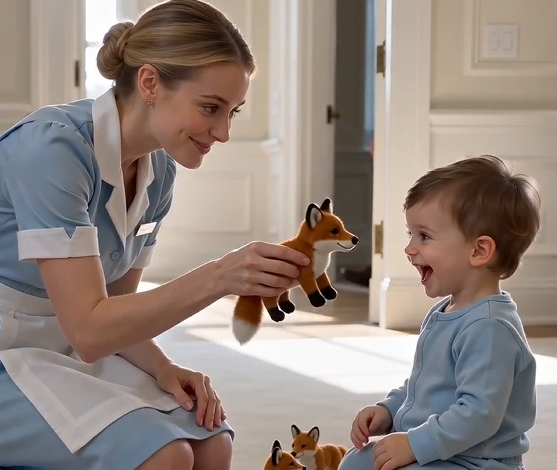
Michael did not move for a long second.
In that house, everything had a place. Art was lit from above. Shoes disappeared before guests saw them. Voices stayed low. Theo’s meltdowns were treated like weather systems to survive, not messages to understand. And now his son was sitting on the back staircase in the middle of the afternoon, knees bent, hair sticking to his forehead, handing a toy to a girl who looked more like a college babysitter than the kind of specialist Michael had spent thousands trying to find.Vanessa recovered first.
“This cannot become a habit,” she said, already tight with anger. “The stairs are not a playroom. And he needs consistency before your parents arrive.”
Elena didn’t argue. She didn’t defend herself. She just held the fox where Theo had placed it in her hand.
Theo watched Vanessa’s mouth start moving faster, and his shoulders tensed.
Michael saw it happen in real time. The small closing. The retreat.
Elena set the fox gently on the next stair. “Bear waits. Fox waits. Dog waits.”
Theo’s eyes dropped back to the toys. His breathing steadied again.
That should have embarrassed Michael more than it did. A twenty-something nanny with no polished credentials had just done, in three quiet words, what the adults around him had failed to do for nearly two years.
He said, “Leave it.”
Vanessa turned to him. “Michael.”
“I said leave it.”
Theo flinched at the sharper tone, but Elena immediately moved the rabbit one step down, then one step back up, the same slow rhythm. Not fixing the room. Fixing the moment.
That night, Michael asked for a report in his study.
He expected theory. He expected something clinical he could evaluate.
Instead Elena stood near the leather chair, hands folded, and said, “He doesn’t just hate change. He hates surprise he can’t repair.”
Michael looked at her.
She went on. “When something moves and nobody lets him be part of what happens next, he panics. On the stairs, he can break the line himself and see it come back. Same steps. Same order. Same people. He knows the change isn’t the end.”
Michael thought of the million things he had outsourced since his wife died. Grief counselors. tutors. child behavior experts. sleep consultants. drivers. meal planners. It had all looked responsible. Efficient. Necessary. He had turned care into a system because systems were the only things that still obeyed him.
“How did you figure that out?” he asked.
Elena shrugged once. “At the grocery store, he stopped crying when the oranges rolled and I lined them back up. He watched my hands first, then the order. He likes a pattern he can trust. And he likes it better when the pattern has room for him.”
Room for him.
The phrase stuck in Michael’s throat after she left.
For the next few days, Elena did not try to force bigger miracles. That was the part that made the change real. She did not chase speech. She did not celebrate Theo so loudly that he shut down. She simply returned to the same staircase twice a day.
Same basket. Same seven toys. Same opening line.
Bear waits. Fox waits. Dog waits.
Sometimes Theo came quickly. Sometimes he stood three steps above her, watching. Sometimes he only moved one animal and left. Elena never reached for more than he offered.
Slowly, a ritual formed.
She would line the toys along the back stairs. Theo would mess up the order. Elena would restore it. Then she would make one mistake on purpose and wait. Theo began correcting her. Then testing her. Then building his own versions, sometimes with all the animals crammed onto one stair, sometimes one toy balanced on each edge as if the whole thing might fall apart.
When he got overwhelmed, Elena didn’t say, “Use your words.” She didn’t remind him how old he was. She didn’t tell him to calm down. She lowered the world.
She repeated the sequence.
She kept time with him until he could feel the next moment coming.
By the fifth day, Theo had started expecting her at the stairs. Not with open excitement. He was not suddenly easy. But if another nanny tried to redirect him to the playroom, he froze. If Elena sat down on the fourth stair, he came to the sixth. If she placed the fox wrong on purpose, he rushed down to fix it before his own panic could rise.
Then came the setback that made the entire house smug.
Vanessa decided Theo was improving enough to practice for the grandparents’ visit. Michael’s parents had not been to the estate since Lydia’s funeral. They were old-school, formal, and deeply invested in appearances. Vanessa wanted the weekend perfect. Family tea in the garden room. Theo in a navy sweater. Greeting at 4:00 sharp.
So she changed the afternoon.
Elena came in from the kitchen and found the toy basket gone.
Theo was in the sitting room in stiff clothes, standing beside Vanessa while a seamstress pinned the cuff on his sleeve. The staircase doors had been closed to “avoid distraction.”
Theo’s face had gone pale and hard.
Elena knew that look now. It wasn’t defiance. It was collapse arriving.
Vanessa gave a small smile that did not reach her eyes. “We need him prepared for real life, not dependent on a staircase routine.”
“It’s not dependence,” Elena said. “It’s how he gets there.”
Vanessa’s voice sharpened. “He is not a project for improvised games.”
Theo let out one sound, high and raw.
Then another.
Within seconds he was on the floor, kicking at the polished table leg, nails digging into his own arms, sweater half off one shoulder because the cuff had caught. The seamstress backed away. A maid rushed for headphones. Vanessa started talking too much, too fast.
Michael came in to find exactly what he hated most: chaos he couldn’t solve.
For one terrible second, old instinct took over. He looked for the nearest competent adult to manage it.
Elena was already moving.
Not toward Theo’s hands. Not toward his face. Not with pressure or commands.
She went straight to the closed staircase doors, opened them, and said only, “Bear waits.”
Theo’s scream broke in the middle.
He didn’t get up right away. He stayed folded on the carpet, sobbing, trying to drag breath back into his body. Elena repeated, “Fox waits.”
Theo crawled.
Not to Vanessa. Not to Michael.
To the stairs.
Elena had no basket, so she grabbed the only objects nearby: a folded napkin, a wooden spoon from a serving tray, a lemon from the tea cart, three place cards, and a little silver favor box Vanessa had ordered for the weekend table. She lined them up on separate steps as if they were priceless artifacts in the most ridiculous museum on earth.
Theo stopped crying long enough to stare.
The spoon went one step too high.
Theo rose to his knees, grabbed it, and put it where it belonged.
The room went silent.
That should have settled it. In a sane house, it would have. But resistance always gets louder before it loses.
Vanessa waited until Theo was upstairs asleep that night before she came for Elena in Michael’s study.
“This is exactly the problem,” she said. “He is attaching to a person instead of a structure. What happens when she leaves? What happens when she gets sick? What happens when she decides this family is too much? You are letting a domestic employee become the center of his regulation.”
Michael was tired enough to hear the truth hiding inside her complaint.
Vanessa was not only afraid for Theo.
She was afraid of becoming unnecessary.
She had come into a grieving house and tried to master it with polish, timing, and rules. Elena had entered by accident and, with a toy line on the stairs, exposed the emptiness of all that management.
Michael asked, “Did you move the basket on purpose?”
Vanessa held his gaze. “I was trying to stop this from becoming unhealthy.”
“No,” he said. “You were trying to stop it from becoming important.”
The next morning she did not come down for breakfast.
Michael found Theo already on the back stairs with Elena. The sun was cutting through the high windows in pale stripes. Seven toys. Same steps. Same breathing room.
But something was different.
Theo had added an extra place at the bottom.
Elena looked up when Michael stopped in the doorway, but she didn’t call attention to him. She just said, “Looks like somebody left room.”
Michael almost laughed, and the sound felt foreign in that part of the house.
He loosened his tie and sat on the lowest stair.
Theo stared at him with all the alarm of a child watching furniture move by itself. Michael expected him to bolt. Instead Theo pushed the bear one step down, then waited.
Elena said nothing.
Michael understood with a strange ache that this was the invitation he had been missing for years. Not because Theo had never needed him, but because Michael had kept appearing only as interruption, correction, or rescue after the explosion had already begun.
He picked up the bear and placed it on the next stair.
Theo watched his hand. Then picked up the fox and gave it to Elena.
Then, after a pause, he took the dog and placed it directly on Michael’s knee.
Michael’s throat tightened. It was such a small thing that no one outside that house would have understood it. But in that moment, his son had done three impossible things at once: included Elena, included him, and trusted the pattern to hold.
From then on, the stairs were not just a nanny’s trick. They became a family language.
Still, the real test was coming.
Michael’s parents arrived Saturday at four. The driveway filled with black cars. Flowers were refreshed again. Crystal was reset. Vanessa came downstairs in a cream dress and a face so composed it looked painful. The staff had been warned a dozen times. No clutter. No surprises. No scenes.
Theo had made it through lunch. Then the front gates buzzed earlier than expected.
Too soon.
The sound alone changed the air.
Theo was in the upstairs hall. His whole body snapped tight. The schedule in his head had just broken. He grabbed the banister with both hands and began that terrible breathing Michael knew too well, the one that came right before screaming.
A maid whispered, “They’re early.”
Vanessa said, “We have to bring him down now before this gets worse.”
That was the old order speaking. Push through. Present well. Pay later.
Michael saw Theo’s fingers whitening around the rail and, for the first time, did not ask what would look best.
He asked, “Where’s Elena?”
She was already there, coming from the service hallway with the toy basket held against her hip.
Not rushing. Not dramatic.
Just in time.
She sat halfway down the staircase between the family wing and the front foyer, where anyone entering could see. She set the animals out in their familiar line. Bear. fox. dog. rabbit. turtle. horse. lion.
The front door opened below. Michael heard his mother’s voice carrying into the marble entry.
Theo made one sharp sound in his throat, torn between panic and recognition.
Elena placed the lion wrong.
Theo stared.
The sound from below grew louder. Shoes. greetings. staff voices. Vanessa’s pulse seemed to radiate through the wall.
Elena did not plead.
She only touched the empty step beside her and said softly, “Last one needs deciding.”
Theo took one step down.
Then another.
Michael’s father was visible now in the foyer, taking off his coat, already looking up with that familiar family expectation that things should be in order.
Theo stopped halfway, trembling.
Vanessa whispered, “Michael, do something.”
He did.
He walked past her and sat on the bottom stair, exactly where Theo could see him.
Not blocking. Not commanding.
Joining.
He picked up the bear and put it in place.
Elena set the fox two steps away and left it there.
Theo’s eyes moved from Elena to Michael, then to the fox. For a second the whole house seemed to hang on whether he would fall backward into the old panic or forward into this strange new ritual.
Then Theo came down three fast steps, snatched the fox, and pressed it into Elena’s hand.
The same offering as before, but stronger now. Chosen under pressure. Chosen in front of everyone.
And before anyone could speak, he grabbed the dog with his other hand, turned, and shoved it at Michael’s chest.
A clear command.
Join.
Michael took it.
Theo dropped to sit between them on the stair, breathing hard, and began arranging the last three animals across their knees as if the rest of the room no longer mattered.
Nobody in the foyer moved.
Michael’s mother, who had spent her life believing manners could solve nearly anything, looked stunned. His father started to say something about the guests and stopped.
Vanessa stood above them, defeated not by rebellion, but by a child choosing the people who let him feel safe.
Theo did not look at the grandparents. He did not perform. He did something far more important.
He protected the connection.
Every time a voice from below rose too quickly, he grabbed one of the toys and pressed it into Elena’s palm, then Michael’s, re-making the triangle he trusted. Elena kept the rhythm. Michael followed it. One by one, the steps filled.
No screaming. No collapse. No forced greeting.
Just a boy on a staircase holding the line together the only way he knew how, until the adults were finally wise enough to meet him there.
Michael’s mother took two cautious steps closer and lowered her voice. “Should we wait?”
Michael looked at Theo, then at the toys, then at the whole overmanaged machine of his life.
“Yes,” he said. “We wait.”
It was the smallest rebellion of his career and the first one that mattered.
The grandparents sat in the foyer chairs for nearly twenty minutes while Theo finished the sequence. No one rushed him. No one touched the line. When he finally placed the last animal, he leaned sideways against Elena for one second, then against Michael for another.
Then he stood.
Not smiling. Not magically cured. But standing.
He looked at his grandparents, then back at the stairs, as if checking the world was still there.
It was.
Michael held out his hand. Theo didn’t take it, but he walked beside him all the way down.
Later, after tea had been moved to the smaller family lounge and every plan Vanessa had made had quietly died, Michael found Elena in the back kitchen rinsing fruit.
“You stayed in the line,” he said.
She glanced at him. “He asked both of you to.”
Michael leaned against the counter, exhausted in a way no deal had ever made him. “I thought providing everything meant I was doing my job.”
Elena dried her hands. “He didn’t need everything. He needed somebody to stay for the next step.”
That was not a speech. It was a fact. Which made it harder to escape.
Vanessa left the estate two weeks later. Officially it was for “space.” In truth, the house had shifted out from under her. She could manage schedules. She could host donors and charm grandparents. But she could not stand being in a family where connection outranked presentation, because that meant she was no longer the one controlling the room.
Elena did not replace her. She did not become some fantasy mistress of the house, and Michael did not turn her into a symbol. He did something harder.
He changed the structure around the truth she had uncovered.
Theo kept the staircase ritual every day, morning and late afternoon. Same seven toys. Same room for breakage and repair. The back stairs, once polished for appearances, became the most alive place in the mansion.
And Michael blocked out one fixed time every week that nobody could buy back from him.
Saturday, sixth slot.
Not because an app reminded him. Not because a consultant recommended bonding practice. Because Theo had once pushed a dog into his lap and asked him to enter his son’s world, and Michael was ashamed it had taken him so long to understand.
At first Michael was clumsy. Too fast. Too verbal. Too eager to turn progress into a goal. Elena corrected him only by example. Pause longer. Leave one toy wrong. Let Theo repair it. Don’t celebrate every sound. Stay in the pattern.
Over months, Theo changed in ways the expensive experts had predicted in charts but never reached in life.
He still struggled when plans shifted. He still covered his ears when too many people spoke at once. He still had days when the line on the stairs was the only thing that kept him from falling apart.
But he began to use one or two words inside the ritual. “Wrong step.” “Again.” “Dad.”
The first time he said that last one, Michael had to look away.
The staff changed too. The house became less museum, more home. Not messy exactly. Just lived in. A bowl left on the counter. A blanket in the family lounge. Theo’s toy basket no longer hidden before company came. The silence left first. Then the fear of disruption.
As for Elena, her place in the family became obvious the day Michael’s mother visited alone and brought a polished wooden animal set from some expensive shop. Theo ignored it, took Elena by the wrist, and led her to the back stairs instead. He placed one old plastic fox in her hand, then stood between her and the basket until no one else touched a thing.
He was keeping her.
That was the point no one could argue with anymore.
She had entered by accident, on a trial week born from a grocery store meltdown. She stayed because the child everyone called difficult had made the clearest choice in the house. Not for status. Not for order. For the person who had let his broken world have a rhythm again.
By winter, Michael no longer watched the staircase from the doorway like an outsider. He sat in it. Sometimes in work clothes, sometimes in socks, one knee bent awkwardly, waiting while Theo decided which toy would go first. Elena still anchored the ritual, but now it belonged to all three of them.
One cold evening, after the line had been broken and rebuilt four times, Theo picked up the lion and looked from Elena to Michael with that deep, searching seriousness that always came before he risked something new.
Then he placed the lion on the final step by himself.
No panic. No prompting. No scream.
Just a child who had learned that change did not always mean loss, because the people who mattered would stay long enough to help him build the next shape.
Michael looked at Elena. She gave him the smallest nod.
He had spent years believing authority meant keeping every surface under control. Theo had taught him otherwise, on a staircase littered with cheap plastic animals.
Sometimes love looked less like expertise and more like sitting on the wrong stair at the right time, waiting while a grieving child decided to let the world back in.
And in the house that once put elegance before comfort, the most important rule became the simplest one:
When Theo reached out with a toy, the adults reached back.