WHEN THE RICH MAN’S SILENT SON SPOKE ONE WORD AT A GARDEN TEA, THE WHOLE HOUSE HAD TO ADMIT THE NANNY THEY LOOKED DOWN ON WAS THE ONLY ONE WHO HAD HEARD HIM

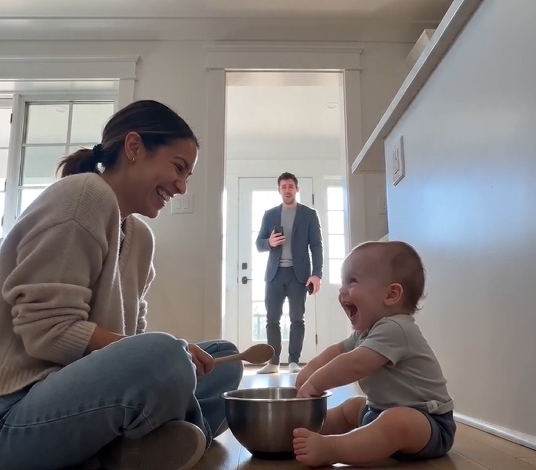
The next sound in the room was not another tap.
It was Benjamin setting his keys down very slowly on the counter, like any fast movement might shatter what had just happened.Miles still held the spoon. His knuckles were white around it. He didn’t repeat the word, but he pushed the bowl again, closer to Claire this time.
“More,” Claire echoed softly, not celebrating, not crowding him. She tapped once on the rim. Then she placed the spoon down between them and waited.
Miles tapped twice.
Claire answered twice.
Benjamin had spent almost a year watching professionals explain his son to him. Delayed grief response. Selective mutism. dysregulated attachment after maternal loss. He had nodded through all of it and written checks at the end.
But now he stood in his own kitchen and watched a young woman in cheap sneakers do something none of them had done.
She left room for the child to come forward.
Vanessa recovered first. “Benjamin, this is exactly what I meant. He needs structure. We cannot reward this kind of regression.”
Claire didn’t argue with her. She kept her eyes on Miles.
That bothered Vanessa more than if Claire had snapped back.
Benjamin finally spoke. “He said a word.”
Vanessa folded her arms. “Children make sounds. That doesn’t mean this is healthy.”
Claire looked up then, not rude, just direct. “It wasn’t random. He asked for the pattern again.”
Vanessa gave a short laugh. “A pattern? With cookware?”
Benjamin’s jaw tightened, but his voice stayed level. “Leave it.”
Vanessa stared at him, shocked less by the words than by the fact that he had said them in front of staff.
Claire shifted the bowl away and rested her palm on the tile. “That’s enough for today, Miles.”
The little boy stiffened at the stop, and for one second Benjamin thought the moment was over. But Claire touched the floor twice with her fingertips.
Tap. Tap.
Pause.
Miles, breathing through parted lips, copied her with the spoon.
Tap. Tap.
Pause.
Then he let Claire take the spoon from him without a fight.
That became the beginning.
Not a miracle. Not a transformation. A beginning.
Over the next several days, Claire did not invent ten new methods or turn the boy into a project. She repeated the same safe rhythm in ordinary parts of the day. On the breakfast room floor with two wooden coasters. On the back steps with pebbles against the railing. On the rug beside the toy basket. In his room at dusk with fingertips on the side of a cardboard storage box.
Sound. Pause. Choice.
That was the part no one else in the house had ever given him.
Choice.
If he wanted in, he joined. If he didn’t, she stopped. If he tapped once, she answered once. If he moved away, she let the silence sit until it didn’t feel like punishment anymore.
She also noticed something else. Every night Miles woke at almost the same time, sat up rigid, and clutched the edge of his blanket without making a sound. He did not call because somewhere inside him, calling had become useless. His mother had been there, and then one day she wasn’t. The break had been too sudden for his small body to understand. He hadn’t just lost a person. He had lost the belief that reaching out meant someone would come.
The adults around him had responded by managing him harder.
Vanessa wanted brushed hair, clean collars, proper napkin use, calm entrances, calm exits, no clinging, no disorder. She wasn’t cruel in the obvious way. That almost made it worse. She was the kind of person who could speak gently while removing every messy human thing from a room.
Benjamin was different but no less damaging. He loved his son, but he loved him with solutions. If Miles couldn’t sleep, there would be better blackout curtains. If he wouldn’t eat, there would be a nutrition specialist. If he wouldn’t speak, there would be appointments and charts and private assessments. Benjamin was always moving resources toward the child. He had not realized that to a grieving three-year-old, movement was not the same as presence.
Claire did not explain any of this like a lecture. She lived it in front of him.
One night Benjamin was working in his study when he heard a faint rhythm in the hall monitor.
Tap. Pause. Tap-tap.
He checked the nursery feed.
Claire sat on the floor beside Miles’s bed in the dark, not touching him, not shushing him, not turning on bright lights. Just tapping lightly on the wooden bed frame with two fingers. Miles, sitting upright and trembling, slowly pressed his own fingers to the mattress edge in answer.
Tap. Pause.
His breathing eased.
Benjamin watched for ten full minutes. Claire never once told the boy, “Use your words.” She never said, “It’s okay” in that automatic adult tone children don’t believe. She simply answered when he reached.
The next morning Benjamin found her in the kitchen rinsing berries.
“How long have you been doing that at night?” he asked.
Claire shrugged. “Since the second night.”
“And he responds every time?”
“Not every time.” She shook water from the strainer. “But he knows I’ll answer every time.”
That sentence hit him harder than any specialist report.
Vanessa did not like the shift in the house. She noticed that Miles now looked for Claire when he entered a room. She noticed that he tolerated breakfast better when Claire tapped once on the table before placing his plate down. She noticed that he sat closer to the floor den Claire made out of dining chair cushions and a throw blanket than he ever had beside the expensive sensory tent someone had recommended online.
She noticed, most of all, that Benjamin had started coming home earlier to watch.
Not interfere. Watch.
To Vanessa, that looked dangerous.
The community garden afternoon tea had been on the calendar for weeks. It was one of those polished estate traditions the neighborhood expected: long linen tables under trimmed hedges, silver tea pots, little pastries, wealthy families pretending their lives were softer than they were.
Vanessa cared about it deeply. She said it would be good for Miles to be seen, good for him to practice social presence, good for the community to see that he was “doing better.”
Claire heard the words and knew what they really meant.
Performance first. Child second.
The morning of the tea, she found a tiny toy set hidden behind a chair in the family lounge: a cheap metal whisk, two measuring cups, and a plastic container with a cracked lid. Miles had been pulling them into corners all week, building little nests with them under side tables and beside window seats. His own secret version of the kitchen rhythm.
She didn’t move them.
At lunch Vanessa did.
“These ugly things don’t belong out,” she told a maid, dropping them into a pantry bin.
Miles saw.
He didn’t cry. That would have almost been easier. He just went blank. Shoulders up. Mouth shut tighter. Lunch untouched. Eyes glazed over as if he had stepped behind glass again.
Claire found the missing toys ten minutes later and put them back under the console table in the breakfast room without making a scene. She tapped once on the wood floor.
Miles did not answer.
That scared her.
Not because he was “backsliding.” Because she knew exactly what had happened. His small proof of control had been erased by adult taste.
At three o’clock the guests began arriving at the community garden behind the estate. The place was gorgeous in that controlled way money makes possible: rose arches, white gravel paths, clipped lavender borders, wrought-iron chairs, iced tea sweating in crystal dispensers. Children in pressed clothes drifted around while adults performed interest in one another.
Miles stood beside Benjamin in a pale blue linen shirt, silent and rigid. Vanessa crouched beside him, smoothing his collar every thirty seconds.
“Remember,” she whispered, “sit nicely, no floor play, no kitchen noises, no mess.”
With each instruction, he seemed to shrink.
Claire stayed near the dessert table at first, technically there as help, not family. She could see the pulse fluttering in Miles’s neck from ten feet away.
Benjamin saw it too.
That was new.
An older neighbor bent down and said too brightly, “And how is our handsome boy today?”
Miles pressed himself against Benjamin’s leg.
Vanessa stepped in instantly. “Miles, look at her when she’s speaking.”
The child’s breathing changed.
Benjamin looked down.
Claire caught his eye and gave the tiniest shake of her head.
Then one of the catering staff accidentally dropped a spoon into a tray. The sharp metal sound cut through the garden.
Miles’s face snapped up.
Claire saw it happen. So did Benjamin.
The boy wasn’t avoiding the world. He was listening for something inside it.
Vanessa took his hand. “Come on, sweetheart, let’s greet everyone properly.”
She tried to guide him toward the table.
He froze.
She tugged again, still smiling because people were watching.
His knees locked. His eyes went wild. Not loud, not dramatic. Worse. He was disappearing right there in public.
“Vanessa,” Benjamin said quietly.
But she was too committed now. “He has to learn.”
Claire moved before anyone else did.
She stepped to the edge of the tea table, picked up two plain butter knives, and lightly tapped them against the underside of a serving tray where guests couldn’t quite see.
Tap. Tap-tap. Pause.
Vanessa spun around in disbelief. “Claire, stop that this instant.”
Miles’s eyes found Claire like a drowning child finding shore.
She lowered herself all the way to the gravel path in her dress and cardigan, ignoring every stare. Then she dragged a small wicker basket on its side and set one napkin over it, making a crooked little cave beside the tea table. A ridiculous, simple shelter. Not a therapy station. Not a lesson. Just a tiny secret place in the middle of a too-perfect garden.
The same logic as the kitchen floor. Sound. Pause. A place small enough to feel safe.
Some guests looked embarrassed. One woman looked offended. Vanessa looked furious.
Benjamin did nothing.
He stood still and watched.
Claire tapped the tray again, softer.
Tap. Pause.
Miles took one step.
Vanessa reached for him. “No. We are not doing this.”
The second she touched his arm, he recoiled so hard he nearly lost his balance.
That was the moment everyone saw it. The old method didn’t fail privately anymore. It failed in daylight, in front of witnesses, under white roses and polished silver.
Claire didn’t reach for him. She just touched the wicker basket twice with her knuckles.
Tap. Tap.
Pause.
Miles whispered a breath, then another. He crossed the gravel on his own, small shoes crunching loud in the sudden silence. He crouched near the basket but didn’t go in. Instead he looked at Claire, then at Benjamin.
His lips parted.
Nothing came.
Claire waited.
No rescue words. No “Say it.” No pressure.
Miles grabbed the edge of Benjamin’s trouser leg with one hand and pointed at the crooked basket-cave with the other.
Then he said it.
“Dad.”
One word.
Not Claire’s name.
Not “more” this time.
“Dad.”
Benjamin’s face changed so completely it made two nearby women turn away out of embarrassment, as if they had seen something private.
Miles tugged his father’s leg again, harder now.
“Dad.”
The request was clear even before the next word came. Claire tapped once on the basket. Benjamin, stunned, lowered himself to the gravel in a suit that cost more than Claire made in two months.
The guests murmured. Vanessa went white.
Benjamin looked at Claire, and for the first time he did not ask for an explanation. He asked for instruction.
Claire nodded toward the basket. “Answer him.”
So Benjamin did the strangest thing that had ever happened at one of those garden teas. He bent down beside his silent son and tapped on a wicker basket covered with a napkin while kneeling in gravel between expensive shoes and china stands.
Tap. Pause.
Miles stared at him, searching.
Benjamin tapped again.
Tap-tap. Pause.
Miles’s mouth trembled. Then, with a tiny burst of courage that seemed to tear straight through the dead center of that family, he ducked into the little makeshift cave and pulled at the napkin edge.
Benjamin blinked. “Me too?”
Claire said nothing.
Miles pulled again.
Benjamin crawled partly under the ridiculous basket tent until his shoulders were hidden and his son’s hand landed flat against his wrist.
The child exhaled against him like he had finally found the door he had been waiting at for months.
People stopped pretending not to watch.
From inside the napkin-shadow, Miles tapped Benjamin’s hand with two fingers.
Benjamin answered.
The garden seemed to hold its breath.
Then Miles whispered one more word, rough and uneven but unmistakable.
“Again.”
Benjamin let out a sound that was almost a laugh and almost a sob. He tapped again.
Inside that ridiculous little shelter beside the tea table, father and son found each other in a language no one rich or polished had thought to use.
Vanessa’s voice came out tight. “Benjamin, this is humiliating.”
He turned his head just enough to look at her from the gravel. “No,” he said quietly. “This is my son.”
No speech followed. No dramatic public takedown. He didn’t need one.
Everyone there had already seen what worked, and what didn’t.
After the guests left, the house changed in ways both small and enormous.
Benjamin extended Claire’s trial into a full contract before dinner.
But that was the least important part.
He also canceled two standing evening commitments each week and blocked the time as nonnegotiable. One afternoon with Claire guiding the rhythm they had built. One second stretch that would belong to him and Miles alone. No calls. No assistants. No disappearing into his study after ten minutes. He asked Claire to show him the nighttime tapping sequence, the breakfast pause, the way to wait without crowding, the way to answer without taking over.
He learned badly at first.
That mattered too.
Because in that house, adults had always acted as if mistakes were intolerable. Claire didn’t let him hide there.
When Benjamin rushed in too fast, Miles pulled back. When Benjamin filled silence with too many words, Claire simply said, “Wait.” When he treated a response like a result to secure, the moment died.
So he tried again.
That became the second new family rule after the tea: Miles was allowed to try, fail, hide, return, and try again without being corrected for the feeling of it.
The first new rule had already happened without being announced: connection now ranked above appearances.
Vanessa lasted three more weeks in the house.
Not because Benjamin threw her out in some dramatic scene. The truth was colder than that. Her authority had depended on being the adult who best fit the polished life he had built. Once he saw that polish had been costing his child too much, he stopped mistaking elegance for care.
She complained that Claire encouraged dependence.
Benjamin answered, “She encouraged trust.”
Vanessa said the house was becoming disorderly.
Benjamin looked at the blanket den now allowed in the corner of Miles’s room, the mixing bowl on the low shelf, the wooden spoons, the cheap whisk, the little secret cave materials no one was allowed to “tidy away,” and said, “Good.”
By the time she left, no one needed to say who had lost ground.
As for Miles, healing did not arrive in a straight line.
Some nights he still woke rigid and silent. Some afternoons he shut down when plans changed. Some days he wanted only the basket cave and the tapping rhythm and no eye contact at all.
But now when he reached, someone answered.
Sometimes Claire. Sometimes Benjamin.
And eventually, not every answer had to be a tap. Sometimes it was a hand offered and accepted. Sometimes it was Miles pushing a bowl toward his father. Sometimes it was one word at breakfast.
“Blue,” for the cup he wanted.
“Out,” when he needed the room to breathe.
“Again,” still his favorite.
Claire’s position in the house changed too, though not in the fake fairy-tale way people like to imagine. She did not suddenly become family in name, and she did not stop being an employee. But she also stopped being treated like a replaceable helper who should be grateful for proximity to wealth.
Benjamin listened when she spoke. The schedule bent around the child instead of around adult image. Her ideas were no longer tolerated in secret and dismissed in public.
The room where Miles slept kept one permanent ritual from those first kitchen days: a metal bowl, a wooden spoon, and a small folded blanket tent stored in the basket by his bed. Not for decoration. For use.
On the last warm evening before fall, Benjamin sat on the nursery floor while Miles tapped the side of the bowl and waited. Claire stood in the doorway, half in shadow, watching just long enough to make sure neither of them rushed the silence.
Tap. Pause. Tap-tap.
Benjamin answered correctly this time.
Miles smiled without showing teeth, scooted closer, and leaned his shoulder into his father’s arm.
Then he looked up at Claire and patted the rug beside them.
A place saved for her.
Not because the story was over. Because it wasn’t.
That was the hope in it.
The estate was still large. The grief was still real. The child was still healing in small, uneven pieces. But the house was no longer pretending that expensive order was the same thing as love.
And in a family that had once mistaken silence for compliance, a little boy had found a way to ask again.