THE BILLIONAIRE ORDERED ME TO NEVER TOUCH HIS PARALYZED SON-UNTIL HE FOUND US ON THE PARLOR FLOOR DOING THE UNTHINKABLE

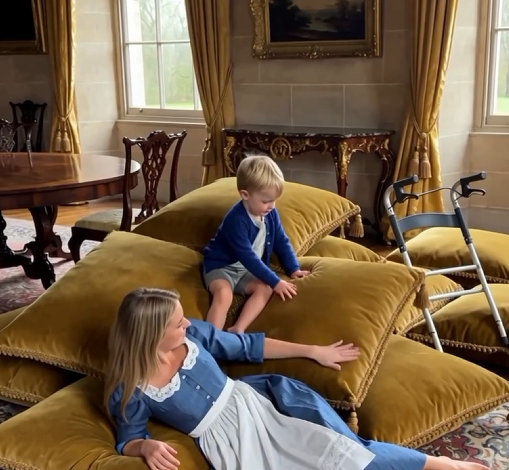
He reached out with both hands, grabbed the stroller handle from the side — not to climb back in, but to push off it.
And he let go.
Fifty people on a manicured lawn stopped breathing at the same moment.
Caleb Prescott stood on his own two feet in the grass with nothing holding him up: no harness, no gait trainer, no braces locked at the knee, no two certified aides at his elbows. Just a four-year-old in a stiff navy blazer, swaying like a sapling, eighteen months of fear running out of him and into the ground.
He took a step.
It was terrible. His left foot dragged a crescent through the clover and his hip swung out wide to compensate and his whole body listed sideways like a boat taking water.
He took another one.
“Three steps to the cushions,” Emma said from where she lay, perfectly calm, as if they were still on the drawing room floor with the door shut and nobody watching. “That’s all. Three. I counted.”
Caleb’s face screwed up. Not crying — concentrating. His arms came out for balance, wobbling.
Third step.
He didn’t make it. His ankle rolled on a clump of grass about two feet short and he went down hard onto his hands and knees in the turf, and fifty people made a single horrified sound, and Dr. Vance lunged forward with his hand already going to his jacket pocket.
James got there first.
Not to pick him up.
James Prescott — in a suit that cost more than the caterer’s van, in front of his board, in front of his dead wife’s mother — dropped onto his knees in the wet grass beside his son and did not touch him.
It was the hardest thing he had ever done in his life. Every muscle in his arms was screaming at him to scoop the boy up and run for the house and the harness and the people with credentials. He had been doing exactly that for eighteen months. He had done it on the interstate too, in his head, ten thousand times, except in that version he got there in time.
He put his hands flat on his own thighs and he left them there.
“You okay, bud?” he said.
Caleb looked up at him from all fours, grass stains blooming on the knees of his pressed shorts.
And then, because nobody had grabbed him — because for the first time since the accident the world had not immediately lifted him out of a hard moment and strapped him back into safety — Caleb pushed up onto one foot, then the other, and stood.
He was two feet from the cushions. He covered it in one lurching, graceless, enormous step and landed face-first in the yellow pile next to Emma, and he laughed.
It was a terrible laugh, honestly. Wheezy and startled and clogged with snot.
It was the first sound his father had heard him make in a year and a half that wasn’t a whine, a scream, or a silence.
“Mr. Prescott.” Dr. Vance’s voice came from somewhere above and behind. “I need to be extremely clear that I did not authorize—”
“No,” James said. “You didn’t.”
He didn’t get up. He was still on his knees in the grass, looking at his son, who had rolled onto his back on an outdoor cushion and was kicking both legs in the air — both of them, the bad one too — like a beetle.
“There is a documented risk of—”
“What’s in your pocket?”
A pause. “I’m sorry?”
James turned his head. “Your jacket. What’s in it.”
Vance’s hand came out of the pocket, empty, a little too fast. “A standard anxiolytic. For emergencies. We discussed—”
“You walked across my lawn toward my four-year-old with a loaded syringe because he was crying at a party.” James heard his own voice as if from a distance. It was very quiet. The nearest guests had gone absolutely still. “Was that the emergency? That he was upset in front of my investors?”
“Mr. Prescott, with respect, the protocol you yourself signed—”
“I know what I signed.” James got to his feet. There was grass on his knees and he didn’t care. “I signed it eleven days after I buried my wife, in a room where six people with your qualifications told me that if I didn’t, my son would never walk. I’d have signed anything. You knew that.”
Vance’s face closed over. “This is an emotional reaction to an unsafe incident.”
“He walked, Vance.”
“He fell.”
“He got up.” James’s voice finally broke its leash, and several guests flinched. “Eighteen months. Five clinics. Four hundred thousand dollars of equipment in my basement. He has never once put his heels on the ground. He just crossed eight feet of lawn to get to a girl you tried to have fired.”
He looked at the drinks table, at the white linen, at the board members holding their wine glasses frozen halfway to their mouths, at his mother-in-law with her hand pressed over her mouth.
“Your team’s done,” he said. “Send the final invoice to Margaret. Don’t send a transition plan. Don’t call. Get off my property.”
They talked about it for a long time afterward, in the way that people like that do — at other luncheons, in the backs of cars. Did you hear what Prescott did at the Memorial Day thing. Fired the whole medical team on the lawn. Got down in the grass in a Brioni suit.
What almost none of them mentioned was the part that came after, because it wasn’t dramatic enough to repeat.
The caterers served lunch. The string quartet started up again. And James Prescott spent the next two hours sitting on an outdoor cushion on his own lawn with his shoes off, while his son climbed up a slope of pillows and fell down it, climbed up and fell down, climbed up and fell down, until the knees of the boy’s pressed shorts were green and ruined and he was shrieking with laughter every single time he hit the bottom.
Falling, it turned out, was the whole lesson. Emma had built the incline out of cushions for exactly one reason: so that a child who had been taught by every adult in his life that his body was a catastrophe waiting to happen could fall over fifty times in an afternoon and discover that nothing happened. The world did not end. He got up. He did it again.
You cannot teach a child to walk if he believes the ground is trying to kill him.
Emma did not get a dramatic apology that day. She got one about three weeks later, badly, in the kitchen, while James was trying and failing to make pancakes.
“I was going to settle your contract,” he said, to the pan.
“I know. Margaret told me.”
“You came anyway.”
“I’d already told him we were doing cushions on Saturday.” She shrugged. “He’s four. You don’t tell a four-year-old you’ll be somewhere and then not be there. Everything else is details.”
James stood looking at the burning pancake for a moment.
“Dr. Vance has a fellowship and twenty-two years of experience,” he said. “You have an associate’s degree and you work at a daycare on Mondays.”
“That’s true.”
“He had Caleb for a year and a half. You had him for nine days.”
Emma took the spatula out of his hand, flipped the pancake, and set it back down. “He had a patient for a year and a half,” she said. “I had a kid for nine days. That’s the whole difference. There isn’t a secret.”
Caleb Prescott walked into his kindergarten classroom on his own two feet at five years and four months old.
He had a limp. He still has it; he always will — there’s a plate in his hip and some nerve damage below the right knee, and no amount of love or cushions was ever going to undo what a semi did to the passenger side of his mother’s car. On bad days he uses a stick. On very bad days he uses the chair, which lives folded by the back door and which nobody in that house treats as a defeat.
What changed was not that he was fixed.
What changed was that he stopped being handled.
The German adaptive stroller went to a family across the state who actually needed it. The gait trainer went into storage and then, eventually, to the curb. The two-way glass in the home therapy suite got taken out and the room became, by Caleb’s direct request, “the falling room” — cushions floor to ceiling, no schedule, no clipboard, no twenty-minute standing tolerance window.
Emma stayed four years. She left for a physical therapy program in Boston that James paid for, under an arrangement that specified in writing — twice, because Emma made him rewrite it — that it was not contingent on her coming back. She came back anyway, most summers, for a week or two, and Caleb would hear her car on the gravel and come down the stairs far too fast.
And on the lawn, every Memorial Day after that one, there were cushions.
Not for anyone’s benefit. Not as a symbol. Just a pile of waterproof yellow outdoor cushions stacked against the slope at the bottom of the south lawn, where a boy who had been told his body was made of glass learned, eight feet at a time, that it was made of a child instead.