He Was Once the Boy Waiting for Bread in the Rain. The Rich Only Realized Too Late Who the Restaurant Truly Served.

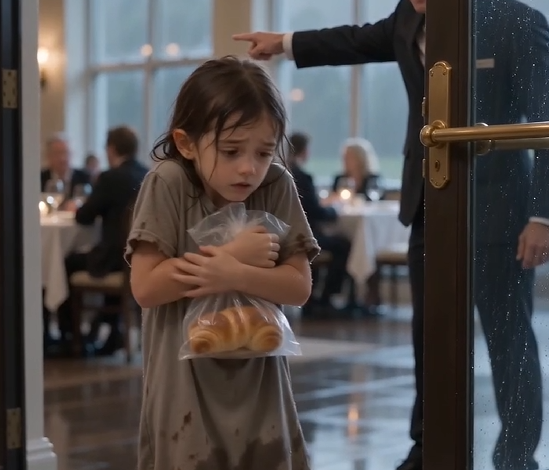
“Don’t let that little girl in.”
The manager said it fast, under his breath and through clenched teeth, but the warning came a second too late. The front door had already opened, letting in a sheet of rain-cooled air and a silence so sudden it felt like glass breaking across the room.
For a moment, nobody moved.
Inside the three-star Michelin dining room, the whole evening had been unfolding with the careful precision of theater. Warm amber light floated above white tablecloths. Crystal stemware caught the glow in trembling reflections. Silver touched porcelain with the soft, expensive music of people who never had to raise their voices to be heard. Butter, wine, and the perfume of roasted herbs drifted through the room in layered warmth. Beyond the tall windows, rain had just begun to slide down the glass in thin silver lines.And in the doorway stood a child.
She could not have been more than eight.
Her sandals were soaked through, leaving dark little prints on the polished floor. Her dress was too thin for the weather, faded past any clear color, the hem stained with mud. Her hair clung to her cheeks in wet tangles. In both arms she held a crinkled plastic bag against her chest as if it were the only thing in the world she trusted not to disappear.The maître d’ stopped mid-step. A server carrying a bottle of Bordeaux nearly missed a pour. At the nearest table, a woman wearing diamonds the size of raindrops lowered her glass and stared with the open irritation people reserve for inconvenience dressed as tragedy.
The girl swallowed, standing in the doorway while the rain whispered behind her.
“I…” Her voice was so small that the room seemed to lean toward it in spite of itself. “I just wanted to ask for some leftover food.”A man near the center of the dining room laughed first.
It was not a loud laugh. That was what made it worse. It was the kind of laugh that expected agreement.
“There are no leftovers here,” he said, dabbing his mouth with a linen napkin. “That’s not how this place works.”
Another guest, a silver-haired woman in a navy silk dress, frowned as though the child had committed an act of indecency. “Someone should take her outside.”
The manager was already moving.He cut across the room with practiced calm, his face arranged in the smooth, expressionless mask of luxury hospitality. But his eyes were sharp, embarrassed, angry that something real had entered a room built to keep reality out.
When he reached the girl, he bent slightly, not out of kindness but because humiliation is more efficient at eye level.
“You don’t belong here,” he said.
The words were quiet, polished, and merciless.
The girl tightened her arms around the plastic bag. Her chin dipped lower. She gave one tiny nod, not because she agreed, but because she had clearly heard worse and knew what came next.At the open kitchen beyond the far side of the room, Chef Daniel Rousseau stopped moving.
Only the knife in his hand remained lifted.
Around him, cooks continued their choreography for another heartbeat—sauces checked, pans turned, garnishes placed with tweezers—before the stillness reached them too, as if some unseen current had moved through the walls. Daniel did not look at the guests. He did not look at the manager.
He looked only at the girl.
At the wet sandals.At the plastic bag pressed to her ribs.
At the way she stood like someone apologizing for existing.
The overhead kitchen lights struck the blade in his hand, and beyond the windows lightning flashed white across the rain-dark street.
Something shifted behind his eyes.
Not in the room.
Far away.
A different city. A different rain. A different door.
Paris.
A cramped back alley behind a restaurant whose name nobody remembers unless they owe it their life. Grease in the gutter. Cold so hard it sharpened the breath in his lungs. A boy of seventeen standing under an awning with shoes split at the sole, waiting for bread someone might throw away. His hair dripping into his eyes. His stomach clenched so tightly with hunger it felt less like pain and more like being hollowed out from the inside.
He had stood there for an hour.
Then two.
Then a cook came out carrying a bin.
The boy stepped forward.
“Please,” he had said.
The cook looked at him once, then at the stale loaf tucked beneath the scraps and peelings. The boy remembered thinking he could survive on that loaf for two days. Maybe three if he was careful.
Instead, another man appeared behind the cook—owner, manager, someone who had the power to decide whether hunger counted as a moral failure.The slap had come fast.
Not hard enough to knock him down. Hard enough to teach him where he belonged.
“If you have no money,” the man had said, “you do not deserve to eat.”
Back in the present, Daniel’s hand trembled.
It was slight. Barely visible. But the knife point wavered once in the light.
Beside him, his sous-chef noticed. “Chef?”
Daniel set the knife down.
The sound it made against the steel counter was gentle. Final.
He stepped out of the kitchen.At first, few people understood what they were seeing. Daniel Rousseau rarely left the line during service unless the matter was catastrophic. He was known for impossible standards, for a palate that could detect imbalance in a sauce from a single breath, for running his kitchen with the severity of a conductor leading a symphony over a cliff edge. Guests spoke his name with the same reverence they used for cathedrals, surgeons, and old money.
Now he walked straight toward the front of the room, his white chef’s coat immaculate, his face unreadable.The manager straightened at once. “Chef, I was just handling—”
“Set a table,” Daniel said.
The manager blinked. “Sir?”
“A table.” Daniel’s eyes did not leave the girl. “For her.”
The manager glanced around the room, perhaps hoping he had misheard, perhaps praying Daniel would notice the horror on the faces of people who had paid hundreds for exclusivity and no part of their evening to include witness.
“Chef,” he said more softly, stepping closer, “this is the VIP dining room.”Daniel turned his head.
Nothing in his expression rose. Nothing in his voice sharpened. But something colder than anger entered the air.
“Set. A. Table.”
Silence spread outward like a stain.
At table twelve, the man who had laughed first shifted in his seat. The woman in silk looked away and then back again, as though unable to decide whether outrage or curiosity would serve her better.
The manager swallowed. “Of course.”
He snapped his fingers at two servers, and their training overrode whatever protest they might have felt. In less than a minute, a small two-top near the center of the room was cleared and reset. White linen. Water glass. Bread plate. Silver aligned exactly.The absurdity of the scene seemed almost unbearable. A beggar child being seated in a temple of controlled appetite while those who had arrived in chauffeured cars watched as if some forbidden ritual had begun.
The manager turned to the girl and forced a smile so thin it barely qualified. “This way.”
She looked from him to the chair to the door behind her, as if she suspected they might still push her back into the rain at the last second.Daniel spoke, and his tone changed.
Not softer. Stranger than that. Human.
“You’re all right,” he said.
The girl looked up then, only for an instant.
He saw fear first. Then disbelief. Then the tiny, dangerous flicker of hope that hunger makes a person ashamed to feel.
She stepped forward.
Every eye in the room followed her.
She walked carefully, almost on tiptoe, trying not to let her wet sandals squeak against the floor. When she reached the chair, she hesitated before sitting, as if she were afraid the fabric of her dress might stain the upholstery simply by touching it. Even seated, she stayed at the edge, her back rigid, the plastic bag still locked in her hands.
A server reached for it reflexively. “Would you like me to take—”
“No.”
The answer came out sharp, terrified.
A few guests flinched. The server pulled back immediately.
The girl lowered her gaze. “Sorry.”
Daniel took the seat opposite her.
That caused the next ripple.
One woman actually gasped.
A famous chef did not sit in his own dining room during service. Not with guests waiting. Certainly not across from a drenched child who had come in asking for scraps.
Yet there he was, folding himself into the chair with no trace of performance, no indulgent smile for the room, no speech yet to sanctify what he had done. He simply sat.
“What’s your name?” he asked.
The girl’s fingers crackled against the plastic bag. “Sophie.”
“How long since you ate, Sophie?”
She shrugged in that way children do when the truth is both ordinary and humiliating.
“I had a cracker this morning,” she said. “Half.”
The room heard it.
You could feel people trying not to hear it.
Daniel nodded once. “Do you have anyone with you?”
Another shrug. Smaller this time.
“No.”
The manager, still hovering, stepped closer. “Chef, perhaps social services should be called.”
Daniel did not look at him. “Later.”
“But—”
“Later.”
The manager backed away.
In the kitchen, the line had slowed nearly to a standstill. Staff were watching openly now. Guests were forgetting to pretend they were not listening. Rain moved in shining threads down the windows. Somewhere in the room, someone’s phone buzzed and went unanswered.
Daniel lifted a hand toward the kitchen.
The first plate arrived a minute later.
There was no tower of scallops. No jewel-like arrangement under foam and flowers. No luxury translated into edible geometry.
Only a piece of bread.
It had been toasted just past golden, one edge darkened into a slight char. A little butter had melted into the surface. Nothing more.
The server set it down with the grave care usually reserved for a twelve-course tasting centerpiece.
Sophie stared at it.
Her lips parted.
She did not touch it.
For a second Daniel thought she might not understand that it was for her. Then he saw the change in her face. Not confusion. Recognition. Something old and immediate and devastating.
The redness came first, blooming around her eyes.
Daniel spoke quietly. “Eat.”
She looked at him. Then at the bread. Then back at him again, as if checking whether this was some kind of trick, whether taking it would trigger laughter, punishment, a hand catching her wrist.
When no one moved, she reached out.