He Was Once the Boy Waiting for Bread in the Rain. The Rich Only Realized Too Late Who the Restaurant Truly Served.

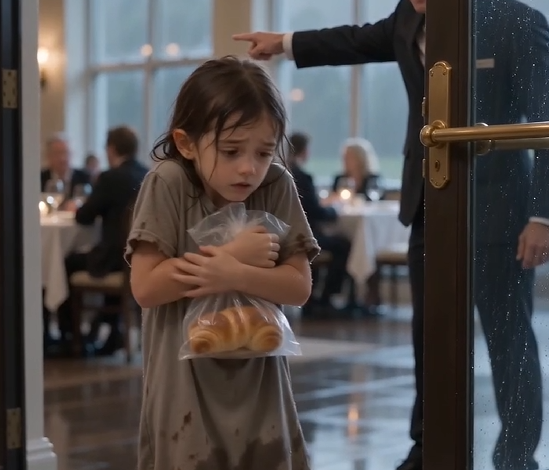
Her hand was so small around the bread that it seemed to vanish against the plate.
She took one bite.
And began to cry.
Not delicately. Not the kind of tears people dab away while apologizing for emotion. It broke out of her all at once, raw and helpless. Her shoulders shook. She covered her mouth with one hand, still trying to be polite while sobbing over burnt bread in the most expensive room she had likely ever seen.
No one in the restaurant moved.
The sight had changed something.
Because hunger, when dressed properly, can be discussed as policy, philanthropy, unfortunate statistics. But hunger with tears on it, hunger in a child trying not to stain a white tablecloth with grief—that was harder to place at a comfortable distance.
Daniel leaned back slightly.
Twenty years collapsed in his chest.
He saw the old kitchen in Paris again. Not the slap this time. The moment after.
An older dishwasher had come out when the others went back inside. A man with ruined knuckles, a bent spine, and eyes too tired for cruelty.
He had not asked questions. He had not demanded gratitude. He had taken a blackened heel of bread from his apron pocket—burnt from the ovens, meant for no one—and held it out.
The boy Daniel had been took it with both hands.
“Why?” he had asked, because at seventeen pride survives even when dignity doesn’t.
The old man had shrugged.
“Not because you deserve it,” he had said.
“Because you’re hungry.”
Daniel looked at Sophie, weeping over the same gift.
And finally he spoke loudly enough for the room to hear.
“Twenty years ago,” he said, “someone gave me exactly that.”
Every face turned fully toward him now.
The rain beat harder against the windows.
Daniel’s voice remained level, but something underneath it was burning. “Not truffles. Not caviar. Not a dish with my name attached to it. Bread. Slightly burnt, because that’s what was left.”
Sophie kept crying quietly, trying to chew and breathe at the same time.
Daniel continued. “I was seventeen. Wet from the rain. Starving. Standing behind a kitchen waiting for the garbage to go out.”
Across the room, the man who had laughed first stopped holding his wineglass. It rested forgotten on the tablecloth.
Daniel folded his hands once, then opened them again. “A man told me I did not deserve food if I could not pay for it.”
No one made a sound.
He looked at the guests now.
Not accusingly. Worse than that. Clearly.
“And another man,” he said, “who had almost nothing himself, gave me a piece of burnt bread because I was hungry.”
His gaze moved over diamonds, tailored jackets, watches worth more than some people’s rent for years.
“Not because I deserved it.”
He turned back to Sophie, whose tears had quieted into trembling breaths.
“Because I was hungry.”
At the far edge of the room, one server put a hand over her mouth.
A man at table six looked suddenly interested in the stem of his glass. The silk-dressed woman sat very still, one hand frozen near her collarbone, as if something had tightened there.
Daniel stood.
Everyone seemed to tense, sensing that whatever happened next would settle something larger than dinner.
He turned toward the room.
“Today,” he said, “this restaurant does not serve the rich.”
The words dropped into the silence like stones.
A murmur began at once, shocked and disbelieving.
The manager took one involuntary step forward. “Chef—”
Daniel lifted a hand, and the room stopped again.
“We serve,” he said, each word measured, “those who need to be served.”
The man at table twelve found his voice first. “Excuse me?”
Daniel looked at him.
The man straightened in his chair, offended enough now to borrow courage from his own bank account. “I’m a paying guest.”
“Yes,” Daniel said.
The simplicity of it seemed to throw him off.
“I booked this table three months ago.”
“I know.”
“This is unacceptable.”
Daniel considered him for a moment. “A child asked for food, and that is what offends you?”
The man’s face colored. “That is not what I said.”
“No,” Daniel replied. “It’s what you revealed.”
A few heads turned sharply toward the man. He looked around, expecting allies, and found something less comfortable: the possibility that the room had shifted without telling him.
The silver-haired woman spoke next, her tone brittle with discomfort. “Surely there are charities for this kind of thing. Shelters. Proper systems.”
Daniel nodded once. “There should be.”
“Then why bring this into here?”
The question hung there, naked in its meaning.
Why bring need into luxury?
Why place hunger where appetite is entertainment?
Why remind us?
Daniel’s answer came without hesitation. “Because she walked in.”
The woman stared at him.
He went on. “Because she is real. Because hunger does not become less urgent simply because it is inconvenient to witness over wine.”
One of the younger guests, a man in his thirties seated near the window, cleared his throat. “Chef Rousseau…”
Daniel turned.
The man looked embarrassed to be speaking but compelled all the same. “If she needs help, I’ll pay for whatever she wants.”
It might have sounded noble if not for the way he said it—like a solution one could purchase quickly enough to restore atmosphere.
Daniel did not embarrass him. “That is generous,” he said. “But she is not a disturbance to remove.”
The younger man lowered his eyes.
At the table, Sophie had stopped crying. She held the bread in both hands now, chewing slowly, reverently, as if each bite required permission from the world. Her plastic bag still lay against her lap.
Daniel sat back down.
“Would you like more?” he asked her.
She glanced at the bread, then at the room, then at him.
“Is it really okay?”
“Yes.”
She hesitated. “Can I… can I save some?”
“For later?”
A nod.
“For someone else?”
Another pause.
Then, almost inaudibly: “My brother.”
Something moved through Daniel’s face. Brief. Painful. Familiar.
“How old is he?”
“Five.”
“Where is he?”
“In the laundry place down the street. They let us stay in the back when it rains if we’re quiet.”
A server nearby closed his eyes for a second.
Daniel spoke gently. “You came here for him too.”
Sophie’s chin trembled. She nodded.
That single answer rearranged the room more thoroughly than any speech could have done.
She had not entered for herself alone. She had crossed polished floors under the judgment of strangers carrying fear in her body and hope in a plastic bag because somewhere nearby a five-year-old was waiting in damp clothes.
The manager’s face lost some of its certainty then. Perhaps for the first time all evening, he truly saw her.
Daniel turned slightly toward the kitchen. “Prepare a meal to go. Warm. Enough for two children tonight, and breakfast in the morning.”
“Yes, Chef,” came three voices at once.
“And bring soup now.”
The kitchen sprang back into motion—not the elegant pace of luxury service, but something quicker, more urgent, almost relieved to have a purpose less decorative than perfection.
Sophie watched all of it with huge, wary eyes.
“Do you always make people listen to you like that?” she asked.
A few guests, despite themselves, smiled.
Daniel did too, though only faintly. “Not always.”
“You’re the boss?”
“Sometimes.”
She looked around the room, at the chandeliers, the flowers, the polished glasses. “This is your place?”
He shook his head once. “No. It belongs to many people. But tonight I am responsible for it.”
That seemed important to her. She thought about it, then asked, “Does being responsible mean you can tell mean people to be quiet?”
A few breaths in the room turned suspiciously close to laughter, the embarrassed kind that arrives when a child has said the truest thing.
Daniel’s mouth almost curved. “Yes.”
“Good.”
The soup arrived in a white porcelain bowl, fragrant with chicken stock and root vegetables, steam lifting in soft threads. Beside it came another plate of bread, then a small dish of butter, then a folded cloth napkin, though Sophie still kept wiping her fingers carefully on the inside hem of her dress when she thought no one noticed.
Daniel noticed.
So did a woman at the back of the room who had until now remained silent. She wore no diamonds, only a simple black dress and a wedding band, and her husband beside her had been staring at his plate with the distant expression of a man seeing his own childhood somewhere he did not expect.
The woman raised a hand for the manager.
When he approached, stiff and uncertain, she said quietly, “Please send another meal with the takeaway. And dessert.”
He blinked. “Madam?”
“For the children.”
He looked toward Daniel, perhaps instinctively asking permission.
Daniel only nodded.
Then the younger man by the window called the manager too. “Add mine.”
The silver-haired woman did not speak for another minute. Then, without looking at anyone, she placed her napkin down and said, “And mine as well.”
A strange thing happened then, one that no one would have believed possible twenty minutes earlier.
The room began to soften.
Not all at once. Not cleanly. Pride and shame rarely surrender with elegance. But one table after another called for the manager or a server. Quietly. Awkwardly. Irritated with themselves, perhaps, for being moved. Yet moved.
Another meal.
Make it three.
Add coats if possible.
There’s a children’s pharmacy on the corner. I can send supplies.
Can someone contact a shelter?
Do not tell the press.
The last one came from the man who had laughed first.
He said it without conviction, without looking up, and no one answered him.
Sophie kept eating.
Daniel let the room evolve without blessing it too easily. He had seen guilt masquerade as goodness before. He knew how quickly rich people can mistake a gesture for a changed heart. But he also knew this: sometimes the first crack is enough. Sometimes shame is the only place decency can enter.
He poured water into Sophie’s glass himself.She whispered, “Thank you.”
He nodded toward the plastic bag. “What’s inside?”
Her arms tightened at once.
He waited.
After a few seconds she opened it just enough to show him.
A small yellow sweater, still damp.
A toy car missing one wheel.
A packet of crackers, empty.
A receipt.
And tucked carefully at the bottom, wrapped in tissue, a photograph.
Daniel saw only a glimpse: two children and a woman seated on a curb in sunlight. The woman’s face was tired but smiling. Sophie shut the bag again quickly.
“My mom,” she said.
“Where is she?”
The girl stared at the tablecloth.
“Hospital,” she whispered. “Maybe.”
The word struck oddly.
“Maybe?”
“She got sick. A man said they took her to a hospital, but he didn’t know which one. That was two days ago.”
Daniel felt the room recede for a second.
Two days.
Children do not speak in measured tragedy. They speak in gaps.
“Have you been alone since then?”
She shook her head. “With my brother.”
“That’s not what I meant.”
“I know.”
It was such an adult answer that something twisted in him.
Across the dining room, people who had arrived expecting an evening of excess now sat with untouched glasses and cooling plates, forced into the humiliating realization that they had built their comfort so carefully they had begun to mistake distance for innocence.
Daniel asked, “Why here?”
Sophie took another bite of bread before answering, perhaps because eating while asked difficult questions had become a habit of survival.
“Because it smells warm outside,” she said.
He did not move.
She went on, still looking at the plate. “Sometimes places smell angry. This one smelled… nice.”
That nearly undid him more than the tears had.
Not because it was sentimental. Because it wasn’t. It was practical, observational, exactly how a child would choose where to ask for mercy.
The manager approached again, slower this time.
“Chef,” he said, and there was less authority than before, more uncertainty. “I contacted a women’s shelter nearby. They may have room tonight. And one of the dishwashers says he knows someone at the county hospital who can help check admissions.”
Daniel looked at him.
The man’s polished composure had worn thin. Underneath it was a face not unlike many others: frightened of getting things wrong, trained to prefer systems over people because people demanded more than procedure.
“Good,” Daniel said.
The manager nodded once, relieved and chastened in the same breath. “I’m sorry.”
It took Daniel a moment to understand he did not mean the interruption to service.
Daniel said nothing for a while. Then: “So am I.”
“For what?”
“For the years it took to make a room like this forget what food is for.”
The manager lowered his eyes.
Sophie glanced between them, uncertain whether she had caused trouble.
Daniel turned back to her immediately. “You didn’t do anything wrong.”
She nodded as if she wanted to believe him but had learned not to trust such declarations on the first hearing.
The main dining room resumed a kind of service after that, though no one would later agree it was the same evening. Plates continued to emerge from the kitchen. Wine continued to be poured. Yet the performance had cracked, and through the opening, something less polished and more honest breathed.
At one table, a husband and wife argued quietly—she wanting to leave, he refusing, insisting they stay. At another, a businessman picked at a course he had been eager for all week and found he could no longer taste it properly. The younger man by the window asked for the check early and then doubled the amount before leaving instructions for anonymity that ensured no one would think him selfless. The silver-haired woman remained seated until the end of service, spine straight, expression unreadable, as if enduring a verdict she had not consented to but could not dismiss.
Daniel stayed with Sophie.
He did not hover. He did not interrogate. He sat and ate a little bread with her, drank water, asked only questions she could answer without defending herself.
What did your brother like?
Red things.
What was his name?
Eli.
Was he brave?
Sometimes when he forgot to be scared.
When dessert came, it was not one of the plated masterpieces on the tasting menu. It was rice pudding with cinnamon, warm and simple. Sophie looked at it as if simplicity itself were suspicious.
“Is this fancy?” she asked.
“No.”
“Good.”
He almost laughed then.
She took one spoonful and closed her eyes.
In the kitchen, cooks kept glancing out, perhaps at him, perhaps at the child, perhaps at the unsettling possibility that they might remember all over again why they had first wanted to feed people before ambition turned nourishment into art and status and exhaustion.
Later, when one of the servers brought over a small paper bag packed carefully with food, Sophie reached for it so quickly her chair scraped.
“For Eli,” the server said.
Sophie’s eyes widened. “Really?”
The server nodded, and her own eyes were bright now too. “Really.”
Sophie looked at Daniel. “Can I go now?”
He studied her face.
There it was again—that survival instinct adults often romanticize as resilience because the truth is uglier. She had eaten. She had cried. She had rested exactly as long as danger allowed. Now her mind had returned to the boy waiting somewhere else.
“I’ll take you,” Daniel said.
The manager stepped in at once. “Chef, I can send security.”
“No.”
“You have the final seating in twenty minutes.”
“Then they can start without me.”
The manager looked like he might protest, then stopped himself.
Daniel stood and took off his chef’s coat.
That stunned the room more quietly than anything before it. The coat was not merely clothing. It was rank, myth, identity. Without it, he looked less like an institution and more like what he was beneath the reputation: a man with old scars hidden under clean sleeves.
He draped the coat over Sophie’s shoulders.
It swallowed her whole.
She looked down at herself in astonishment. “I’ll get it dirty.”
“It can be washed.”
She touched the cuff carefully. “It smells like bread.”
He did not trust himself to answer that.
Outside, the rain had eased to a cold mist.
The city had become reflective, every light doubled in puddles. Cars hissed past. Under the restaurant’s awning, Daniel crouched to Sophie’s height while one of the line cooks handed him the packed food and an umbrella.
“Which laundry place?” he asked.
She pointed down the block.
He walked with her through the damp night while, behind them, through the tall windows, the restaurant glowed like a gilded aquarium full of people reconsidering themselves.
The laundromat was open, fluorescent and nearly empty, the air humid with detergent and heat. In the back, behind a row of rattling dryers, a little boy sat on an overturned basket hugging his knees.
He sprang up when he saw Sophie.
“You came back.”
“Of course I came back.”
He stared at Daniel at once, all suspicion and hunger. Then at the paper bag. Then at the white coat hanging off Sophie’s small frame like some impossible trophy.
“This is Eli,” Sophie said.
Eli narrowed his eyes. “Are you a cop?”
“No.”
“Then what are you?”
Daniel considered it. “A cook.”
Eli thought that over. “A real one?”
“A real one.”
Sophie knelt and opened the bag. The smell of food filled the warm, humming laundromat in seconds. Eli moved closer before he could stop himself.
“There’s enough for both of you,” Daniel said.
Eli looked at him with the frankness only small children can manage. “Why?”
The question landed harder coming from him.
Because unlike adults, he was not asking for philosophy. He was asking for the terms of danger.
Daniel crouched.
“Because you’re hungry.”
Eli looked at Sophie. She nodded once.
That was enough.
The boy took the sandwich from the bag and bit into it with both hands. His eyes widened at the first taste, not because it was elaborate but because it was warm.
Daniel called the number the manager had texted him while the children ate. Shelter confirmed. A hospital contact called back ten minutes later and said they were searching records. Another server arrived with blankets. Then the manager himself came, awkward and out of breath, carrying two pairs of dry socks and a paper sack from the pharmacy.
He stopped short when he saw Daniel looking at him.
“I thought,” the manager said, almost defensively, “they might need these.”
Daniel took the bag. “Thank you.”
The man nodded, surprised by how much that mattered.
Sophie and Eli sat together on the floor, eating from the paper bag while wrapped in blankets far too big for them. For the first time all night, they looked less like creatures in flight and more like children interrupted by exhaustion.
An hour later, they were driven to a shelter with confirmed beds for the night. The hospital still had no answer about their mother, only a possibility, a name close enough to hers to warrant checking in person in the morning. It was not resolution. It was not rescue complete. It was a corridor with one light on.
Before Sophie climbed into the shelter van, she pulled Daniel’s coat tighter around her shoulders.
“I have to give this back,” she said reluctantly.
“Yes.”
She hesitated.
Then she looked up at him with a seriousness too old for her face. “When I came in there… I thought everyone was going to hate me.”
He said nothing.
She added, “Most of them did.”
Daniel almost smiled at the honesty.
“But you didn’t.”
“No.”
“Why not?”
Rain ticked softly on the van roof. The streetlight above them buzzed.
Daniel took a breath.
“Because once,” he said, “I was the one standing at the door.”
Sophie looked at him for a long second. Children know when an answer is true. She slipped out of the coat and handed it back, carefully, as though returning something sacred.
“You should keep making bread like that,” she said.
“The burnt kind?”
She nodded. “It tastes like somebody means it.”
Then she climbed into the van beside Eli.
Daniel stood in the rain and watched the doors close.
Back at the restaurant, service had ended, but no one had left the story behind.
Half-finished glasses sat abandoned on tables. Flowers drooped in their arrangements. The kitchen was being cleaned in unusual silence. The dishwasher at the far sink looked up when Daniel reentered and gave the smallest nod, like one laborer recognizing another.
The manager met Daniel near the pass.
“There are messages already,” he said. “Two guests complained. One demanded refunds. Several left donations. Someone from table four wants to fund emergency meals here once a week.”
Daniel took off his damp jacket and set it aside.
“And you?” he asked.
The manager looked around the restaurant, no longer quite seeing what he had seen this morning.
“I don’t know yet,” he admitted.
That, at least, was honest.
Daniel walked through the empty dining room alone after everyone else had gone.
He passed the table where Sophie had sat.
There, on the bread plate, lay one tiny crust she had not finished. Beside it, almost hidden against the linen, was a folded scrap torn from a receipt. He opened it.
In a child’s uneven handwriting were four words:
For when someone comes hungry.
Daniel stood very still.
Outside, the rain had finally stopped. The city kept shining anyway.
He folded the note and slipped it into his pocket. Then he looked around the room that had spent years teaching people to admire food without asking whom it failed.
Tomorrow, the critics would still come. The wealthy would still book months ahead. The silver would still gleam. The wine would still breathe. The performance would continue because the world rarely changes all at once.
But something had been broken open.
And now he knew he would never let them close it again.
Because the most expensive thing ever served in that room had not been listed on any menu, plated under any spotlight, or paired with any vintage.
It had crossed the threshold in wet sandals, carrying a plastic bag like a whole life, and asked for what the room had almost refused to remember was sacred.
And long after the candles burned down and the polished glasses were cleared away, what remained was not the taste of butter or wine or status.
It was the unbearable knowledge that kindness costs the least to give—
and that is exactly why so many people spend their lives refusing to afford it