PETALS ON THE NURSERY TABLE

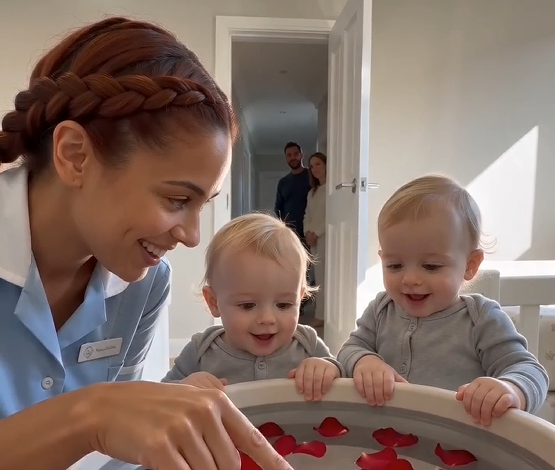
Grant had built the nursery around prevention. Rounded corners, muted colors, locked cabinets, an air purifier that hummed softly through every nap, and a calendar that promised no one would be surprised by anything.
Yet the first thing he saw when he entered was not danger. It was Noah’s wet palm resting in Mara’s open hand while a rose petal floated between them, and Eli watching the petal as though it had told him a secret.Vivienne stepped over the threshold in her narrow heels and looked at the water spreading in a thin crescent beneath the bowl. “Mara, clean this up now,” she said. “And please do not teach them that the rules disappear when they refuse to cooperate.”
Mara did not look at Grant for rescue. She looked at the boys, who had gone motionless again, and lowered her voice. “I can clean it after they finish. They’re being careful.”
“They are not being careful,” Vivienne said. “They are being indulged.”
Grant almost agreed from habit. A mess was a variable; variables made his plans fail. But Eli’s fist was closed around a petal, not his own shirt, and Noah was still standing instead of folded in the corner with the silk scarf.
“Five minutes,” Grant said.
Vivienne turned on him. “For rose petals?”
“For the children,” he answered, though the sentence felt unfamiliar in his mouth.
Mara placed two petals at the far end of the table and tapped twice beside them. Eli stared at her fingers. After a long minute, he set his petal down and tapped once.
Mara waited.
He tapped once more.
Noah made a small hum, a sound that seemed to surprise him as much as it surprised everyone else. He looked at his brother, then reached into the bowl and sent a petal sliding toward him over the water.
Grant had a dozen cameras in the house, but none of their recordings had ever felt like proof of anything worth saving. He took out his phone, then stopped before he could press record. He did not want their first sounds turned into a file before they had a chance to become real.
Vivienne left the room without another word.
That evening, Grant opened the care dashboard and found it useless. It had places for appetite, sleeping, outbursts, and completed activities. It had no field for Eli tapping an answer. It had no way to record that Noah had hidden behind Mara rather than running from every adult in the house.
He added a note anyway: petals, water, two taps, hum.
Mara found him outside the nursery after the twins were asleep. She carried the bowl, now rinsed clean, and a small paper envelope filled with dry petals.
“You don’t have to keep them,” Grant said.
“I know,” she replied. “But they might ask for them tomorrow.”
Grant looked toward the closed door. “They don’t ask.”
Mara did not correct him sharply. “Not with words yet. But they do ask. Noah asks by bringing the scarf to the kitchen and waiting beside the chair. Eli asks by standing near a door and looking at the handle. People have been answering the behavior with instructions instead of answering what they’re trying to say.”
It irritated him because it was precise.
He told her the twins had specialists, routines, and every possible support. Mara nodded as if those things could all be true and still not be enough. “I am not here to fix them,” she said. “I am here to notice them.”
The next morning, Vivienne arrived with a styling tray full of matching pajamas for the photographer. She wanted the twins awake, clean, and seated together beneath the nursery window by ten.
At nine-forty, Noah took the paper envelope from Mara’s bag and held it against his chest. Eli walked to the low table and touched the empty bowl.
Mara put the bowl down and added water from a pitcher. She did not say a word.
Vivienne watched from the doorway, her expression tightening. “The photographer will be here in twenty minutes.”
Mara let the boys sprinkle petals onto the water. Noah smiled first.
It was not a broad, posed smile. One side of his mouth lifted when a yellow petal spun in a tiny circle, and then his whole face changed because he had forgotten to stop it.
Eli saw his brother’s face and made the breathy sound again. This time it had a shape: “Ah.”
The photographer, arriving with her equipment case, heard it from the hall. So did Grant, who had been reviewing slides for a board call in his office. He came down fast enough to leave his presentation open on the screen.
Vivienne moved toward the boys. “Sit up, both of you. This is lovely. We can use this.”
The smile vanished from Noah’s face.
Mara stepped between the table and the camera without touching either child. “Not today,” she said quietly. “They don’t have to make it for anyone.”
Vivienne’s eyes flashed. “Excuse me?”
Grant reached the doorway in time to see Eli pull the bowl closer to Mara, not to Vivienne. Then Eli looked at his father and tapped twice against the rim.
Grant did not know what the taps meant, but he knew they were not nothing.
He told the photographer they would not be taking pictures. Vivienne said he was overreacting to an accident of timing. The photographer, embarrassed and kind enough not to linger, packed her case and left.
When the front door shut, Vivienne faced Grant in the library. “You are letting an employee undermine me in my own home.”
Grant’s instinct was to argue about employment boundaries, credentials, and protocols. But he could still see Noah’s smile disappear when Vivienne had turned it into a scene.
“It is their home,” he said.
The words landed harder than he intended.
Vivienne stared at him. “I have spent two years trying to make this family presentable after everything that happened. I have made space for them.”
“You made space around them,” Grant said. “That isn’t the same thing.”
For the first time, he did not offer a schedule as a compromise.
Dr. Patel came that afternoon for a routine visit Grant had nearly postponed. Grant wanted confirmation before he trusted his own response. He told himself that was caution, though Mara could see it was fear: if the boys’ change was only a moment, he would have to return to the old machinery.
The doctor sat on the nursery floor instead of using the chair Mara offered. Noah held the envelope of petals. Eli stood against the table, one hand on its edge, studying Dr. Patel’s face.
“I heard there was a new game,” Dr. Patel said.
Mara filled the bowl with water and set three petals beside it. She began with the same simple motion, floating one petal and tapping the table twice. Noah picked up another and pushed it across the water with one finger.
Eli tapped back.
Dr. Patel did not announce anything. She only watched until Eli picked up a petal, held it to his lips, and released a tiny puff of air that sent it skimming over the surface.
“Puh,” he said.
Grant’s hand went to the wall.
Mara smiled but did not crowd him with praise. She made the sound once, softly, as if giving it back to him. Eli looked at the petal, then at her.
“Pet,” he whispered.
Noah laughed.
It was a thin, rusty laugh at first, but it was laughter. He slapped both hands on the table, water jumped onto his sleeves, and he laughed again because Eli had spoken and because his brother’s startled face was funny.
Dr. Patel let the moment belong to them before she spoke to Grant in the hall. “This is not a performance and it is not a cure,” she said. “It is communication. Mara is giving them room to lead, and they are showing you what they can do when no one turns them into a problem to display.”
Grant nodded too quickly. He needed something more measurable, some guarantee he could put in a calendar. Dr. Patel gave him none.
“You can protect the conditions that allowed it,” she said. “That part is your job.”
That sentence changed the power in the house.
Grant canceled the photographer’s rescheduled visit. He removed the nursery’s recording feed from Vivienne’s tablet and set a rule that no guest could enter the room without asking Mara or the boys first. He expected Vivienne to call it dramatic.
She called it humiliating.
At dinner, she sat across from him at the long table while the twins ate upstairs with Mara. “You are letting a girl with mud on her boots rewrite every decision we make,” Vivienne said.
Grant looked at the untouched place setting beside him where the twins had once been positioned for holidays. “No,” he said. “I am seeing that our decisions were built around what looked easy from outside.”
Vivienne pushed her chair back. “And what happens when she leaves? Are you going to throw petals forever?”
The question stayed with him because he had no answer.
Mara’s work did not become a miracle. Some mornings Eli would not leave his bed. Some evenings Noah clutched the scarf until his face went tight and refused the bath. But Mara did not turn their hard days into failures.
She brought ordinary life into the spaces that had been reserved for management. She let Noah carry clean washcloths from the laundry basket to the nursery shelves. She let Eli drop socks into pairs and celebrate when he found two that matched. She opened the back door so they could watch rain bend the garden stems and gather fallen petals into a jar after the storm passed.
At lunch, Mara spread a towel on the kitchen floor when neither boy would sit in a chair. She gave them warm toast cut into small triangles and a bowl of berries to wash, even when Vivienne complained that fruit did not belong near the cabinets.
Noah began bringing Mara a berry before eating one himself.
Eli started saying single pieces of the world: “red,” for a strawberry; “wet,” for Noah’s sleeves; “more,” when the petal envelope was empty.
Grant watched from the kitchen doorway one afternoon as Mara guided the twins through folding dish towels. He almost told her that the housekeeper could do that. Then he saw Eli press a towel flat with both palms and look toward his father.
“Dad,” Eli said.
It was not loud. It was not polished. It was the first word he had directed at Grant since before the loss.
Grant stood there with his work phone vibrating in his pocket and no prepared response. He knelt on the tile, carefully enough that he did not startle either boy.
“I’m here,” he said.
Eli handed him one corner of the towel.
Grant held it. Together, without knowing how to fold it properly, they made a crooked square. Noah laughed at the result and piled another towel in Grant’s lap.
Mara turned away toward the sink, giving them privacy without making the moment important enough to scare it away.
Vivienne saw them from the breakfast room. Later, she told Grant that the children were becoming dependent on Mara and that he was confusing novelty with progress.
“She will have a life outside this house,” Vivienne said. “You cannot make her the center of yours.”
Grant heard the warning in a way he had not before. Vivienne was not worried about the twins needing Mara. She was worried that the home she had planned would no longer orbit around Vivienne’s version of it.
He did not ask Mara to promise she would stay. Instead, he began changing what he had control over. He shortened his evening calls. He ate breakfast in the kitchen rather than at the formal table. He learned which drawer held the twins’ cups and which towel Noah wanted beside the bath.
He made mistakes. Once he tried to hurry bedtime because an investor was waiting on a call, and Eli went silent again, body stiff under his blanket.
Mara did not shame Grant. She placed the dry petal envelope beside Eli’s pillow, dimmed the nursery lights, and sat on the floor near the bed. “We can wait,” she told Eli.
Grant looked at the clock, then at his son.
He sent the investor a message that the call would have to wait.
Noah climbed onto the bed with the scarf bunched under his chin. Mara began a slow game, setting one petal from the envelope on the blanket and letting the boys blow it toward the foot of the bed. Eli’s first breath barely moved it.
Grant did not take over. He lay on the rug beside the bed and waited for the next breath.
“Again,” Eli said.
The anniversary of their mother’s death had always been the worst day in the house. Vivienne called it a day of careful presentation. She ordered pale flowers, arranged a quiet dinner, and told Grant the boys should wear navy because it photographed respectfully.
The year before, the twins had spent the day in separate rooms after crying whenever anyone brought flowers near them.
Three days before the date, Grant found Mara in the garden with the boys. They were collecting fallen petals in a glass jar, not the expensive flowers Vivienne had ordered, but the loose ones that had dropped naturally after rain.
“I thought we could make a little water table in the nursery,” Mara said. “No speeches. No pictures. Just something they recognize.”
Grant wanted to ask whether that was wise. He wanted a professional opinion, a risk assessment, a plan with contingencies.
Then Noah held up a petal and said, “Mama’s red.”
Mara did not tell him he was wrong or ask him to explain. She simply said, “This one is red.”
Eli touched the jar and whispered, “For Mama.”
Grant had to turn away for a moment.
Vivienne objected as soon as she heard. “That date needs dignity,” she said. “You cannot turn it into a craft project in the nursery.”
Grant looked at the boys through the glass door. They were shoulder to shoulder on the grass, each holding a petal as gently as a coin.
“It is not for us to stage,” he said.
Vivienne’s face hardened. “I have given up enough space in this relationship to a memory. Now I am supposed to give it up to her too?”
There it was, plain at last. Not concern for the children. Not order. A demand that grief be made small enough to fit the life she wanted.
Grant did not raise his voice. “You are asking them to make their mother disappear so you can be comfortable. I won’t ask that again.”
Vivienne left the house that evening with two suitcases and the framed photographs she had chosen for the formal rooms. Grant did not stop her. Her outcome came from the choice she kept making: image over the boys standing in front of her.
The anniversary arrived gray and wet. No photographer came. No guests came. Grant shut his office door before breakfast and left his phone in a drawer.
In the nursery, Mara covered the low table with old towels. The twins filled a shallow bowl with water, then opened the jar of petals they had gathered themselves. Grant sat on the floor nearby, not directing the ritual, only present for it.
Noah placed a red petal on the water and watched it drift. “Mama,” he said.
Eli placed another beside it. “Mama loves rain,” he whispered.
Grant’s face folded before he could stop it. The boys saw him cry, and neither of them was asked to comfort him or pretend not to notice. Mara stayed quiet, close enough to help, far enough away to leave the family room to be what it was.
After a while, Eli gathered a handful of petals. He looked at Noah, then at Grant.
“Up,” he said.
Grant opened both hands.
The twins tossed the petals into the air together. They fell over the wet table, the towels, Grant’s hair, and Mara’s shoulder. Noah laughed first, and Eli followed him with a clear, surprised laugh that filled the nursery without asking anyone’s permission.
That night, the boys did not fall asleep alone behind a monitor. Mara read them a short story while Grant folded laundry at the foot of the bed, badly but earnestly. Noah placed the silk scarf beside his pillow instead of gripping it. Eli saved one dry red petal in the paper envelope.
When Mara stood to leave the room, Eli caught the edge of her sleeve. “Stay for toast tomorrow,” he said.
Grant met Mara’s eyes over the boys’ beds. There was no grand request, no promise that erased the difference between her life and his. There was only a family that had learned not to make love into a job someone else performed.
Mara stayed for toast the next morning, then for the garden and the laundry and the bedtime story. Over time, she stayed because Grant made room for her voice in the home, because the twins reached for her without fear, and because the work of becoming a family was no longer hers alone.
At breakfast, four mismatched chairs crowded the kitchen table. Noah floated a petal in his cup of water while Eli carefully divided toast into four uneven pieces. Grant accepted the smallest piece without correcting him, and Mara tucked the old paper envelope into the center drawer, ready for the next ordinary day.