THE BOY THEY KEPT HIDING UPSTAIRS WALKED TO THE FRIDGE AND CHOSE HER IN FRONT OF THE WHOLE FAMILY

It was not a lullaby, not exactly.
Just a simple tune with a kitchen rhythm to it, like someone folding laundry or washing dishes and refusing to let the room go dead.
The next morning, Emma asked for five minutes in the kitchen.
Vanessa said no.
Michael, without looking up from his espresso, said yes.
Vanessa turned toward him. “Michael, your parents arrive in three days. This is not the moment to let staff experiment.”
He almost answered the way he always did, with a smooth compromise that solved nothing. But then he remembered his son’s weight leaning willingly into another human being.
“Five minutes,” he repeated.
Emma didn’t celebrate. She just took Leo downstairs at the same hour as the day before.
Same light through the windows. Same place on the warm tile. Same low voice.
“Let’s see what color forgot to hide today.”
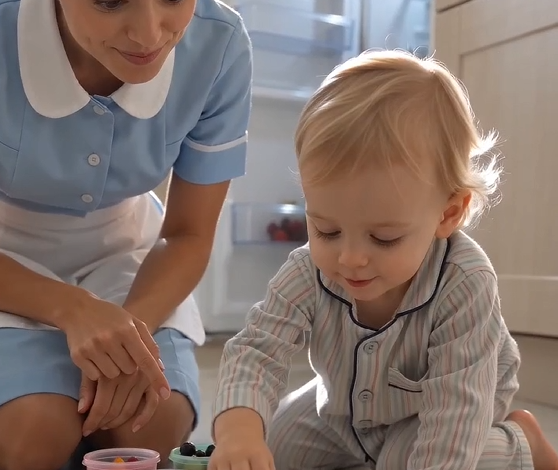
Leo didn’t come close right away. That mattered. Emma didn’t rush to improve the scene. She opened the fridge. Took out yellow. Red. Green. Waited. Named what she saw. Nothing more.
On the third morning, he pointed sooner.
On the fourth, he touched the cold yogurt lid before pulling back.
On the fifth, he picked the red strawberries himself and set them near Emma’s knee.
Every day followed the same small shape. Kitchen. Fridge light. Color hunt. A fruit or pudding cup. Emma’s soft narration. No forced eye contact. No praise explosions. No crowded hands.
A life rhythm, not a performance.
That was the thing Michael had never understood.
He had mistaken intensity for care.
He had outsourced every hard feeling to the best-paid adult in the room and called that responsibility. He had built safety out of gates, schedules, specialists, and privacy, while Leo needed something lower and warmer: a pattern he could predict with his body.
Emma had not tried to drag him back into the world.
She had made a tiny world he could safely enter.
And because children always expose the lie adults are living inside, the change in Leo began to threaten more than the routine.
It threatened Vanessa.
At first, her complaints stayed polished.
The kitchen floor was unsanitary.
The open fridge wasted energy.
The child was becoming dependent on one person.
The staff needed clarity.
But beneath every complaint was the real fear: Leo now watched for Emma. And Michael had begun watching Emma too, not with romance, but with the raw attention of a father realizing someone else had done the most human thing in his house.
Vanessa had spent months positioning herself as the person who could restore elegance after loss. She planned meals. Managed visits. selected flowers. Softened awkward silences when Michael’s parents called. She believed order would eventually become healing if she enforced it hard enough.
Then a twenty-two-year-old with grocery-store instincts and no polished pedigree sat on the floor and proved otherwise.
The first direct clash came when Vanessa found Leo waiting at the nursery door ten minutes before kitchen time.
That alone was shocking. He used to hide from transitions. Now he was anticipating one.
“We’re doing music therapy instead,” Vanessa said brightly.
Leo’s face changed at once.
His shoulders rose. His mouth flattened. When she reached for his hand, he smacked her arm and stumbled backward until he hit the wall.
Emma, arriving at the end of the hall, stopped there.
She didn’t rush in.
She didn’t plead.
She simply crouched and said, “Blue might be gone if we’re late.”
Leo’s head turned.
Vanessa stared at her. “Don’t undermine me.”
Emma kept her eyes on the child. “I’m not talking to you.”
It was such an ordinary sentence, but in that house it landed like glass breaking.
Michael heard the commotion and came upstairs just in time to see Leo make his choice.
Not a dramatic movie choice. Not a speech.
He pushed off the wall, took two uneven steps past Vanessa, and went straight to Emma. Then he pressed himself into her middle, hard, almost desperate, as if her body was the only part of the day he trusted would stay where it belonged.
Vanessa went pale.
Michael felt something in himself give way.
That night he told Vanessa they would keep Emma’s routine.
Vanessa asked whether he understood what people would think if his parents came all the way from Boston and found their grandson crawling around a kitchen floor with pudding cups like a toddler.
Michael’s answer came out colder than he intended. “People already think my son is hidden because he can’t be handled. I am done organizing this house around appearances.”
She looked at him for a long time. “This isn’t just about Leo.”
He didn’t deny it.
Because it wasn’t.
It was about the fact that after his wife’s death, he had turned fatherhood into administration. He had kept the estate running, the investments stable, the press away, the rooms immaculate. And every day his son had disappeared further upstairs.
The grandparents arrived on a gray Saturday afternoon, bringing polished luggage, careful sympathy, and the old family instinct to pretend difficult things could be improved by behaving correctly around them.
Leo had always been removed before visits. Staff would mention he was resting. His grandparents would nod, grieved but relieved not to witness the truth.
Vanessa expected the same arrangement.
By noon, she had already instructed a maid to prepare the upstairs playroom.
Emma found out because Leo saw the tray being carried up and started to fold in on himself, one hand hitting at his own knee in a small panicked rhythm.
Michael saw it too.
And this time, he finally chose in real time.
“No,” he said.
The maid stopped.
Vanessa turned. “Michael, not today.”
“Especially today.”
His parents arrived an hour later to the sight of tension set like crystal across the house. His mother kissed his cheek and immediately searched his face for damage. His father glanced around the great room as if quiet wealth itself could explain why the child was missing.
Only this time, Leo was not upstairs.
He was in the kitchen doorway, half-hidden behind Emma’s leg.
His grandmother’s face crumpled at the sight of him. Not because he looked wild. Because he looked guarded. Tiny. Overcareful. Like a child who had learned that adults brought weather with them.
“Hello, sweetheart,” she whispered.
Leo flinched and drew back.
Vanessa stepped in fast. “He’s overwhelmed. We should take him up and let him settle.”
Leo’s fingers clenched in Emma’s pants.
Emma lowered herself to his height. “Should we check if blue survived the visitors?”
He looked toward the fridge.
Then, for the first time anyone in that family could remember since the funeral, he made a sound that was clearly meant for another person.
“Blue,” he said.
Small. Rough. But real.
The room stopped.
Michael’s mother covered her mouth.
His father took off his glasses, blinking hard.
Vanessa stood frozen, as if the child had betrayed a script she had spent months defending.
Emma did not turn the moment into a celebration. She only nodded once, like he had said the most practical thing in the world. “Let’s see.”
She walked to the fridge with Leo tucked to her side. This time Michael followed.
Not as the owner of the house. Not as the man observing a technique.
As the father who had finally understood he was supposed to be inside the moment.
Emma opened the fridge.
“Yellow’s here,” she said.
Leo touched the pudding cup.
“Red,” Emma said.
He glanced at the strawberries.
“Green.”
He found the apple slices.
Then he stopped and looked up, not at Emma.
At Michael.
It was a direct look. Fragile, but unmistakable.
Emma’s voice stayed easy. “We still need blue.”
Michael stared at the crowded top shelf like it contained a language he had never learned. For years he had signed checks, approved treatment plans, and told himself he was helping. But finding one blueberry cup in his own refrigerator while his son waited for him felt harder than any boardroom negotiation of his life.
He moved things aside too fast at first. Bottles clicked. A jar tipped. Emma said nothing.
Leo didn’t panic. He watched.
Michael slowed down.
There, tucked behind a carton of eggs, sat the blue cup.
He pulled it out and held it up.
Leo’s mouth opened in the smallest stunned smile.
Then the boy did the impossible twice.
First, he stepped away from Emma.
Second, he crossed that tiny space and pressed the side of his body against his father.
Michael dropped to his knees so fast the blueberry cup nearly slipped from his hand. Leo took the cup, then reached back with his free hand for Emma, pulling her closer too.
It was not a choice between them.
That was the lesson.
The child had not been waiting for one perfect replacement adult.
He had been waiting for the adults around him to stop making connection compete with control.
Michael broke then, not loudly, not theatrically. Just one sharp inhale, one hand over his eyes, while his son stood between his knees holding blue and keeping Emma within reach.
His mother turned away crying.
His father put a hand on the counter because he seemed to need support.
Vanessa said, very softly, “This is ridiculous.”
Michael looked up at her with a calm she had never seen from him. “No. Hiding him was ridiculous.”
No one argued after that.
The afternoon did not become magically easy. Leo still startled when his grandparents moved too quickly. He still retreated behind Emma when the room got too loud. But nobody took him upstairs. Nobody erased him to preserve comfort. When he needed space, the adults made space around him instead of removing him from it.
Later, in the quiet that followed dinner, Michael found Emma rinsing fruit containers at the sink.
The kitchen still held traces of their ritual: one spoon on the counter, a damp ring from a pudding cup, the fridge stocked now with more colors than any luxury household had ever intentionally displayed.
“I owe you more than a thank-you,” he said.
Emma shook her head. “He did the hard part. He just needed the day to stop lying to him.”
Michael stood with that sentence.
It was brutal in its accuracy.
He asked about her plans, and for the first time she gave him more than practical answers. She wanted training. Real education. Early childhood development, maybe pediatric care later. She had never said it out loud in that house because wanting something for herself felt too large compared to everyone else’s grief.
Michael made the decision before his old instincts could complicate it.
He set up a scholarship in Emma’s name through one of his family foundations, enough to cover tuition, books, and living expenses for a degree program. He added paid professional training immediately, so she could keep working without being trapped by gratitude. When she protested, he told her this was not charity.
“You gave my son a bridge back to us,” he said. “I’m not going to pretend that should leave you where you started.”
The changes in the house became visible after that.
Not perfect. Real.
The upstairs hiding routine ended for good.
The kitchen remained a family space, not a showroom. A lower fridge drawer was stocked every week with bright fruit cups, puddings, yogurt, berries, apple slices, and whatever small edible colors Leo had learned to trust.
Michael blocked off the first parent-child hour every Sunday morning and protected it like any board meeting he had ever considered important. No staff substitutions. No social calls. No Vanessa-designed itinerary. Just him and Leo in the kitchen, learning how to start with yellow, red, green, and wait for blue.
At first, Emma stayed nearby, enough for Leo to feel the outline of safety.
Then gradually, because healing was never about making himself dependent on her forever, she stepped back inch by inch.
Sometimes Michael got it wrong. He moved too quickly. Asked too much. Filled silence because it scared him.
But now Leo had a way to show him. He would stop. Point. Wait by the fridge. And Michael learned to begin again where his son could meet him.
Vanessa lasted three more weeks.
She could tolerate grief. She could not tolerate losing influence to something so humble and undeniable. In the end, she called the new routine provincial, unhealthy, and beneath the standards of the house.
Michael, who once would have negotiated around everyone’s discomfort, simply told her the standards of the house had changed.
When she left, the rooms did not get colder.
They got louder.
Not with chaos. With life.
Cabinet doors opened. Water ran. Music played low in the mornings. Leo began appearing downstairs before being summoned. Sometimes he still swatted hands away. Sometimes he froze at sudden arrivals. Trauma did not vanish because one ritual worked.
But now there was a path back.
Weeks later, on a clear morning with snow still sitting on the far ridge, Emma sat at the kitchen table reviewing college program materials Michael’s office had printed for her. Leo climbed into her lap without asking and leaned there while she turned the pages.
When Michael came in, briefcase in hand, Leo looked up and pointed to the fridge.
Michael set the briefcase down.
“Starting without me?” he asked.
Leo, still sparing with words, patted the spot beside him.
Then he said, “Blue last.”
Emma looked at Michael.
Michael looked at his son.
For all the money he had spent trying to rescue that child, the real change had begun with a girl on the kitchen floor, a cold light from an open refrigerator, and the radical choice to stop treating connection like something embarrassing.
He came over, crouched beside them, and waited for Leo to lead.
This time the boy smiled before the game even started.