WHEN THE NANNY LET THE HEIR OF A PENTHOUSE STEP INTO MUD, EVERYONE SAID SHE’D LOST HER MIND UNTIL THE BOY FINALLY PUT HIS FEET ON THE GROUND

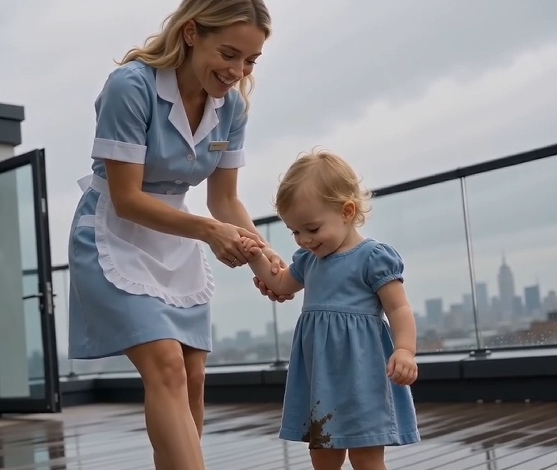
Henry’s voice cracked across the terrace so sharply that Owen jerked.
The boy’s knees folded at once. He reached up in panic, sobbing for someone to pick him up, his muddy feet slipping. Henry lunged forward on instinct, scooped him into his arms, and the moment was gone. Owen buried his face in his father’s shoulder and pulled both legs tight against his chest again.Elena stayed crouched in the mud, breathing hard, one hand still pressed to the ground.
The silence after that felt ugly.
Henry looked from his son’s trembling body to Elena’s bare feet and muddy jeans. “This is a child, not an experiment.”
Elena stood slowly. “I know.”
“You had him outside, barefoot, in filthy water.”
“It isn’t the mud,” she said quietly. “It’s the rhythm. He was choosing before you stopped him.”
Henry hated that sentence because some part of him knew she was right.
He handed Owen to the house manager, who had rushed in at the commotion with a towel already unfolded like the penthouse itself had arrived to wipe the scene away. Owen clung, crying harder now, and the manager shot Elena a look that said exactly what everyone in that home was thinking: this was what happened when people without training forgot their place.
Henry ended the terrace scene the way he ended most things in his house. With control.
The mud was washed away that evening. The terrace was closed. Elena was told that outdoor play required prior approval. And Owen was put back on the clean schedule that had never once helped him.
The next morning, breakfast looked beautiful enough for a magazine. Cut fruit in neat rows. Warm mini pancakes under silver covers. Fresh flowers. Sun pouring over the skyline.
Owen would not let his feet touch the chair rung.
He sat sideways in the house manager’s lap, exhausted from crying, refusing to eat. Henry stood by the counter in a pressed shirt, checking his watch between emails while a feeding specialist on speaker suggested “firm consistency.”
The word consistency made Elena almost laugh.
Because what that house called consistency was changing adults, changing methods, changing instructions, changing pressure, all wrapped inside expensive routines. The only thing that stayed steady was Owen’s fear.
She didn’t argue. She just sat on the floor several feet away with a wooden spoon and tapped it against a mixing bowl.
Tap-tap. Pause. Tap-tap. Pause.
Owen’s sobs thinned.
The house manager stiffened. “Please don’t start that again.”
Elena kept the same pace.
Owen turned his head.
She tapped again, then pressed her palm flat against the kitchen tile the way she’d pressed it into the mud. After a few seconds, the boy slowly opened one fist and placed his own hand against the table edge.
Not much. But deliberate.
Henry noticed.
That was how it kept going over the next several days. Not as a miracle. As repetition.
Elena never rushed him. She didn’t talk to him like a project. She built a little pattern around him and waited for him to come into it.
At the terrace doors in the morning, she would tap the glass frame twice, pause, tap twice again. At snack time, she tapped the spoon against the bowl before offering food. When she helped with socks, she pressed one hand to the floor first, then his calf, then waited. If he cried when lowered, she didn’t force his feet down. She breathed with him, matched his panic, then slowed her own body until his followed.
Tap-tap. Pause. Tap-tap. Pause.
By the fourth day of that rhythm, Owen let one foot brush the rug for half a second.
By the sixth, he let both feet touch Elena’s sneakers while she sat cross-legged on the floor.
By the eighth, he did something so small that anyone outside that house would have missed it.
He leaned away from being carried.
Not far. Not bravely. But on purpose.
Henry saw that too.
He had started coming home early without telling anyone. At first he told himself he was monitoring the new nanny because what she did looked unprofessional. The truth was uglier. He had begun to suspect that the person who understood his son best was the one person in the penthouse who had never tried to impress him.
He watched from doorways.
He watched Elena ignore the formal dining room rule one rainy afternoon when Owen got restless and started crying at the threshold. Instead of carrying him away, she sat with him on the floor just outside that forbidden room. The glossy stone table stood inside like a shrine to adults who didn’t live there. Elena took a napkin from the sideboard, folded it, smoothed it flat, and tapped it with two fingers.
Tap-tap. Pause.
Owen stared into the room.
His mother had gotten sick in that season of the house, before the hospital bed, before the nurses, before everything went quiet. She used to sit at that dining table because it was near the windows. Staff brought trays. Doctors called there. Henry had taken meetings there with one hand over spreadsheets while his wife smiled too hard and said she was fine.
Nobody had said any of that out loud.
But children lived inside what adults refused to name.
Elena figured it out because she noticed when Owen looked at that room, his whole body went rigid before his feet even came near the floor.
She didn’t drag him in. She didn’t cheer him up. She made the edge of the room survivable.
Tap-tap. Pause.
He began to breathe with her.
That evening Henry asked her, “Why the dining room?”
She answered without drama. “Because everyone acts like it’s too important to be touched.”
Henry looked through the glass doors at the untouched table settings. “It is important.”
She met his eyes. “More important than your son?”
He had no answer ready. Money had always given him fast answers. That question didn’t.
A week later came the early childhood observation class.
It was the kind of thing rich parents in that building signed up for because every child was expected to be assessed, enriched, and quietly compared. Private instructor. soft play setup. polished wood room. Little stations with balance beams, blocks, textured mats, and parent chairs arranged along the wall.
Henry had been avoiding it for months because Owen couldn’t even stand. But the specialist insisted they needed to “observe baseline function in a peer setting.” So Henry booked the private slot and brought Elena along because he no longer trusted anyone else’s read on his son.
Owen arrived already clinging, knees locked against Henry’s waist.
The instructor, smiling too brightly, suggested they begin with a gentle floor transition. Henry shifted Owen forward. Owen screamed at once and climbed higher, shaking so hard he nearly choked.
The instructor murmured about regulation tools. Another aide brought out beanbags. Someone dimmed lights. The room filled with helpful, polished failure.
Then a metal cart rattled in the hallway outside the studio door.
A sudden sharp crash followed when something fell.
The sound hit Owen like a bolt of electricity. He flinched, twisted violently, and for one second Henry lost his grip. Owen slid downward, half suspended, one sneaker scraping the floor.
That was the trigger.
Terror flooded the room. The instructor moved in. Henry grabbed harder. Voices layered over each other. “It’s okay.” “Lift him.” “Don’t let him fall.”
And Elena said the only useful thing anyone said.
“Wait.”
Her voice was low, but Henry heard it.
She was already kneeling on the floor.
Not on the soft mat the class had prepared. On the plain tile near the door, where a custodian’s wet umbrella had left a small muddy smear from outside.
In that polished room, it looked almost obscene.
Elena put both palms down near the muddy water mark and gave Owen the same rhythm.
Tap-tap. Pause. Tap-tap. Pause.
No lecture. No command. No panic.
Just the beat he knew.
Owen’s crying changed first. It broke from blind screaming into ragged breaths that were actually listening. His eyes found her hands. Then the mud. Then her face.
Henry was still holding him, but less tightly now.
Elena pressed her palm into the smear and lifted it, leaving a faint handprint on the tile. She made another beside it.
“One for me,” she said softly.
Tap-tap. Pause.
Then she placed her hand flat and waited.
The instructor looked appalled. Henry barely heard her say something about sanitation.
Because Owen was moving.
Very slowly, the boy uncurled one leg.
His sneaker lowered until the toe touched the tile.
He whimpered, froze, and looked like he might bolt back up.
Elena didn’t praise him. Didn’t rush the moment. She just tapped the floor twice beside the little muddy print.
Tap-tap. Pause.
Owen swallowed.
Then, in front of all of them, he put his whole foot down.
Henry’s face changed.
He had seen specialists produce reports, charts, plans, diagnoses, recommendations, invoices. He had never seen his son choose the ground.
Owen was trembling so hard Henry could feel it through his own arms. Then came the second impossible thing.
The boy stretched one hand toward Elena’s muddy print. Missed. Tried again. Touched it.
And then he turned, not to Elena, but to Henry.
He reached for his father’s wrist and pulled.
Not up.
Down.
The room went dead silent.
Henry stared at his son, not understanding at first. Owen made a small sound through his tears, not even a full word, just a desperate little breath of insistence, and tugged again toward the floor.
He was asking his father to join.
Elena looked up at Henry with wet eyes and said, “Last step.”
That broke him.
All the distance he’d called productivity. All the grief he’d hidden inside schedules. All the hours he’d outsourced because standing near his son’s pain felt like failing his dead wife twice. It all cracked in one second in a room where a tiny muddy handprint on a tile mattered more than every polished system he had built.
Henry went down to his knees in his expensive trousers.
Then, because his son was still pulling, he put one hand into the muddy smear too.
A ridiculous thing for a man like him. A tiny thing. A world-changing thing.
Owen stared at his father’s hand on the floor.
Then he lowered his second foot.
For the first time since his mother died, he stood with both feet on the ground while touching something with his father.
Not alone. Not abandoned. Not forced.
Connected.
Henry made a sound that was almost a laugh and almost a sob. He reached to grab Owen out of reflex, but Elena shook her head once.
So Henry stayed low. Stayed still. Stayed with him.
Owen shifted his weight. One second. Two. Three.
Then he leaned forward and placed his small muddy palm over Henry’s hand.
The instructor quietly stepped back. The aide looked away to hide tears. Nobody in that room mistook it for misbehavior anymore.
It was a child finding a safe place to stand.
The ride home was different.
Owen still needed to be carried part of the time. He still cried when transitions came too fast. He still curled his legs up at random moments. Nothing about him became magically easy.
But when they entered the penthouse, he didn’t bury his face in Henry’s shoulder the whole way.
He looked toward the terrace doors.
Elena saw it first.
So that afternoon, with Henry watching and no one else allowed to interrupt, they reopened the muddy corner after watering the planter boxes. Elena stepped in first. Then she waited.
Owen held Henry’s hand. Tapped his father’s wrist twice with one finger. Pause. Tapped twice again.
Henry looked at Elena.
She nodded. “He wants the rhythm from you.”
That landed harder than any accusation ever could.
Because it meant Owen had not simply attached to the nanny. He had built a bridge and was trying to pull his father across it.
Henry stepped barefoot into the mud.
Cold dirt squeezed between his toes. In any other season of his life he would have hated it. Owen stared at him, breath held, then slowly lowered one foot, then the other, standing on the mud while clutching Henry’s hand.
He cried. He stayed. He did not ask to be picked up.
By the end of that week, Henry canceled two evening standing calls and moved them permanently.
By the end of the next week, he blocked a fixed hour every morning and another on Saturdays labeled only with one word on his calendar: Owen.
Not therapy. Not observation. Not developmental support.
Owen.
He stopped cycling strangers through the nursery. He kept Elena, but not as a substitute parent carrying the whole emotional load. He asked her to help him learn the rhythm instead. She agreed on one condition: if he was home, he had to show up.
No hiding in the study. No watching from the doorway with his phone. No handing the hard part to someone else.
He said yes.
The formal dining room changed too.
One afternoon Henry walked in to find paper spread under one end of the stone table and Owen pressing washable paint handprints beside muddy ones Elena had helped transfer from the terrace. Months earlier the staff would have panicked. This time Henry pulled out a chair, sat down on the floor instead, and asked for a turn.
The rule died there.
The room that had been kept for guests became part of the family’s life again. Not ruined. Used.
And once the adults stopped treating order like a religion, Owen kept moving.
Not instantly, not beautifully, but truly.
First two steps between Elena and Henry on a rug. Then three from couch to coffee table. Then a bare-foot shuffle onto the terrace by himself when it rained. Then one morning, half asleep and clutching his blanket, he walked straight into the kitchen because he heard the spoon tapping the bowl.
Tap-tap. Pause. Tap-tap. Pause.
He still had bad days. Loud noises still startled him. He still asked to be carried when overwhelmed. Grief did not leave the penthouse just because muddy footprints finally touched the floor.
But the old lie did.
The lie that enough money could spare a father from being needed. The lie that clean rooms and professional language meant a child felt safe. The lie that protecting a home’s image mattered more than letting a broken child touch life again.
Months later, during another observation session, the instructor wrote that Owen showed “marked improvement in independent ground tolerance and parent-linked mobility.” Henry almost laughed reading it.
Such careful words for what had actually happened.
His son had needed someone to stop making the world so polished that it felt untouchable. He had needed rhythm. Mess. Predictability. A hand on the floor waiting for him. And a father willing to get down there too.
By then, Saturdays had their own ritual.
Henry, Owen, and Elena went to the terrace garden after breakfast. Not every time to make a mud pit. Sometimes just to water herbs, press handprints into damp soil, or tap patterns on planter boxes before stepping onto the stone.
The sixth parent-child time of every week belonged to Henry alone. No staff rotation. No substitute. Elena stayed close at first, then farther back as he learned how to read Owen’s breathing, when to wait, when to crouch, when to tap the beat instead of rushing to rescue.
That was the real ending.
Not that Elena saved the boy and became everything.
That she refused to.
She gave Owen a way back to the ground, then forced Henry to meet him there.
One rainy morning, long after the worst of it, Owen stood at the terrace door in his socks and looked over his shoulder at his father.
Then he tapped the glass with two fingers.
Tap-tap. Pause. Tap-tap. Pause.
Henry put down his phone immediately.
When he came over, Owen lifted both arms for balance, planted his feet, and walked the last three steps toward the door on his own.
Not toward the nanny.
Toward his father.