THE DAY A LAUNDRY BASKET IN A MANSION POOL MADE A SILENT BOY SPEAK

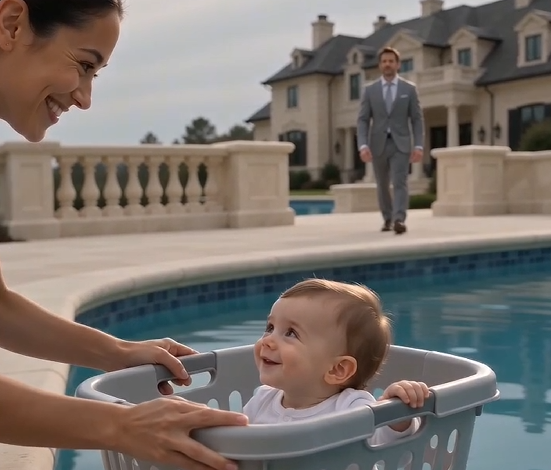
William had seen Caleb cling before, but only in panic.
This was different.The boy reached for Maya with intention, one hand still gripping the basket, the other grabbing the sleeve of her shirt as Celeste’s heels clicked closer across the stone.
Celeste stopped at the pool and looked disgusted.
“He is sitting in laundry,” she said. “In front of staff.”
Maya kept her hand on the basket. “He was tracking the movement.”
“He is not a science project.”
“No,” Maya said. “He’s a child.”
That should have made William step in. Usually he restored order fast, signed off on whatever system someone else built, and moved to the next thing. He had become very good at paying for solutions and very bad at staying in the room long enough to see if they were real.
But Caleb was still looking at Maya.
Not through her. At her.
William saw the tension in his son’s shoulders every time a voice got sharp. He saw how fast Caleb’s fingers began folding into his palms when Celeste came too close. He also saw something uglier: the moment Maya had said “wait,” he had almost ended the whole thing just because it looked wrong.
He cleared his throat. “Finish what you were doing.”
Celeste turned. “William.”
“I said finish.”
Maya did not look triumphant. She just went back to the rhythm. Push. Float. Stop. Tap.
Caleb’s breathing slowed.
After three more passes, he touched the water with his fingertips.
The next day Maya did it again, but not at the big pool. She used a deep utility sink in the sunny back laundry room with toy measuring cups and scraps of sponge. Same pattern. Sound. Touch. Pause. Wait.
The day after that, she used a wide storage bin on the covered terrace while rain ticked on the roof. Caleb sat wrapped in a towel, and she let bottle caps drift by one at a time.
She did not force variety. She built a ritual.
Morning snack at the same little table by the kitchen window. One soft song, always the same. One bowl of water. One object that floated. One pause long enough for Caleb to decide if he wanted more.
That was the part none of the specialists had given William: not a trick, but a rhythm.
Maya later explained it to him in the simplest terms possible because he did not deserve a speech polished enough to let him feel wise too early.
“He lost predictability before he lost language,” she said while drying plastic cups at the kitchen counter. “His mother got sick. Then strangers rotated in. Then every adult around him started trying to pull a reaction out of him. If he can’t trust what comes next, he shuts down before he needs anything.”
William stood there in a suit at seven-thirty at night, listening like a man getting bad news he should have understood a year earlier.
“So you’re teaching him to speak?”
“I’m teaching him that his signal changes the world.”
That line stayed with him.
Because he knew, all at once, what Caleb’s life had become.
Nurses. therapists. nannies. house staff. drivers. meal plans. gates. calendars. All of them moving around him. All of them deciding. All of them anticipating before he had to ask.
If Caleb pointed, someone handed him the thing.
If he froze, someone carried him away.
The child barely had to initiate life. He only had to survive it.
Maya changed that by waiting.
It looked small. It was not.
By the end of the first week, Caleb made tiny choices visible to anyone who paid attention. He touched the red cup and not the blue one. He tapped once when he wanted the basket moved again. He tugged Maya toward the laundry room when the house got too loud.
Celeste hated all of it.
She hated the towels drying over chairs. She hated that the back terrace now had chalk circles for “boat stops.” She hated hearing spoon taps from the kitchen. Most of all, she hated that the child she called impossible seemed less impossible around someone she considered temporary.
At dinner one night she set down her fork and said, in front of William’s father and two guests, “The new nanny has turned the service wing into a daycare center.”
Maya was not seated with them, but she heard it while bringing in a plate.
William heard it too. He looked up, then back down. Old habit. Avoid the friction, keep the peace, handle it later.
Then Caleb, in his high chair between them, stopped eating and folded inward.
Maya saw it from the doorway. She moved toward him slowly and tapped two fingers on the tray: tap, tap, pause. Their signal.
Caleb looked at her. His shoulders loosened a little.
William saw the whole exchange. So did the table.
His father said quietly, “Whatever she’s doing, the boy knows her.”
Celeste smiled the thin smile she used when she was about to turn social pressure into a weapon. “Attachment is one thing. Boundaries are another.”
Maya lowered the dish onto the table and stepped back. “He needs both.”
Celeste’s eyes sharpened. “You’re staff. Don’t correct me at my table.”
Caleb’s spoon dropped with a clang.
Silence spread.
Maya did not answer. She knelt beside Caleb and placed the spoon on the tray again without making him pick it up. Tap, tap, pause.
William hated himself in that moment because the person protecting his son was not him.
Two days later the neighbors hosted the pool gathering Celeste had been planning for weeks.
It was the kind of event William’s circle loved: white umbrellas, catered lunch, champagne on silver trays, children in coordinated resort clothes, women discussing schools and renovations like they were acquisitions.
Caleb should not have gone. William knew that before they left the driveway.
But Celeste insisted he needed “normal exposure,” and William, out of habit and fatigue and the cowardice of men who confuse compliance with calm, let it happen.
Maya came because Caleb now lasted longer in hard environments if she kept the rhythm intact.
She packed a plain tote bag with towels, a plastic cup, two bath toys, and a small collapsible laundry basket she had bought herself after realizing the house manager was never going to forgive the first one.
Celeste saw it as they arrived.
“You are not bringing that out in front of people,” she said under her breath.
Maya answered evenly, “Then he may not last long.”
“He needs to adapt.”
Maya looked at Caleb, who was already pressing his fingers into his own wrist. “He needs a way back.”
The first thirty minutes went as badly as William feared. Music. laughter. splashing. too many adults leaning in with bright voices. Caleb stood rigid beside William’s chair, then crouched under it, staring at the wet concrete.
When a neighbor tried to hand him a toy boat, he did not take it.
When another guest said, “Poor little thing still doesn’t talk?” William felt his jaw lock.
Celeste moved to smooth it over. “He’s in excellent programs.”
Excellent programs.
William wanted to throw the phrase into the pool.
Maya stayed near but not over Caleb. She did not coax. She set the folded basket and one toy cup near the edge of the shallow kiddie area where water lapped softly. Then she sat on the ground herself.
No performance. No announcement.
Tap on the basket rim. Pause. Cup into water. Pour out. Pause. Tap again.
Caleb’s eyes moved.
Celeste noticed and walked over fast, smiling for the other women while hissing through her teeth. “Not here.”
Maya kept her voice low. “He’s asking for pattern.”
“He is not asking. You are indulging.”
That was when one of the older boys cannonballed into the deeper section and the crack of water sent Caleb into instant panic. He covered both ears, dropped to his knees, and made a raw breathy sound that turned several heads.
William was already moving, but he moved like he always had: too late and too big.
“Caleb,” he said, reaching down.
Caleb recoiled.
Celeste bent too, trying to gather him up and saying, “Come on, sweetheart, up, up, up, don’t do this here.”
That phrase, don’t do this here, hit William like a slap because it sounded exactly like the house rules that had ruled them all year.
Caleb twisted away, eyes wild.
Maya did not grab him.
She slid the basket into the shallow lip of the kiddie pool, let one inch of water settle around it, and tapped the rim twice.
Tap, tap, pause.
Then she waited.
People were staring now. The kind of wealthy stare that pretended not to be staring.
Celeste straightened in anger. “This is humiliating.”
Maya looked at Caleb, not at her. “No. This is communication.”
Caleb’s breathing was ragged. His hand hovered in the air.
Tap, tap, pause.
He crawled one step.
William felt his own chest tighten.
Another pause.
Caleb put one hand on the basket.
Maya did not praise him. Did not rush. Did not say good job in that fake bright tone adults used when they wanted visible progress.
She gave him the same world he already knew.
Tap, tap, pause.
Caleb pulled the basket closer.
The rain started then, sudden and summer-heavy, rippling the pool and scattering the guests into squealing clusters beneath umbrellas.
Staff moved to save platters. Mothers grabbed towels. Someone cursed about shoes.
Celeste snapped, “Inside. Right now.”
But Caleb was no longer folding inward.
He was staring at the rain hitting the water around the basket.
Maya gently set the toy cup inside. She touched the side. Waited.
Caleb lifted his face.
A drop hit his cheek. Then another.
William saw the exact second fear became attention.
Maya slid the basket forward in the shallow water and stopped.
Caleb looked at the cup. Looked at Maya. Then, unbelievably, looked at William.
Not past him.
At him.
His mouth opened. Closed.
William did not breathe.
Maya stayed perfectly still. She did not rescue the moment.
Caleb grabbed the rim, then reached one wet hand toward the floating cup that had drifted just out of the basket’s corner.
And in a thin, rusty voice that sounded borrowed from another life, he said, “More.”
Everything stopped inside William.
The rain, the guests, the music from the speakers, Celeste’s outrage, all of it dropped away under that one word.
More.
Not a cry. Not an accidental sound. A request.
He wanted something, and he had used language to pull the world toward him.
Maya’s eyes filled, but she did not break the rhythm.
She tipped the cup closer and said softly, “More.”
Caleb turned again, this time to William, and grabbed the leg of his pants with his free hand. Then he pulled.
William went down to his knees in the rain without caring that the concrete soaked through his trousers.
Caleb pulled again, toward the basket.
For the first time in months, William understood his son clearly.
Join.
Not watch. Not manage. Join.
Maya picked up a second plastic cup from her bag and held it out to William. “Same pace,” she said. “Don’t talk too much.”
He took it like instructions for landing a plane.
Tap on the basket rim. Pause. Pour. Pause.
Caleb watched him.
William copied Maya exactly, awkward at first, then steadier.
Tap. Pause. Pour.
Caleb pushed the basket once with his own hand, then looked between them.
“More,” he whispered again.
William made a sound that was almost a laugh and almost a sob.
From the patio, everyone was still watching. The whole polished crowd. The women with dry hair under awnings. The men pretending to check phones. The children peeking between deck chairs.
Let them.
The child they had all reduced to a sad fact was pulling his father into play in the rain.
Celeste came forward one last time, voice sharp with the panic of someone losing authority in public. “William, this is enough. He’s drenched. She has made a spectacle of him.”
William rose halfway and looked at her with a clarity she had not seen from him in a long time.
“No,” he said. “We did that. She’s the first person who stopped.”
Celeste froze.
He went back down beside Caleb.
The rain kept falling. Caleb did not collapse. He stayed there in the shallow water, hair plastered to his forehead, waiting for the next pause he trusted would end with response.
Later, when they got home, Caleb said nothing else.
But he touched the folded basket before bedtime and looked at William.
William understood enough to ask Maya, “Again tomorrow?”
Caleb tapped the basket once.
That became the seventh fixed block in William’s week.
Not delegated. Not moved. Not “if possible.” Every Saturday morning, no phone, no calls, no meetings invented at the last minute, he joined Caleb for basket drift, cup pour, and pause. At first Maya led it while William copied. Then she stepped back a little. Then more.
He learned things money had let him avoid learning.
That Caleb needed warning before transitions. That silence was not emptiness. That a child could refuse speech because the world had never truly waited for his version of it. That presence was work, and also the only part that could not be outsourced.
The house changed by irritation before it changed by grace.
Celeste objected to towels in the mudroom. Objected to the fourth family rule being rewritten from “Keep the grounds presentable at all times” to “Caleb is allowed to test, spill, splash, and try.” Objected to the kitchen now being used for mixing batter, rinsing cups, and making rhythms with measuring spoons. Objected to William canceling one dinner to stay for bath routine.
She lost ground every time she treated Caleb’s healing like a stain problem.
At a charity brunch, a guest said, “He seems different lately.”
Celeste answered, “His consultants have finally found the right plan.”
William said, in front of her and without softening it, “Maya did.”
That was the beginning of the end of Celeste’s moral authority in the house. Not a screaming scene. Something worse for her. Public correction. Repeated. Precise.
Mrs. Dunlap stopped enforcing the old no-mess rules on Caleb’s side of the property. William’s father started asking Maya directly what routines were working. The pediatric specialist, after observing one home session, asked Maya to walk him through her timing instead of speaking over her.
Respect in wealthy homes does not arrive in one apology. It arrives when the room starts orienting around the person it used to ignore.
Still, the apology came too.
It happened at the long dining table one month after the pool party.
Caleb was in his seat, not speaking much, but no longer absent. He now had a few words he used when he trusted the moment: more, again, no, cup, Dad.
That last one had almost broken William the first time he heard it.
Dinner was simple. Rain pressed softly against the windows. Caleb had spent the afternoon doing his now-favorite ritual on the covered terrace, then running one wet hand to William and saying, “Dad. More.”
After the plates were cleared, William asked Maya to sit.
She hesitated because staff did not sit there.
“Please,” he said.
His father was present. Mrs. Dunlap stood near the sideboard. Even Celeste was there, stiff and cornered by a reality she had failed to control.
William folded his hands, then unfolded them. He was not good at this kind of speaking without a contract or agenda in front of him.
“I hired people,” he said, looking at Maya. “I funded programs. I told myself that meant I was doing everything possible for my son.”
Maya said nothing.
“I was wrong. I outsourced the part that mattered most, and when you showed me that, I almost stopped you because it looked improper in my world.”
He glanced toward Caleb, who was rolling a spoon slowly against the table edge and listening.
“You gave him a way to ask. You gave me a way to answer.”
Then he said the thing Maya had earned in the only currency that meant anything in that house.
“Thank you. And I’m sorry.”
William’s father added, “We all owe you more respect than you were given.”
Mrs. Dunlap nodded, embarrassed. “Yes.”
Celeste said nothing for a few seconds too long. Then, because silence had finally shifted sides in this house, she said, “I misjudged you.”
It was not warm. It was not graceful. It was still an admission.
William had already made the practical changes before that dinner. Maya’s title was changed from nanny to developmental caregiver and family support lead. Her pay matched the outside consultants. Her schedule included protected planning time. She was given final say over Caleb’s home routines and authority to refuse social events likely to flood him.
More important than the contract, though, was the daily fact of the house.
The basket stayed.
Not hidden in a closet, not removed when guests came over, not treated as an embarrassing phase. It lived in Caleb’s room beside the reading corner and the shelf of cups, sponges, and floating toys. A ridiculous plastic object in a luxury room, and everyone now knew better than to question it.
When it rained, William no longer shut the doors and worried about footprints first.
Sometimes he took Caleb to the covered terrace and let him watch puddles form on the stone. Sometimes Maya joined them. Sometimes she did not need to.
One evening, months after the pool party, the three of them stood in the garden that had once been kept clean for photographs. Caleb had on rain boots and no interest in staying neat. The first drops started to fall.
William looked automatically toward the path, toward the mud, toward old rules.
Then Caleb tugged his hand and said, clear enough this time to leave no doubt, “Dad, come.”
Maya was a few feet away with a towel over one shoulder, smiling only after Caleb looked away so she would not break his concentration.
William stepped off the stone path and into the wet grass with his son.
By the time they came back inside, both of them had mud on their cuffs.
Nobody complained.
And when Mrs. Dunlap moved to take Caleb upstairs, the boy shook his head, ran back to the kitchen where Maya was drying cups, wrapped both arms around her leg, and said the longest sentence he had managed yet.
“Maya stay here.”
He did not mean for the hour.
He meant in his life.
William heard it. So did everyone else.
This time nobody corrected the child. Nobody called it attachment confusion. Nobody said boundaries.
Because the truth was already settled.
She had entered the house as hired help.
She stayed as the person they finally had the sense to honor.