THE GIRL IN THE WHEELCHAIR HAD NOT REACHED FOR ANYONE SINCE HER MOTHER DIED, UNTIL THE YOUNG NANNY TURNED A MARBLE FOUNTAIN INTO A RAINY-DAY GAME

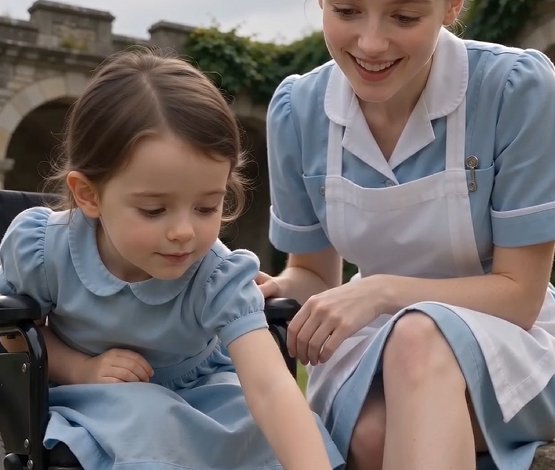
Her head snapped toward him.
For one frightening second, Daniel expected the old reaction. Lucy would pull away. Her breathing would break. She would fold into herself while someone called for a towel and wrote down another failed transition.
Instead, she looked at him, then looked at Ruby.
Ruby did not turn around.
She kept tapping.
One.
Two.
Splash.
Daniel stepped closer.
“What is happening?”
“The rain is happening,” Ruby said.
The house manager, Mrs. Bell, hurried across the courtyard with an umbrella. “Mr. Whitmore, this is completely inappropriate. Lucy’s afternoon schedule was changed without approval.”
Lucy tightened her hand around Ruby’s.
It was such a small movement that another person might have missed it.
Daniel did not.
He had spent two years watching specialists measure the angle of Lucy’s knees, the strength in her fingers, the length of her attention. He had watched screens fill with numbers while his daughter stared past every adult in the room.
He had believed numbers meant progress.
He had believed control meant safety.
He had believed that if he built a perfect enough system, grief would have nowhere left to enter.
Ruby looked at Lucy’s face, not at the schedule.
“She likes the sound,” Ruby said. “It stays the same even when the rest of the day does not.”
Claire appeared behind Mrs. Bell, dry beneath a cream raincoat. She looked from Ruby’s soaked clothes to Lucy’s hand.
“Take her inside,” Claire said. “Now.”
Lucy flinched.
Ruby stopped tapping.
The rain filled the silence.
Claire softened her voice for Daniel, not for Lucy. “She could get sick. And this is not how the doctors told us to work with her.”
“She is holding Ruby’s hand,” Daniel said.
“Because she is confused and overstimulated.”
Lucy pulled her hand closer to her chest.
Ruby did not fight Claire. She only tapped the stone again.
One.
Two.
Splash.
The little girl’s grip returned.
Daniel’s face changed.
Claire saw it. So did Mrs. Bell.
That was the moment the fountain stopped being a messy game and became a threat.
For months, Claire had been the person Daniel trusted to manage the house when he was buried in business. She knew every appointment, every medication, every private report. She had created the revised schedule after Lucy’s mother died. She had told Daniel that loose routines made children with severe emotional problems worse.
She had also made sure every hour had a place for her.
Breakfast with Daniel.
A meeting beside Daniel’s office.
Dinner in the formal room.
A quiet evening where Lucy was taken upstairs before Daniel could be distracted by her crying.
Ruby had not been in the house long enough to understand the rules.
That made her dangerous.
The next morning, the fountain was locked behind a temporary iron gate.
Ruby found it while pushing Lucy toward the breakfast room.
Lucy saw the gate and immediately went rigid.
Her knees pulled inward. Her hands clamped onto the wheelchair. A sharp cry escaped her, then another. Mrs. Bell called it a setback. Claire called it proof that Ruby had created a dependency.
Daniel was in a conference call in the library. He heard the crying through the open doors.
By the time he came out, Claire was already speaking.
“She is expecting Ruby to entertain her every time she gets upset,” Claire said. “That is not care. That is indulgence.”
Ruby stood beside Lucy’s chair, soaked in panic even though the courtyard was dry.
“I did not entertain her,” Ruby said. “I gave her something that did not change.”
“She needs structure.”
“She had structure before.”
Claire’s eyes sharpened. “And now she refuses to cooperate because someone taught her that rules are optional.”
Lucy made a small choking sound.
Ruby crouched near the chair. “One. Two.”
Lucy did not look at her.
“One. Two.”
Daniel watched his daughter shake.
He had seen that shaking in private doctors’ offices, in the back seat of the car, and at the foot of the stairs. Every time, someone increased the instructions. Count to five. Lift your chin. Take the hand. Try again.
The more they demanded, the farther away Lucy went.
Ruby placed her palm on the wheelchair armrest, leaving space between them.
“One,” she whispered.
Lucy took a breath.
“Two.”
The girl looked at the closed gate.
“Tap,” Ruby said.
Lucy moved one finger against the armrest.
Tap.
Ruby tapped back.
Tap.
No one in the hallway spoke.
For the next six days, Ruby repeated the same rhythm.
She did not drag Lucy to the fountain. She did not make the child perform. She brought a shallow blue bowl of water to the patio and let the rain fill it. On sunny mornings, she used a pitcher. When Lucy became frightened, Ruby tapped the bowl. When Lucy got tired, Ruby stopped.
One.
Two.
Splash.
One.
Two.
Splash.
Sometimes Ruby put one foot into the water.
Sometimes she only touched the surface with two fingers.
Sometimes Lucy watched from across the room and did nothing.
Ruby treated the stillness as part of the rhythm, not a failure that needed to be corrected.
Daniel began seeing the difference.
The old schedule had made Lucy’s body a battlefield. Every refusal became evidence that she was difficult. Every delay became a reason to add another expert.
Ruby gave her a place where nothing was taken from her.
Not her hands.
Not her silence.
Not her fear.
On the fourth day, Lucy reached toward the blue bowl.
On the fifth day, she touched the water.
On the sixth day, she grabbed Ruby’s hand before Ruby could offer it.
Daniel saw that too.
He had come through the side door after canceling a meeting. Ruby was kneeling on the patio, counting quietly. Lucy’s fingers had slipped around hers, and the girl was guiding Ruby’s hand toward the bowl.
Ruby looked up at Daniel.
“She wants the next step.”
Daniel looked at the wheelchair.
“What next step?”
Ruby turned to Lucy. “The one she chooses.”
Lucy tapped the bowl twice.
Ruby put one bare foot into the water.
Lucy watched.
Then Lucy lifted her own foot a few inches from the footrest.
It was not standing. It was not walking. It was a small, shaking attempt to move toward something she wanted.
Daniel’s breath caught.
He started forward, but Ruby raised one hand.
“Do not rush her.”
Daniel stopped.
The instruction was simple. It was also the hardest thing anyone had ever asked him to do.
Lucy lowered her foot. Ruby tapped the bowl. The child held Ruby’s hand tighter.
Daniel stood there with his expensive suit damp from the patio mist, unable to solve the moment and unable to leave it.
Claire did not see it as healing.
She saw it as replacement.
The night before the neighborhood pool party, she removed the blue bowl from the patio and replaced Lucy’s afternoon routine with the old schedule.
The pool party was the next day. It was also the date Lucy’s mother had died two years earlier.
Daniel had planned to keep Lucy inside during the gathering. He told himself the noise, the water, and the guests would overwhelm her. Claire agreed and arranged for Lucy to have a private lunch upstairs with an aide.
Ruby found the schedule on the kitchen counter.
“She should not be taken to the pool,” Claire said. “Tomorrow is already difficult.”
Ruby looked toward the hallway, where Lucy sat motionless in her chair.
“She knows the date?”
“She knows enough to become distressed.”
“Then locking her away will not make it disappear.”
Claire stepped closer. “Daniel needs peace tomorrow. The family needs to look normal.”
Ruby stared at her.
There it was.
Not Lucy’s safety.
Not even Daniel’s grief.
The appearance of a family that had not cracked open.
Daniel entered the kitchen as Claire finished speaking. He had heard enough.
“Lucy stays upstairs,” he said.
Ruby’s face fell, but she nodded.
Then Lucy made a sound from the hallway.
A single tap.
Her hand had struck the wheel.
Tap.
Tap.
Ruby turned.
Lucy was looking at her.
Daniel looked at the girl, then at the patio doors. Beyond them, the fountain steps gleamed under a gray sky.
“She heard the bowl,” Ruby said.
“There is no bowl,” Claire replied.
Lucy tapped again.
Daniel felt something inside him collapse. He had spent two years protecting Lucy from reminders of her mother, from rain, from noise, from messy food, from every ordinary thing that might bring a difficult feeling.
He had not protected her.
He had made the whole house smaller.
The next afternoon, the neighbors’ pool party began under a bright sky. Children ran across the lawn in swimsuits. Adults stood near the pool with drinks in their hands. Music played beneath a white canopy.
Daniel’s estate had been designed for gatherings like this. The grass was perfect. The stone terrace was spotless. Every cushion had been placed at the exact same angle.
Lucy sat near the glass doors in her wheelchair, dressed in a yellow sweater.
She had not looked at the pool once.
Claire stayed beside Daniel, answering questions for him and smiling whenever a neighbor glanced over.
“Such a hard day for the poor girl,” one woman said.
Claire pressed her hand to Daniel’s arm. “She is being kept comfortable.”
Then clouds moved over the lawn.
Rain began.
At first, it was a fine mist. Children screamed with delight and ran toward the covered patio. The adults gathered their glasses. The music stopped.
Lucy lifted her head.
From the far end of the garden came the sound of water striking stone.
One.
Two.
Splash.
Ruby stood beside the fountain. She had taken off her shoes.
She did not wave.
She did not call Lucy’s name.
She simply stepped onto the lowest fountain stair and tapped her foot.
One.
Two.
Splash.
Lucy stared at her.
Claire leaned toward Daniel. “Do not let this happen here.”
Daniel did not move.
Ruby tapped again.
One.
Two.
Splash.
Lucy pushed against the wheel.
The chair moved less than an inch.
Several guests turned.
Claire quickly signaled to the aide. “Take her inside.”
The aide reached for Lucy’s handles.
Lucy screamed.
It was not a loud, angry scream. It was the sound of a door being slammed shut inside her.
Ruby stopped moving.
She did not come running.
She waited.
Then she tapped the stone once.
Lucy looked at her.
Twice.
Lucy loosened one hand from the wheel.
Daniel saw the choice forming in his daughter’s face.
For two years, adults had carried Lucy away from every hard moment. Today, the hard moment was asking her to choose.
Lucy moved her hand toward the side of the chair.
Ruby walked one step closer, then stopped.
The rain grew heavier.
Lucy pushed again.
The wheelchair rolled across the wet terrace.
Not far.
Just enough.
A neighbor’s child stopped splashing in the shallow end of the pool. The adults grew quiet. Even Claire forgot to smile.
Lucy reached the fountain.
Ruby held out her hand, palm open.
Lucy stared at it for three seconds.
Then she grabbed it.
The first time had happened in private. This time, everyone saw.
Lucy held Ruby’s hand with both of hers.
Daniel covered his mouth.
The girl did not look at the guests. She did not look at Claire. She looked at the fountain and tapped Ruby’s wrist.
One.
Two.
Ruby stepped onto the stone.
Splash.
Lucy laughed.
It was a tiny laugh, almost lost beneath the rain, but Daniel heard it.
He had not heard that sound since before the hospital room, before the machines, before Lucy’s mother became a framed photograph on the staircase.
Claire’s voice cut through the garden.
“Daniel, this is enough. She is becoming dependent on Ruby in front of everyone.”
Lucy immediately stiffened.
Ruby’s fingers remained still inside hers.
Daniel looked at Claire.
Then he looked at his daughter.
For once, he did not ask which choice would make the house look controlled.
“What does she need?” he asked.
Claire blinked. “She needs to go inside.”
Daniel knelt beside Lucy’s chair.
The rain soaked his trousers. Water ran from his expensive watch onto the stone.
Lucy looked at him carefully.
Daniel held out his hand.
He did not grab her. He did not tell her to try. He waited the way Ruby had waited.
“One,” Ruby said.
Daniel tapped the fountain step.
“Two.”
He tapped it again.
Lucy watched him.
“Your turn,” Daniel whispered.
His voice broke on the last word.
Lucy did not take his hand.
Not yet.
She lifted Ruby’s hand and placed it against Daniel’s.
The three of them were connected in the rain.
Daniel shut his eyes.
For two years, he had sent other people into the difficult rooms. He had signed checks, approved plans, and called every failure a problem with the plan.
Now his daughter was showing him the only step that mattered.
He took off one shoe.
Then the other.
Claire stared at him. “Daniel.”
He stepped onto the fountain stair beside Ruby.
The water was cold. His foot slipped slightly on the wet stone. Lucy watched his face.
Daniel tapped.
One.
Two.
Splash.
Lucy laughed again.
Ruby matched the rhythm.
One.
Two.
Splash.
Daniel followed.
The pool party disappeared around them. The neighbors stopped talking. The rain darkened the shoulders of Daniel’s shirt. Lucy kept one hand in Ruby’s and one hand on the edge of her chair.
She did not stand.
No miracle straightened her legs. No sudden movement erased the months of fear.
But she leaned forward.
Then she reached toward Daniel.
He caught her hand.
Lucy pulled him closer to the fountain.
Daniel looked at Ruby, and the tears finally came. He did not hide them from the guests or from Claire.
“She was asking for me,” he said.
Ruby nodded. “She was showing you how.”
Claire stepped back from the fountain. Her face was pale.
“You cannot let a nanny rewrite the family.”
Daniel stood in the rain with Lucy’s hand in his.
“The family was already broken,” he said. “She is helping us stop pretending.”
Claire left the estate three days later.
There was no dramatic argument in the foyer. Daniel simply ended the arrangement after finding the old schedule marked with Lucy’s refusals, corrections, and punishments. Claire had not created Lucy’s pain, but she had kept treating the pain as an inconvenience that could be managed out of sight.
Daniel finally understood that the house had rewarded her for doing exactly what he had asked.
He was the one who had to change.
The management board was removed from the kitchen wall.
The staff no longer used “emotional resistance” as a label for every difficult hour. Lucy’s schedule still had medical appointments and rest times, but it also had open spaces no one was allowed to fill without asking.
On Thursdays, Daniel came home early.
He called it their fountain time.
Sometimes the weather was sunny, so Ruby poured water into the shallow bowl. Sometimes it rained, and they used the stone steps. Sometimes Lucy only tapped the armrest while Daniel and Ruby made the sound for her.
The ritual stayed small.
One.
Two.
Splash.
Ruby did not become a polished expert. She still left wet towels in the wrong laundry basket. She still arrived with inexpensive sneakers and a loose ponytail. But Daniel invited her into the weekly planning meetings, not as staff waiting for instructions, but as the person who understood the rhythm Lucy had chosen.
Together, the three of them built a different kind of household.
Daniel learned to cancel meetings for more than emergencies. He learned to sit on the floor. He learned that helping Lucy did not always mean moving her body. Sometimes it meant staying close while she decided whether to move at all.
Lucy still used her wheelchair.
She still had hard days.
She still cried when dates changed and panicked when strangers touched her without warning.
But now she reached.
For Ruby’s hand.
For Daniel’s sleeve.
For the blue bowl when it sat on the patio.
Months after the pool party, Lucy’s father took her to the fountain on the anniversary of her mother’s death. The house was quiet, but it no longer felt empty.
Ruby stood on the first step.
Daniel stood beside her.
Lucy rolled forward until the front wheels touched the water.
She held out one hand to Ruby.
Then she held out the other to her father.
Daniel took it.
Ruby began the count.
One.
Two.
Lucy tapped the fountain.
Splash.
This time, Daniel completed the last step himself.
And for the first time since their loss, the mansion did not feel like a place built to contain a broken family.
It felt like a family living there.