THE ICE CUBE THAT BROUGHT A SILENT LITTLE GIRL BACK TO HER FATHER

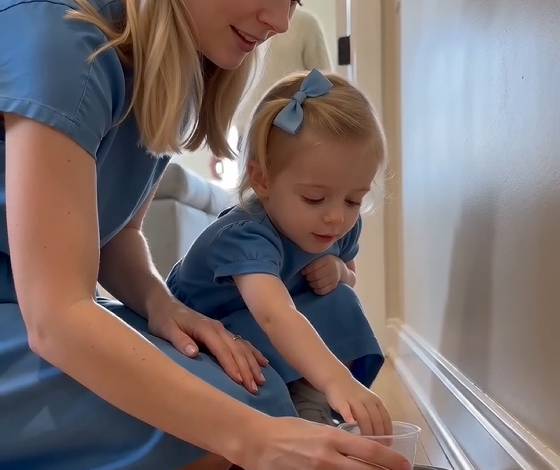
Sophie did not celebrate like the adults expected.
She did not clap or rush in with praise or ask Ivy to do it again on command.She just kept the rhythm.
Every morning after that, at the same time, she set the cup on the same counter, dropped one ice cube into it, and let it slide in silence. The sound was the signal. The same sound. The same pace. The same small, steady world Ivy could predict.
That mattered more than anyone in the house understood.
Ivy had stopped speaking after her mother died in a crash on the highway coming back from a doctor’s appointment. One minute the house had been normal in the way wealthy houses pretend to be normal, full of schedules and staff and polished surfaces. The next minute everything was shock, then quiet, then everyone around her acting careful enough to make the silence worse.
They had thought Ivy needed less stimulation.
What she actually needed was something that stayed.
So Sophie stayed with the ice game.
She let Ivy choose the cup. Choose the plate. Choose whether the cube went from hand to hand or from cup to plate. She never forced eye contact. Never asked for words. When Ivy pointed, Sophie answered. When Ivy pulled away, Sophie waited. When Ivy got frustrated and shoved the cup aside, Sophie picked it up and started over without making a face.
James watched from a distance for three days before he finally admitted what was in front of him.
His daughter was calmer with the strange young nanny than she had been with anyone in over a year.
That should have been the end of the argument.
Instead, it made Mrs. Vale worse.
She called it unprofessional. She said Sophie was encouraging odd habits. She said Ivy needed structure, not little tricks on the kitchen counter. She said the birthday party would be impossible if the child stayed fixed on “that ice thing.”
James should have stopped her then.
He did not.
He had spent too long letting other people tell him what grief should look like in his own house.
The day before Ivy’s birthday, Mrs. Vale had the staff “reset” the house. The kitchen got wiped down. The trays disappeared. The freezer bins got reorganized. Sophie came in and found Ivy already upstairs, shut in her room, because the guests were due the next afternoon and Mrs. Vale did not want “a scene.”
That night, Ivy did not eat.
She did not come down for bath time.
When Sophie brought the cup and plate upstairs, Ivy stared at them for a second, then turned away and curled tighter under her blanket.
By morning, everyone in the house was calling the ice-cube routine a fluke.
James heard it. Sophie heard it. Ivy heard it too, though she said nothing.
At the birthday party, the whole family was there. Friends. A few board members. Mrs. Vale in a cream dress, smiling like the house belonged to her. The dining room was full of flowers and candles and people talking too loudly around a child who sat at the end of the table with her hands tucked under her arms.
Then one of the guests reached too fast to touch Ivy’s hair.
Ivy jolted hard.
The chair scraped. A glass tipped. Her whole body locked. She made a small sound, not a word, just panic, and slid off the chair backward like she was trying to vanish into the floor.
Mrs. Vale went rigid.
James stood up. Sophie was already moving.
She did not touch Ivy right away. She crouched low, took an ice cube from the dessert tray, and set it in a clean glass.
One sound.
Then another.
Ivy’s eyes found it.
Sophie slid the cup across the table the way she always did. Not as a performance. As the same small promise.
Ivy’s fingers loosened.
Then, in front of everyone, she reached out, took the cup, and held it out toward Sophie.
Not to James.
Not to Mrs. Vale.
To Sophie.
The room went still.
Sophie’s hand closed around the cup, and Ivy’s other hand rose and caught James by the sleeve.
He stared at her like he had been struck.
Ivy looked at the ice, then at the cup, then at her father, and with a shaking hand she pushed the cup toward him, clearly asking him to do the last step.
James took it.
He slid the cube from the cup to the plate.
Ivy watched him like he had just learned her language.
And for the first time since her mother died, she smiled.
Not a big one. Not a fake one. A real one.
Mrs. Vale tried to speak over it, to say the child was overstimulated, to say this was not appropriate behavior at a birthday dinner, to say Sophie had crossed lines that did not belong to her.
James did not look at her.
He looked at his daughter.
Then at Sophie.
Then back at the child whose whole body had finally, visibly, chosen connection over hiding.
The old order in that house broke right there.
Not because of a speech. Not because of a diagnosis. Because a little girl who had been hidden upstairs for months had just handed a water cup to the one person who had met her where she was.
After the guests left, James sent the staff home early. He took the tray himself. He sat on the kitchen floor beside Sophie, awkward and quiet at first, and waited while Ivy carried the cup between them.
He was the one who made the ice slide across the plate.
Ivy laughed under her breath and leaned into Sophie’s shoulder, then turned and placed the cup directly into James’s hand, making it plain.
She wanted both of them there.
Not one replacing the other.
Both.
That was the part nobody in the house had understood. The child had not been rejecting love. She had been rejecting the pressure, the noise, the way adults kept trying to handle her grief like a problem to be solved in private.
Sophie’s little ice game did not fix everything in one night. It did something harder.
It gave Ivy a repeatable way back.
After that birthday, James changed the house. He stopped hiding his daughter when people came over. He stopped pretending manners mattered more than his child’s breathing. Mrs. Vale lost ground fast when it became obvious she cared more about appearances than Ivy’s safety. Within a week, she was out of the house and out of James’s life.
He did not rush Sophie into anything. He did not make promises he could not keep. He just kept showing up.
Every night, after work, he took the seventh slot in Ivy’s little ritual. Sophie handled the ice. Ivy chose the cup. James handled the last step.
A month later, Ivy began pointing less and whispering more.
Two months later, she asked Sophie for water without the point at all.
By the end of the season, the mountain house sounded different. Not loud. Just alive. Footsteps in the hall. Ice in a glass. Ivy’s small voice calling from the kitchen. James answering before anyone else could.
And slowly, carefully, without forcing the shape of it, the three of them became a family that did not look like the old one and did not need to.
Sophie had come in as an emergency hire.
She stayed because Ivy reached for her first.
And because James finally learned that money could fill a house, but it could not teach a child how to feel safe again unless someone was willing to sit on the floor and start with one ice cube.