THE QUIET BOY WHO FOLLOWED THE FLOWERPOTS

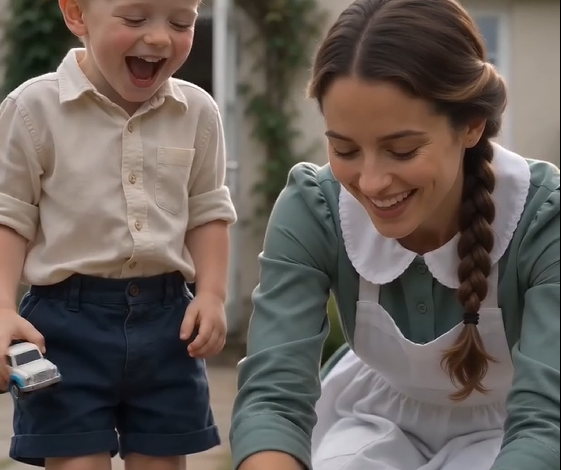
The house manager wanted the garden restored before dinner. He spoke to the gardener in the clipped, careful tone he used for every problem that could be hidden by putting it back where it belonged.
But the father stopped him from entering the back lawn. He had watched his son carry the toy truck from one flowerpot to the next, and he understood that interruption would not be neutral. It would teach the boy that even this small path could be taken away.The nanny kept working without praise. She filled a watering can only halfway so it would not be too heavy, then set it near the child and watered a second pot herself. The boy watched the water darken the earth and made a small sound through his nose, not quite a word.
When the can tipped, water ran over his shoe. He jerked backward and his whole body locked.
She did not grab him to steady him. “Your foot got surprised,” she said, placing the can upright. “Mine did too once.”
She took off one boot, shook the water from it, and put it back on. The boy looked down at his wet shoe, then at hers. After a minute, he nudged the watering can toward her with his toe.
From the doorway, his father felt the familiar urge to solve the moment with instructions. Instead, he held still.
The house manager came to him later in the library. He did not accuse the nanny of being careless; he was too practiced for that. He said the child’s clothing had been soiled, the garden had been disturbed, and a temporary employee was creating habits the household could not sustain.
His father answered with the only fact he had. “He walked outside.”
“That is not a care plan,” the house manager said.
“No,” the father said. “It is something he chose.”
The words sounded unfamiliar to him. For years, he had approved plans for his son as if love could be demonstrated by eliminating every uncertainty. He had accepted each new caregiver because another professional arrival felt more responsible than admitting that his child knew every departure was coming.
The next morning, the boy waited in the dressing-room doorway before breakfast. He had not asked for the nanny. Asking was beyond him. But when she crossed the hall carrying an old basket of seed packets, he stood and followed her without being invited.
The house manager saw it too.
The nanny led him not to the formal garden but to a narrow strip behind the greenhouse, where empty pots had been stacked out of sight. She spread a faded towel on the ground and let him choose which pots to keep. He tapped one blue pot with the wooden truck, then pointed at it.
“Blue one,” she said quietly.
His mouth opened. No sound came, but he touched the pot again.
She did not make him repeat it. She only put the blue pot beside them and began making holes with her fingers. Her movements were broad and easy, the movements of someone who had grown up carrying feed buckets and helping plants survive dry weeks, not someone trained to make a child perform.
Soon the boy copied her. He scooped dirt, stopped when it touched his sleeve, then returned to it after she brushed her own sleeve with a laugh.
The laugh startled him.
He studied her face, as though he had forgotten adults could make that sound without demanding anything afterward. Then he pressed one muddy finger onto the back of her hand.
She held her hand still until he pulled away.
That afternoon, his father canceled a luncheon he had been expected to attend. The house manager reminded him that several family friends would be there and that his absence would be noticed. His father looked through the garden-room glass at his son moving one small pot behind the nanny.
“Let them notice,” he said.
It was the first cancellation he had made for something happening inside his own home.
The routine grew from practical things. The nanny asked the cook for vegetable ends and saved them for the compost pail. She let the boy carry a wooden spoon from the kitchen to the garden, where he used it to press seeds into soil. She folded a small towel and placed it by the dressing-room door so he could wipe his hands before he touched his truck.
He began to expect the sequence: basket, pots, dirt, water, towel, truck. Because it returned each day, he did not have to guess whether she would.
His father noticed another change at dinner. The boy still would not sit at the long formal table, but he came as far as the breakfast-room threshold and stood there while the nanny rinsed dirt from a handful of radishes. When she cut one into thin pieces and placed them on a napkin, he took one and ate it.
The house manager objected to that too. The child’s meals, he said, were supposed to remain predictable and supervised in the nursery.
The nanny looked at the boy, not at the house manager. “He chose a radish.”
“It is not about a radish,” the house manager replied.
It was not. It was about a boy beginning to choose a room, a person, a path, and a small bite of food, all of which made the old system look less necessary.
The father called the house manager into the breakfast room after the boy had gone upstairs. He did not raise his voice. In that family, people had used calm voices for generations to make decisions feel unquestionable.
“The trial continues,” he said. “No one corrects her in front of him unless he is in danger.”
The house manager’s expression barely shifted. “You are allowing a young employee to set the tone of this home.”
“I allowed this home to set the tone for him,” the father said. “Look where that got us.”
For two days, the house manager complied in public. In private, he moved the pots back into storage and told the gardener not to leave tools where a child could reach them. He also told the nanny that the father was concerned about boundaries and expected her to keep the child inside when guests arrived for a family dinner.
The nanny believed him because the request sounded like everything else in the house. She did not argue. At four o’clock, when the boy appeared in the dressing-room doorway with the blue pot held against his chest, she said they could not go outside today.
He did not cry.
That was worse.
He set the pot down, returned to the closet, and pulled the coats around himself. When she sat at the doorway, he turned his face toward the wall and clasped the truck so hard his knuckles whitened.
She stayed on the floor, but he did not look at her.
At dinner, his father found the blue pot missing from its place near the greenhouse. He asked the gardener, who said the house manager had ordered the area cleared. Then he learned that no guest was expected until the next evening.
The lie mattered because it had changed something already fragile.
His father went upstairs without removing his coat. He found the nanny on the dressing-room floor, her back against the wall, speaking softly about seed packets to a child who would not turn around.
“I told him we could not go,” she said. “I thought it came from you.”
His father looked past her at his son, then at the row of coats that had become a hiding place. For the first time, he understood that the child had not merely been difficult with new caregivers. Each adult had taught him that closeness came with conditions he could not understand.
“I did not say that,” the father said.
The boy did not move.
The father wanted to step into the closet, lift him out, and repair the whole thing with one decisive act. The nanny shook her head once, almost imperceptibly. So he stayed outside the doorway.
“I should have asked,” he said, not to the nanny, but to his son. “I should have known what happened in my own house.”
The child’s fingers tightened around the truck.
His father continued, keeping his voice low enough that it did not press into the small space. “The pots are coming back. No one should have taken them.”
The next morning, he carried the blue pot himself to the greenhouse. It was not clean; soil had spilled across the rim in the move. The father set it down exactly where the child had left it, then asked the nanny to decide when to show him.
The house manager arrived before breakfast, stiff with outrage. He said the father was undermining the staff structure and making a temporary worker impossible to manage.
“No,” the father said. “You lied to her so you could manage my son.”
The house manager tried to explain that children required consistency, that the house had standards, that a father with a public position could not allow every emotional moment to overturn procedure.
The father heard himself answer differently than he would have a week earlier. “Consistency is not the same as control.”
He removed the house manager from decisions about the child’s schedule. The man would continue to oversee the household, but he would no longer decide which rooms the child could use, which routines mattered, or who could stand beside him. It was not a dramatic dismissal. It was a loss of the authority he had used to keep the home orderly at the child’s expense.
Then the father left the dressing-room door open and waited at the far end of the hall.
The nanny came with the small basket. She sat on the floor, took out the blue seed packet, and placed it where the boy could see it. “I was wrong yesterday,” she said. “I told you we could not go because I believed something that was not true.”
The boy’s face remained hidden.
“I came back anyway,” she said. “And the pot came back too.”
There was no promise that she would never leave. She did not give him a promise too large for either of them to hold. She only placed one hand on the floor, palm up, at a distance.
After a long while, the boy pushed the wooden truck across the carpet. It stopped against her fingers.
She did not pick it up.
He came out from the coats on his knees, then sat beside her. When she stood, carrying the blue pot in both hands, he reached for the hem of her green jacket.
It was the first time he had touched her without flinching.
She waited until he was ready, then walked toward the garden at the same slow pace as before. He followed, one hand still holding her jacket and the other dragging the truck behind him.
His father watched from the hall. This time he did not feel shut out. He felt responsible for protecting the space that let his son return.
The garden ritual changed because the father changed it. He told the gardener to leave one corner unfinished. He asked the cook to send peelings out for compost. He moved his morning calls from the breakfast room because the boy had begun appearing there while the nanny washed vegetables.
At first, he only watched. He sat at the end of the table while the boy dropped carrot tops into the compost pail and the nanny rinsed pots in the sink. He kept his hands folded whenever the child came close, refusing the old impulse to take over.
One afternoon, the nanny was carrying wet laundry from the utility room when the boy began to panic at the change in their routine. She could not put the basket down quickly without spilling it. The father was nearest.
He looked at her, and she said, “Show him where it goes.”
So the father did not reach for the child. He picked up one small towel and walked it to the back garden line. He clipped it there, then returned for another. The boy watched, uncertain.
The father held out the next towel, not toward the boy’s body, but toward the space between them.
The boy took the edge.
Together, without anyone saying the moment was important, they carried it outside. The boy placed his side over the line. His father pinned it with a clothespin, then waited.
The boy chose a second towel.
That evening, he ate at the small table in the breakfast room rather than behind the nursery gate. The nanny set down bowls of simple soup and a plate of bread. His father sat beside him, not across from him, and kept the conversation to ordinary things: the blue pot needed water, the towels would dry by morning, the radishes had grown crooked.
The house manager passed the doorway and paused. The room was not disorderly. It was simply being used.
The boy dipped a piece of bread in his soup. Then he held another piece toward the nanny. When she accepted it, he turned to his father and held out a third.
The father took it carefully.
Weeks later, the two-week trial ended without ceremony. The nanny remained because the child had made her place clear in ways no contract could improve. She was still young, still wore boots that carried garden dirt into the mudroom, and still treated the grand house like a place where laundry had to be folded, meals had to be made, and plants had to be watered.
The father did not hand her the family’s burdens and call that change. He began taking his own share. He came home before dinner when he could, learned where the towels were kept, and asked his son before picking him up.
Some days the boy still retreated to the dressing room. On those days, nobody pulled him out. The father would sit outside the open door with a basket of clean socks, matching pairs slowly while the nanny watered the plants nearby.
One rainy evening, the three of them moved the flowerpots into the greenhouse. The boy carried the blue one with both hands while his father walked beside him, ready but not touching.
At the last shelf, the boy looked up, pressed one muddy finger against his father’s cuff, and waited.
His father bent down and placed his own hand in the soil beside the blue pot, leaving room for the small hand that followed.