THE WOODEN ANIMALS ON THE STAIRS

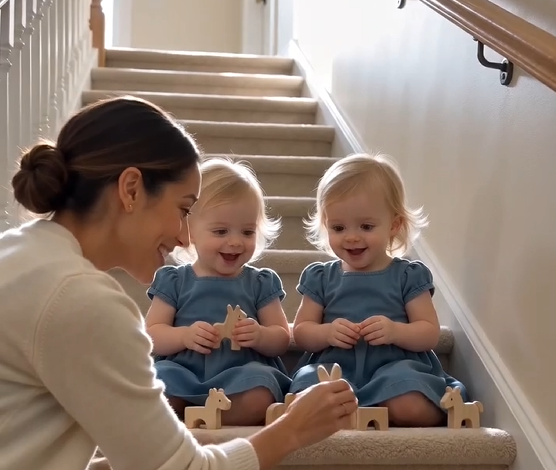
The father remained at the bottom of the staircase with one hand still on his loosened tie, unable to make himself step closer. His mother stood beside him, rigid with disapproval, while the older twin held the nanny’s cardigan as though the fabric had become the only stable thing in the house.
The younger boy had not run to anyone. He sat one stair above them, gripping the fox, watching his brother’s face rather than the window for once.The nanny did not tell either child that they were safe. She had learned through long nights with her own family that frightened people often heard words as more pressure. Instead, she slid the fallen horse toward the older boy’s knee and waited.
After a minute, he picked it up.
The grandmother said the staircase was not a playroom, and the nanny should have known better than to turn it into one. The nanny answered quietly that she would put every animal away when the boys were ready to put them away.
That answer was not defiance, but it was not surrender either.
The father finally looked at his mother. “Leave the stairs as they are,” he said.
His mother stared at him. In that house, staff had always moved when he spoke, and his children had been moved around his calendar with the same efficiency. But he did not sound efficient now; he sounded uncertain, almost careful.
The nanny rebuilt the line with the boys. The older twin placed the horse first, then held his hand over the bear until his brother chose the fox, and together they watched the animals wait on their separate steps.
For the next two days, the staircase became the only place the twins would leave the window for voluntarily. The nanny never summoned them there. She sat down first, made a small line, and let them decide whether a bear belonged beside a rabbit or whether every animal needed a whole step to itself.
The father began coming home to change clothes even when he did not need to. He would stand in the hall, watching from a distance, because the nanny had asked him not to enter the game while the boys were still learning that it would not be taken over.
He wanted to ask questions. He wanted a plan he could approve, measurements he could track, something he could hand to an assistant and call progress. But every time he opened his mouth, he saw the older boy’s shoulders rise toward his ears.
So he learned to stay quiet.
The grandmother did not. She instructed the house manager to return the toys to the nursery after each session. When the nanny came down one morning and found the staircase bare, the boys were already back at the window, one with his forehead against the glass and the other turning the curtain ring.
The nanny did not accuse anyone in front of them. She pulled a strip of masking tape from her bag and placed it along the bottom stair, then another strip on the next one, making pale little roads where the animal line had been.
The younger twin noticed first.
He left the window, walked to the landing, and pressed one finger against the tape. The older boy followed, but he did not touch it until the nanny laid a wooden spoon from the kitchen on the first strip and rolled it gently down to the second.
The spoon made a dull tap at every step.
The boys followed the sound with their eyes.
The grandmother arrived halfway through and demanded to know why there was tape on the imported runner. The older twin froze, then made a sound so raw and sudden that the father, working in the study nearby, came out at once.
The younger boy grabbed for his brother, missed, and reached instead for the nanny’s wrist. The older boy pitched forward toward her, not toward the window, not toward the nearest staff member, but toward the young woman who had not moved the line when someone told her to.
She gathered both boys against her without lifting them or making a show of it. One held her sleeve, the other held the loose edge of her cardigan, and she sat down on the stair with them until their breathing slowed.
The father saw it all.
His mother began explaining that the children were being overstimulated by chaos and inconsistency. The father looked at the two boys, who had spent months silent under the family’s careful consistency, and then at the tape lines that had brought them out of the window again.
“Take the tape down later,” he said. “Not now.”
His mother went pale with anger. “You are allowing a temporary employee to set the standards in your home.”
“No,” he said. “I am seeing what our standards have done.”
The nanny did not celebrate his defense. Once the boys had calmed, she took the spoon away and asked with her hands, not words, whether they wanted to build again. She held out the horse and the bear, leaving room for them to refuse.
The older twin took the bear. His brother took the horse.
That afternoon, the nanny discovered a narrow dressing room beside the father’s bedroom. It had been used for garment boxes and old suit covers, and its far wall held a low window with a view of only the garden hedge.
The older boy walked into it by himself, perhaps because the room was small enough that the world did not keep disappearing through a huge pane of glass. His brother followed, carrying the fox.
The nanny did not drag in bins of toys. She brought the wooden animals, two cushions, and the masking tape.
On the floor, she made short tape marks like miniature stair steps. The boys placed the animals in a curved line that began at the door and ended beneath the low window.
When one animal fell, they did not have to watch it tumble down an actual staircase. They could place it back immediately.
The room became theirs because it did not demand that they perform for anyone.
The nanny called it the little room only when she had to call it anything. She sat outside the doorway when they needed space and inside it when they pulled a cushion toward her.
By the end of the first week, the younger twin began handing her an animal before he placed his own. It was not speech, but it was an invitation. She accepted each offering, set it where he pointed, and let him correct her if she got it wrong.
The older boy still spent long stretches at the window, but now he sometimes looked back toward the hallway as though checking whether the animal line would still be there. The nanny always kept it simple: a few toys, a clear place, and no adult insisting that the boys explain themselves.
Their father noticed something else. At dinner, the boys no longer pushed every piece of food into piles. They still avoided most of the meal, but the younger child would carry a cracker from his plate to the dressing room and set it beside the fox.
The nanny placed one beside the bear.
The older boy watched her, then ate his own cracker.
The father saw this from the doorway and almost spoke too loudly. The nanny caught his eye and touched one finger to her lips, not as a command but as a reminder.
He nodded.
Later that night, he found her washing the animals at the kitchen sink because one had been dropped in a flowerpot on the terrace. He asked what he was supposed to do.
She looked surprised by the question. “With them?”
“With all of it.”
She dried the rabbit on a dish towel. “You can come home before they stop waiting. You can sit down when they are sitting down. And when they show you a thing, don’t turn it into a test.”
He stood there in his expensive shirt, a man accustomed to answers that came in reports and invoices, and said, “I don’t know how.”
“I know,” she said. “They don’t either.”
The grandmother’s objections became more deliberate after that. She told the father that the boys were becoming dependent on the nanny, that a two-week trial had become a household disruption, and that no child in their family had ever been allowed to dictate the shape of a home.
She did not shout at the children. Her fear was quieter than that. She kept trying to restore the old pattern: meals at fixed times, toys hidden away, doors opened before anyone could choose a small room for themselves.
The father had once mistaken those habits for care because they looked like attention. Now he began to recognize what they cost.
On the tenth day, he returned early to change for a dinner he had no intention of attending. Rain had begun hard against the upper windows, and he found the twins in the dressing room with the nanny, their wooden animals lined across the tape steps.
A gust rattled the window frame.
The sound was sudden enough that both boys cried out. The younger twin knocked the horse and fox over with his elbow. The older twin backed into the wall, eyes wide, hands raised as though he could push the noise away.
The nanny did not order them to breathe or tell them it was only rain. She put the cushion between them, sat on the floor, and held her palms where they could see them.
The younger boy crawled into her lap first.
Then the older boy crossed the little room, past the fallen animals, past the low window he usually watched, and seized her cardigan with both hands. He buried his face against her shoulder.
His brother clung to her arm.
Their father remained in the doorway, frozen by the fact that neither boy had looked for him.
The nanny did not look up at him right away. She rocked neither child and offered neither speech; she simply stayed, solid and unhurried, while the rain passed over the roof.
When the older boy finally lifted his head, he saw his father standing there. The father nearly stepped forward too fast, then remembered the nanny’s warning about turning every opening into a demand.
He lowered himself to the floor outside the doorway instead.
For several minutes, the boys watched him. The younger twin held the fox against the nanny’s wrist. The older twin kept one fist in her cardigan, but his other hand moved toward the little tape line.
The father picked up the fallen horse and set it on the first strip.
He did not ask if that was right.
The older boy took the bear from beside the cushion and placed it one step below.
The father waited.
The younger boy set the fox beside the bear. Then, in a voice unused enough to come out rough, he said one word.
“Again.”
The father put his hand over his mouth.
The nanny looked at the boys, not at him. “Again,” she said softly, and they built the line from the start.
That was the first time the father stayed home after a fright instead of having someone else write down what had happened. He canceled dinner, changed into a sweater, and sat outside the dressing-room door until the twins fell asleep on the cushions with the animals between them.
His mother found him there and said the household was beginning to orbit an employee.
He answered that the household had been orbiting his absence for years.
She left without replying, but the next morning the animals were missing.
The twins found the bare tape marks before breakfast. The younger boy began searching the dressing room shelves, his face tightening with every empty box. The older boy went to the low window and struck the glass once with his open hand.
The nanny had just reached the doorway when the grandmother entered holding a storage bin.
“These things are not permanent,” she said. “Neither is she.”
The older twin heard her.
He did not retreat to the window. He walked across the room, took the fox from the bin, and pushed it into the nanny’s hands. Then he pulled at her cardigan and pointed to the empty tape line.
The young woman looked at the father, who had followed the sound from the hall.
The grandmother was waiting for him to restore the order she recognized.
Instead, he took the bin from her. He set it on the floor, opened it, and placed every animal where the boys could reach it.
“No one removes their things without asking me,” he said.
His mother gave a short, disbelieving laugh. “Their things? This is a game.”
“It is the first thing they have asked to keep.”
He did not banish her or humiliate her. He told her the boys’ rooms, routines, and care would no longer be arranged around appearances or his schedule. If she could not respect that, she would have to stop directing the staff who did.
For the first time, the grandmother had no answer that could compete with the older boy laying the bear carefully beside the horse.
The trial ended four days later.
The father had prepared a formal offer through his assistant, full of duties, hours, and conditions. The nanny read it at the kitchen table while the twins sat on the floor nearby, making a small animal line between the chair legs.
She told him she would not agree to be another person hired to keep the boys quiet while he disappeared. She would stay only if the quiet time after breakfast belonged to the boys and their father too, even if he only sat on the floor and learned the order of the animals.
He asked whether she thought he could do that.
“No,” she said honestly. “But I think you can come back tomorrow and try.”
He signed the offer without changing that condition.
The grandmother did not become part of the little room. She still kept the main staircase immaculate and still spoke of the nanny’s methods as temporary indulgences. But she stopped ordering the toys removed, because the twins began looking directly at anyone who tried.
Their father changed more slowly. He missed one morning, then another, and had to face the older boy waiting by the dressing-room door with the bear in his hand. The nanny did not excuse him to the children or scold him for them; she left the empty place in the line visible.
The next morning, he arrived before breakfast.
He sat on the floor in a plain shirt with his phone in another room. The younger twin handed him the fox, and he waited until the boy pointed before placing it on the tape.
When he put it too close to the bear, the older twin moved it without anger.
The father nodded as if he had been given an instruction worth following.
A month after the young woman entered the house, the rain returned. This time the twins did not rush to the great window upstairs.
They carried the animals to the dressing room, where the father was already waiting on the floor and the nanny had placed two cushions side by side.
The younger twin built the line. The older twin put the bear at the end, then looked at the nanny with both hands wrapped around the edge of her cardigan.
“Stay,” he said.
She did not promise him the world. She put her hand over his small fist and stayed while he placed the final animal on the last tape step.