THE SILENT TWINS FOLLOWED THE BUBBLES AFTER THE MANSION’S PERFECT RULES FINALLY FAILED THEM

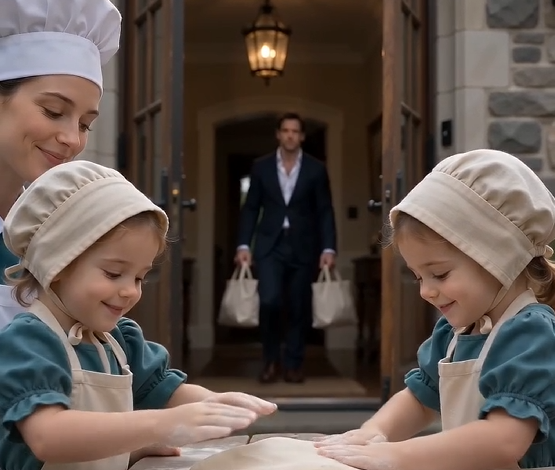
By the time Adrian understood that the sound had come from Milo, the nanny had already lowered her eyes to the table. She did not celebrate the hum, did not demand that he repeat it, and did not turn toward the doorway where the adults were holding their breath. She placed the crooked chef hat on her own head for one second, removed it, and tapped the tabletop twice.
Milo tapped once in return. June watched him, then touched the loose oven glove against her cheek as if checking whether the strange game was still safe.Adrian remained beyond the threshold because the children had not looked at him. He had built his life around entering rooms and changing what happened inside them, but the nanny seemed to know that his authority would crush the fragile thing forming between the twins. When Celia reached for the flour tin, he quietly stopped her again.
“Leave it,” he said.
The word was mild, but it was the first time he had chosen a mess over an explanation. Celia looked from the powder on the counter to the twins’ bent heads, and her mouth tightened as if the dust had personally insulted the family.
The nanny let the game end without asking for more. She set a wooden spoon beside Milo, another beside June, and made a slow circle on the table with one fingertip. Milo copied the circle. June copied Milo, and when the nanny hummed the final note of the old song, both children leaned toward the sound.
That night, Adrian read the report left by the previous caregiver. It described the twins as unresponsive during structured exercises, resistant during meals, and unwilling to participate in conversation. None of the pages mentioned the wooden button Milo carried or the way June watched the chair before every person entered the room.
The nanny had noticed both within an hour. She had also noticed that the twins did not fail to understand people; they had stopped offering themselves to people who kept asking for proof.
Her name was Lena Ortiz, and she had grown up three streets from the small house where the twins’ mother, Elise, had spent her childhood. Lena’s mother had once cleaned for Elise’s family, and Lena remembered Elise singing while carrying groceries upstairs. After Lena’s father stopped working, she had taken responsibility for rent, utilities, and her younger brother’s unpaid school costs.
She accepted the Hawthorne position because the money could keep her family’s lights on. She stayed through the first difficult week because the twins’ silence did not frighten her as much as the adults’ insistence that silence be corrected.
On the second morning, Celia placed a printed schedule beside Lena’s hand. It divided the children’s day into ten-minute blocks, including a period labeled Verbal Response Practice. Lena read it, folded the page once, and set it beneath the fruit bowl.
“Mr. Hawthorne approved this,” Celia said.
“Then he can ask me about it,” Lena answered.
She did not sound rebellious. She sounded busy, because Milo had begun sliding a wooden spoon toward June and June was trying to reach it without leaving her chair.
Lena brought the crooked costumes back after breakfast, but she did not repeat the same performance. She placed the hats on the floor and let the twins decide what the kitchen needed. Milo pushed his hat beneath the table. June carried the glove to the pantry door and waited.
Lena followed her there without touching her. She made a solemn inspection of the empty shelf, then whispered the old neighborhood song under her breath. June pressed the glove to the door and gave one quiet tap.
That was the first distinct change. The twins had not spoken, but June had begun to start an exchange instead of merely surviving one, and Milo had begun watching for her answer.
Adrian saw the record of it from a distance. He came home earlier each day after the canceled flight, then stood in the hall or at the edge of the breakfast room while Lena allowed the twins to lead. His instinct was to ask what method she was using, but every time he formed the question, Milo or June made a small movement that required him to remain silent.
Three days later, Lena carried a bowl of soap bubbles to the terrace. The terrace opened beyond the mansion’s glass doors, a narrow boundary between the polished rooms and the evening air, and the twins usually stopped at its threshold because the stone felt unfamiliar beneath their feet.
Lena crouched near the railing and blew one bubble toward the floor. It drifted past Milo’s knee, caught the sunset, and burst against the tile.
Milo did not move. June looked at Lena’s mouth, then at the empty space where the bubble had been.
Lena blew another, smaller stream. This time June stepped forward.
The movement was only one step, but it carried her beyond the place where adults had always told her to wait. Milo followed several seconds later, his wooden button held tightly in one hand and the other reaching toward the bubbles.
Adrian stood inside the open doorway. He did not call their names, praise the progress, or ask Lena to bring them farther. He watched the children choose the next bubble and understood that his presence had to become something other than an appointment on a calendar.
Celia saw him watching. “This is exactly what I warned you about,” she said. “She is turning the terrace into a play yard.”
Adrian did not answer.
The twins followed the bubbles in uneven rhythms. June moved quickly, then stopped to study each burst, while Milo stayed close to Lena’s hand without actually taking it. When a bubble landed on the wooden button, Milo lifted it toward her.
Lena wiped the button with the corner of a towel and returned it carefully. She did not try to take the object, because she understood that trust could not be built by removing the one thing he still held.
Celia’s objection sharpened the next afternoon. She found flour on the kitchen floor, a wooden spoon in the sink, and one chef hat resting upside down in the fruit basket. She called Adrian while Lena was helping June place bowls on the table.
“She is encouraging them to run the household,” Celia said. “They are supposed to learn manners, not turn private rooms into neighborhood games.”
Lena kept her attention on June, who had placed a spoon beside each bowl. Milo stood near the counter, silently deciding whether the flour belonged in the bowl or on the floor.
Celia took one step toward him. “Milo, put that down.”
Milo’s fingers closed around the button. June backed beneath the table, and the small order that had been forming broke apart in an instant.
Lena did not scold Celia. She knelt at the table entrance, placed one wooden spoon on the floor, and began humming the old song. Milo looked at Celia, then at Lena, but he did not make a sound.
Adrian finally entered the kitchen. He had been watching from the adjoining hall, as he had watched on the first afternoon, yet this time he could not remain outside the consequence of his own household.
“Celia, leave,” he said.
Her face changed. “You are letting a temporary employee dictate how your children behave.”
“No,” Adrian said. “I am seeing how they behave when we stop dictating.”
Celia left with the schedule still folded beneath the fruit bowl. The twins did not immediately return to the game, and Lena’s shoulders lowered as if she had been holding them up for everyone in the room.
Adrian wanted to apologize, but he had learned enough to know that an adult speech could become another demand. He picked up the fallen spoon, set it on the table, and sat several feet from the twins without reaching toward them.
Milo watched him for a long time. June stayed beneath the table, where Lena had built no fort and offered no invitation beyond her steady humming.
After several minutes, Adrian placed his phone face down on the counter. He had never done that during a family hour. Then he folded his hands and waited.
The next morning, Lena was accused of taking the twins’ mother’s old recipes from a locked cabinet. Celia had found a stained card near the terrace door, and because Lena knew Elise’s song and had begun using flour in the kitchen, the conclusion seemed convenient.
Adrian found Lena holding the card while the twins stood behind her. Milo’s face had gone blank again, and June had pressed herself against the cabinet as though the room had become dangerous.
“I did not take it,” Lena said. “June brought it to me.”
Celia pointed toward the children. “They cannot explain themselves. That is why adults must keep control.”
Lena looked down at the card. It contained Elise’s uneven handwriting and a note about making small bubbles from soap for the twins when they were babies. The recipe was not for food at all; it described a terrace game, with one line beneath it: Let them follow when they are ready.
Adrian took the card, but he did not blame Celia for assuming the worst. He asked the house manager to check the cabinet log, and the record showed that Celia had opened it the previous evening while searching for a serving list.
The proof cleared Lena, but the damage had already happened. Milo turned away from her, and June would not leave the cabinet.
Lena could have defended herself loudly. She could have demanded that Adrian dismiss Celia, or insisted the twins be returned to the kitchen, where the first game had begun. Instead, she set the recipe on the floor between herself and the children.
“I should have told you about your mother sooner,” she said softly. “I thought the song would help, but I did not know whether it belonged to you.”
The twins gave no answer. Lena remained seated, letting the silence stand without trying to fill it.
Adrian understood the unfairness of the moment in a way he had not understood the first accusation. Lena had been blamed for carrying too much of the past into the house, while he had spent months paying people to keep the past out of sight.
He wanted to correct the record immediately, but the children needed a different repair. He placed the card beside Lena and said, “Your mother wrote this for them. Nobody is taking it away.”
Milo’s hand moved toward the card, then stopped. Lena nudged it closer and withdrew her hand.
June crawled from the cabinet and touched the corner of the paper. Milo followed, and when Lena began the old tune, he did not turn away.
The misunderstanding was not erased by the house manager’s log. It was repaired because Lena admitted what she had withheld, Adrian admitted what he had failed to notice, and the twins were allowed to decide whether the connection could return.
That evening, the children sat on the terrace while Lena made bubbles from the soap recipe. June followed the first cluster all the way to the railing, and Milo walked after her, no longer dragging his feet across the stone.
Adrian stayed near the doorway. He watched June stop beside a bubble that had landed intact on the floor, then bend over it with astonishing care.
“More,” Milo whispered.
The word was small, rough, and unmistakable.
Lena did not move for a second. Then she blew another bubble, and Milo followed it with his eyes before taking three quick steps across the terrace.
Adrian’s hand closed around the doorframe. He did not interrupt, because the first sound belonged to the children and to the space they had made with Lena, not to the father who had arrived late.
Milo whispered “more” again. June answered with a soft hum, and Lena answered both of them with the song their mother had carried from the old neighborhood.
Celia heard the exchange from the hall. She had spent years preserving the mansion’s appearance, and now the very child she claimed needed order was walking over the terrace with flour on his fingers and asking for something ordinary.
“This cannot continue,” she told Adrian that night. “People will think the family has lost control.”
Adrian looked toward the terrace, where the bowls and towels had been left in a loose circle. “They already thought control was working,” he said. “It was not.”
Celia threatened to move the twins back to the formal nursery and replace Lena before the household became dependent on her. Adrian did not fire her or create a public scene, but he removed her authority over the children’s routines and told her that no one would correct the twins for making noise, touching flour, or choosing the terrace.
That decision changed the family’s power in a different way from Milo’s first word. The children’s behavior had shown what warmth could reach, but Adrian’s choice established that the old order would no longer be allowed to undo it.
He also began spending an hour each evening on the terrace. At first he sat with his phone in his pocket and said nothing, learning how long June needed before approaching and how Milo watched the door whenever footsteps sounded inside.
Later, when Lena invited the twins to build a low fort from towels and cushions, Adrian carried two cushions out and placed them near the wall. He did not direct the structure, correct its shape, or ask to be included.
Milo pushed one cushion toward him. Adrian accepted it and waited for the next instruction.
The fort became their shared world. June arranged the towels in a line, Milo crawled through the opening, and Lena followed only after both twins tapped the floor to signal that the passage was ready.
Their voices returned in fragments. June hummed to announce the bubbles, Milo whispered “again” when a bubble burst too soon, and both children began answering one another before any adult asked a question.
The house did not become loud all at once. A spoon fell during breakfast, a door remained open to the terrace, and a towel was left over the back of a chair, each small disorder surviving because no one rushed to erase it.
Celia stopped appearing during the games. She still corrected the staff and still complained about the family’s standards, but the twins no longer froze when she crossed the room because Adrian had made it clear that her judgments would not govern their ordinary hours.
A month after the canceled flight, Adrian called Lena into the study. She stood near the door with her canvas bag in hand, expecting to hear that the arrangement had become too complicated or that Celia had found another reason to object.
Instead, Adrian placed a formal employment agreement on the desk. It named her a permanent caregiver for Milo and June, gave her a stable salary, paid leave, and authority over the children’s daily routines, and included a separate provision for training support she could use to help her family with their bills.
Lena read the first page twice. “You do not have to make this sound like a favor.”
“It is not a favor,” Adrian said. “You changed what this house understands as care.”
She looked toward the terrace doors. The twins were outside, moving after a trail of bubbles, with June stopping whenever Milo fell behind. Lena signed only after asking for one change: the children would never be required to perform their progress for visitors or relatives.
Adrian agreed. He signed beneath her name, and the agreement changed her position from someone the family could replace between meals to someone the household had formally chosen to keep and respect.
That evening, the family ate on the terrace. There was no staged table setting, no silent service, and no instruction to keep the children clean until the last course.
June placed the old recipe card beside her bowl. Milo held the wooden button in one hand and used the other to point toward the soap dish.
“More bubbles after,” he said.
Adrian looked at Lena instead of answering for him. Lena nodded, and the children returned to their food, speaking in the uneven, careful rhythm they had built together.
When the sun lowered behind the neighboring roofs, Adrian carried the bowls inside but left the terrace door open. A single bubble drifted from the floor, crossed the threshold, and settled beside the recipe card before disappearing.
No one hurried to wipe away the small wet circle. The mansion remained expensive and carefully built, but Lena’s permanent place in it was no longer measured by how well she preserved its appearance.
It was measured by the two little voices asking her to stay for one more bubble.