A LITTLE STEAM ON A BATHROOM MIRROR BROKE THE RULES IN HIS MANSION AND GAVE HIS SON BACK HIS FACE

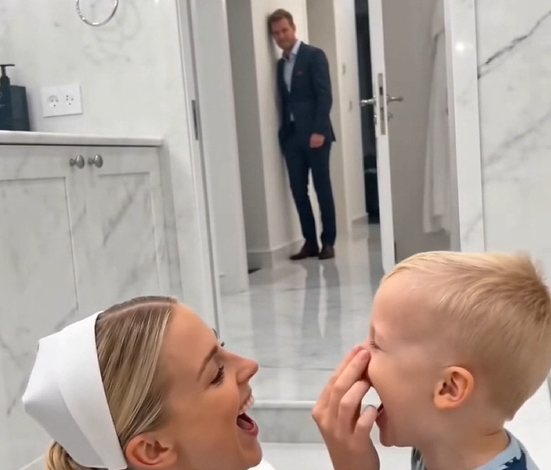
Ethan had built his whole adult life on systems.
His family’s hotel chain had expanded because nothing was left loose. Staff manuals were thicker than some novels. Every guest complaint had a coded response. Every room, every scent in the lobby, every folded sheet corner existed because order was profitable.After his first wife died, he brought that same logic home.
Noah had only been four then. Too young to explain why he suddenly started panicking at little things. A shirt collar. Wet hair. A hand under his chin. The pediatric consultant called it a stress response. A child psychologist said transitions had to be managed carefully. A private nurse suggested reducing sensory surprises. All of it got translated, in Ethan’s hands, into protocols.
There were charts for meals. Charts for bedtime. Charts for clothing changes. Charts for bathing. Charts for “face care tolerance.”
The house got quieter and cleaner. Noah got worse.
The worst part was how small the trigger looked to outsiders. It was only a washcloth. Only a face. Only twenty seconds at a sink. But the second someone said, “Hold still,” his whole body acted like danger had entered the room.
His breathing sped up. His shoulders locked. His mouth opened in raw panic before anyone even touched him.
And because adults were determined to finish what they had started, the scene kept proving him right.
By the time Marisol arrived, Noah already knew what a bathroom meant in that house. A bright light. Running water. A cloth. Adult hands. Calm voices that came right before force.
Marisol didn’t know the clinical language. She didn’t know what the consultants had billed. She only knew the look on a kid’s face when grown-ups had turned one small task into a fight that swallowed the whole room.
At first, Ethan did what he always did. He watched the breakthrough at the bathroom door, then immediately asked, “What exactly did you do?”
Not “Is he okay?” Not “Why does he look different?”
What exactly did you do.
Marisol stood up slowly. Noah was still clutching two fingers of her hand.
“I made him laugh first,” she said.
Claire gave a short, sharp exhale. “That is not an answer.”
Marisol looked at Noah, not Claire. “He thought the cloth was coming for him again. So I let it wipe the sad face off the mirror before it came near his skin.”
Noah, cheeks wet, lifted his hand and patted the glass where the smile had been.
Ethan noticed something then that he hated missing: his son was not just calmer. He was participating.
“Let’s finish,” Claire said briskly, stepping in with the old folded cloth from the tray. “Now that he’s regulated.”
The second Noah saw her take the cloth the old way, his body snapped tight again. He yanked himself behind Marisol’s leg, breath turning ragged.
Claire’s jaw hardened. “This is exactly the issue. Boundaries. He cannot start associating basic care with one temporary employee.”
Marisol didn’t move. “He’s associating it with not feeling trapped.”
Silence dropped into the tiled room.
No one in that house spoke to Claire like that.
Claire recovered first. “You were told to follow the schedule.”
“And he’s been screaming on schedule for months,” Marisol said.
Ethan should have shut it down right there. That was his usual move. Restore order. Enforce roles. End debate.
Instead he looked at Noah.
Noah had one fist twisted in Marisol’s shirt. The other hand was flat against his own chest, a habit he had when he was trying to keep from spiraling. But he wasn’t looking at the sink anymore. He was looking at the mirror.
At the place where a stupid little steam smile had changed the air.
“Finish it your way,” Ethan said at last.
Claire turned to him so fast her bracelet hit the counter. “Excuse me?”
He didn’t answer her. He kept watching Noah.
Marisol breathed on the mirror again. This time she drew one smiling face and one angry one. “Which one gets cleaned first?”
Noah made the smallest sound. It wasn’t a word. More like breath catching on meaning.
He pointed to the angry one.
Marisol wiped it away.
Then she held the cloth up to her own cheek first. “Now me.”
Then the back of Noah’s hand. “Now your hand.”
Then, slowly, she touched the edge of his chin. Not holding. Not pinning. Waiting.
Noah flinched, but he didn’t bolt.
When the cloth touched just under his eye, he made a strained little noise and shoved his face into her shoulder. Marisol let him do it. She didn’t peel him off. She just waited, then pulled back enough to fog the mirror again.
Another smile. Another wipe. One cheek. Pause. Another smile. Another wipe.
By the end, his face was clean.
Noah looked exhausted, suspicious, and stunned. Like he’d survived something that was supposed to hurt and somehow hadn’t.
Then he did the thing that changed the house more than Ethan understood in that second.
He reached up and touched Marisol’s face with the damp cloth.
One swipe across her nose.
A six-year-old’s uneven attempt at returning the gesture.
Claire left the bathroom before anyone could see her expression collapse.
That night she sent Ethan three clipped surveillance videos from the upstairs hall camera and the bathroom entrance camera.
Not the whole event. Only slices.
One showed Marisol ignoring the prepared tray. One showed her on the floor instead of standing professionally. One showed Noah clinging to her shirt. And one, carefully cropped, made it look like she had blocked Claire from approaching the sink.
The text under the clips was clean and strategic.
This is overstepping. She is creating dependency. She is undermining structure and encouraging regression. Temporary help should not be allowed to redefine care in this house.
Ethan watched the clips in his office with the sound off first, because that was how he handled hotel incident footage. Remove noise. Review behavior. Identify deviation.
Then he watched them again with sound.
This time he heard what the clipped angles had hidden.
Noah’s crying changed pitch when Claire stepped in. It softened when Marisol spoke. It stopped altogether when she made him choose the mirror face.
He reopened the full security archive.
For once he did not watch for employee error. He watched for his son.
He saw how every previous caregiver approached the sink the same way: shoulders squared, cloth prepared, adult certainty first. He saw Noah recoil before contact almost every time. He saw the old pattern nobody had named because everyone was too busy calling it resistance.
The adults entered the bathroom like a procedure. So Noah met them like a threat.
The next morning Ethan canceled a breakfast meeting and stayed home.
Claire noticed immediately. She was dressed already, polished and composed, standing in the sunlit family lounge with coffee she barely touched.
“I assume you’ve reviewed what I sent,” she said.
“I reviewed more than what you sent.”
That made her still.
“He needs stability,” she said. “Not improvisation from a girl who stocked cereal boxes last month.”
Ethan had learned enough about Marisol in one file to know Claire wasn’t wrong on paper. No formal childcare degree. No private-family references beyond one elderly neighbor and a church nursery. Oldest of five. Worked produce, inventory, and front register. Took the job because the agency had called in a panic and she needed extra money fast.
And yet she had done in six minutes what his experts had failed to do in six months.
“What he needs,” Ethan said, “is to stop treating a washcloth like an assault.”
Claire’s eyes narrowed. “That is a grotesque exaggeration.”
“No. It’s what I’ve been watching.”
She set down the cup. “You are letting one emotional moment erase consistency. This is why children manipulate fractured homes. They learn where the weakness is.”
That sentence sat between them like poison.
Ethan did not raise his voice. “He’s six.”
Claire folded her arms. “And already being taught that rules disappear if he panics enough.”
From the hallway came a small sound. Both of them turned.
Noah stood there in socks, hair flattened on one side from sleep, holding the dinosaur pajama top he had refused to change out of. He was looking past them, scanning the room.
Looking for Marisol.
Claire softened her tone instantly. “Good morning, sweetheart. Let’s get washed up.”
Noah backed up so fast he hit the wall.
Marisol appeared from the service hall carrying a basket of fresh towels from the laundry room. She froze at the tension in the room, then set the basket down.
Noah moved toward her without speaking.
Not running. Not dramatic. Just a direct, unmistakable choice.
He took her hand and pressed his forehead against her arm.
Claire laughed once under her breath, but there was no humor in it. “You see? Exactly.”
Marisol looked trapped. She was too young, too new, and too aware of what rich adults could do with one decision. “I can step back,” she said quietly.
Noah’s fingers closed harder around her hand.
Ethan saw the panic begin again just from hearing the possibility.
And for the first time, instead of protecting structure, he protected the moment.
“No,” he said. “You won’t step back.”
Claire stared at him.
He wasn’t finished.
“From now on, no more hallway interventions, no more forced completion, no more treating every care task like a timed drill. If he needs to laugh before he washes his face, then he laughs.”
Claire’s control slipped. “You are letting household staff dictate parenting.”
“No,” Ethan said. “I’m noticing parenting failed.”
That landed hard.
Claire did not scream. People like Claire rarely did. She became colder, which was worse.
For the next week, her resistance got smarter.
She didn’t openly attack Marisol in front of Noah. She documented. Timed. Noted deviations. Mentioned hygiene standards. Asked the house manager why the laundry room door was being left open during care transitions. Pointed out that condensation on mirrors left streaks on imported glass. She used the language of management because that was the language Ethan had always trusted.
But Noah kept changing in ways no spreadsheet could dismiss.
On day three, he let Marisol wipe both cheeks without crying. On day five, he wiped the mirror himself first. On day seven, he touched the cloth to his forehead before she did. On day nine, he whispered, “mad face,” then erased it.
That was his first voluntary phrase in a bathroom in months.
The breakthrough spread because it came from the same logic every time. Marisol did not ambush him with care. She gave his fear somewhere else to go first.
If he stiffened at the sink, she fogged the glass. If he dreaded the bedtime wash, she made the mirror yawn and close sleepy eyes. If he panicked after lunch, she drew a milk mustache smile and let him clean that one first. Sometimes she let him hold the cloth. Sometimes he wiped her cheek before she touched his. Sometimes they stood in the laundry room doorway instead of inside the bathroom until he was ready to cross the tile.
Tiny things. Ordinary things. But in that house, ordinary had been missing for a long time.
Ethan started coming home earlier, at first to observe, then because he wanted to be there. He saw something humiliating in those evenings: his son did not need more expertise. He needed less threat.
One night he found Marisol crouched by the laundry room with Noah, both of them breathing fog onto a handheld mirror she’d borrowed from a guest room because the bathroom mirror had been cleaned too dry to catch enough steam.
“Mirror broke?” Ethan asked.
Marisol looked up. “Housekeeping keeps polishing the game away.”
Noah actually smiled.
It was quick, almost private, but Ethan saw it.
So he knelt down in a pressed dress shirt and expensive slacks, feeling ridiculous, and breathed on the mirror too. Nothing appeared at first.
Noah took the mirror from him, turned it the right way, and made a face on the fog with one finger.
Three dots and a crooked line.
Then he handed the cloth to his father.
Ethan understood the invitation and the test.
He did not say hold still. He did not reach fast. He wiped the mirror face first.
Then, when Noah leaned in just a little, Ethan touched the cloth to his son’s cheek and stopped there.
Noah didn’t scream.
The look on Ethan’s face after that was not triumph. It was grief.
Grief for all the times he had mistaken completion for care. Grief for the way his own house had trained his son to expect calm cruelty wrapped in perfect manners. Grief for how much of his child he had outsourced because pain made efficiency feel safer than closeness.
Marisol saw it and looked away, giving him the dignity of not having his shame witnessed too directly.
Claire did not stop. She escalated.
Two days later, when Ethan was downtown, she told the house manager Marisol was no longer needed for the afternoon routine. She said Ethan wanted Noah weaned off “special handling.” By four o’clock, the old tray was back at the sink. Cloth folded. Water temperature checked. Lights bright.
Noah saw it and began shaking before anyone touched him.
Claire tried the soft voice first. Then the firmer one. Then the old line: “We are going to do this now.”
When the cloth lifted, Noah screamed so violently he knocked the tray into the sink. Metal clanged. Water splashed the floor. He ran barefoot into the hall and nearly collided with Marisol, who had just come in through the service entry with grocery bags.
He wrapped both arms around her waist and hid his face in her shirt.
Claire came down the hall, controlled but flushed. “Step aside.”
Noah made a sound Marisol had never heard from him before. Not a cry. A clear, broken word forced out of terror.
“No.”
Claire stopped.
Marisol’s hands hovered in the air, not touching him until she was sure. Then she rested one palm lightly on his back. “Okay,” she said. “Nobody’s doing it.”
The front door opened.
Ethan had returned early because the house manager, rattled by the screaming, had called him directly.
He took in the scene in one pass. Wet footprints. Towel tray abandoned. Claire rigid in the hallway. Noah clinging to Marisol so hard his whole body trembled.
“What happened?” Ethan asked, though he already knew enough.
Claire answered first. “He needs to stop this dependency now.”
Ethan looked at Noah. “Did anyone tell Marisol to leave the routine?”
Claire lifted her chin. “I did. Because someone had to.”
Noah turned just enough to see his father. His face was blotched, wet, and wild. Then he did something no consultant, no report, and no camera edit could reduce.
He reached one hand behind him, blindly searching for the cloth in Marisol’s fingers. When he found it, he held it up toward Ethan with a shaking hand, then pointed to the dark hallway mirror beside the laundry room.
He wanted the game. Not escape. Not delay. The game.
He was showing his father the difference.
Ethan crossed the hall, took the cloth, and breathed onto the mirror. The fog came light but visible. With one finger he drew the lopsided smile Noah knew.
Noah’s sobs broke apart into hitching breaths.
Marisol crouched beside him. “Mad face or scared face?” she asked.
Noah swallowed hard. “Scared.”
She drew round eyes and a wobbly mouth in the steam over Ethan’s smile.
Noah stepped forward. Not to Claire. Not to the old tray. To the mirror.
He wiped the scared face away himself.
Then he turned and let Ethan clean under one eye.
Claire understood in that second that she had lost the argument that mattered. Not the staffing one. The moral one.
This was no longer about a temporary worker crossing a line. It was about a child telling the truth with his body.
Ethan straightened and said, very evenly, “This ends now.”
Claire’s face went pale. “You’re humiliating me in front of staff.”
“No,” he said. “You humiliated my son in front of a procedure.”
She left the hall without another word. By the next week, she had moved into the guest wing, and not long after that, out of the house entirely. Officially it was a separation over “parenting differences.” In reality, it was about power. She could manage a polished home. She could not survive a home that started admitting what it had gotten wrong.
After she was gone, the estate felt different in small, almost embarrassing ways.
Bathroom doors stayed open more. There was laughter near sinks. Hand towels got used messily instead of decoratively. The laundry room stopped being just a hidden service space and became Noah’s reset spot, where he stood in the doorway when he needed one step of distance before doing a hard thing.
And Marisol, who had entered the house as emergency help, refused to become a permanent emotional crutch just because the family now loved her.
That was the part Ethan respected most.
When Noah started reaching for her for every difficult task, she didn’t feed it. She helped him hand pieces back to himself.
She let him draw the face. Then choose the wipe. Then wash one cheek alone. Then both. Then wash her face and his. Then stand at the sink while she waited at the doorway. Then call for his father instead.
The first time Noah cleaned his own face from start to finish, there was no dramatic speech. He stood on the step stool in dinosaur pajama pants, breathed on the mirror, drew a terrible smile with a giant nose, laughed once, and wiped his own cheeks while Ethan watched from the hall.
When he was done, he looked around for Marisol automatically.
She was in the laundry room folding towels.
He took two steps toward her, then stopped. Thought about it. Turned back. Hung the cloth on the rack by himself.
It was such a small act. And it hit both adults like a blow.
Because that was the real goal. Not that he would need her forever. That he finally wouldn’t.
By the end of the month, Noah no longer cried when a cloth touched his face. He still preferred the mirror game when he was tired, and sometimes after bad dreams he wanted Marisol nearby, but the fear had stopped owning the room. He could wash up with Ethan. He could finish after starting. He could pause without collapsing. The old impossible thing had become ordinary.
Ethan offered Marisol a full-time contract, then a larger one, then one generous enough to change her life.
She surprised him by negotiating.
Not for jewelry, clothes, or some fantasy upgrade Claire might have expected.
She wanted predictable hours. A raise sent partly to her mother’s account. Time on Tuesdays and Thursdays for community college classes she’d postponed twice. And one more thing.
“No cameras used to judge care clips without full context,” she said.
Ethan almost smiled. “Fair.”
She stayed, but on terms that kept her from disappearing into the machinery of the house.
Months later, a family friend visited and saw Noah at the upstairs sink brushing his teeth while chattering to his father about whether a fog smile needed eyebrows to count. The friend said, shocked, “I thought he couldn’t handle any of this.”
Ethan looked at his son in the mirror. Noah caught his eye and, with solemn importance, breathed one small cloud onto the glass and drew a smile in it just to make sure his father was paying attention.
“He couldn’t,” Ethan said. “Until somebody stopped trying to win and started trying to meet him.”
What changed the Hale house was not money, or a specialist, or another stricter plan.
It was a supermarket stock clerk who had raised too many younger kids to confuse obedience with comfort, and a child who needed to be caught by something happy before he could face what scared him.
In the end, Noah did not become more dependent on her.
He became less afraid without her.
And that was how everyone in the house knew the healing was real.