THE LITTLE BOY WHO SCREAMED EVERY EVENING UNTIL A GROCERY CLERK ROLLED BLUEBERRIES ACROSS A MARBLE COUNTER

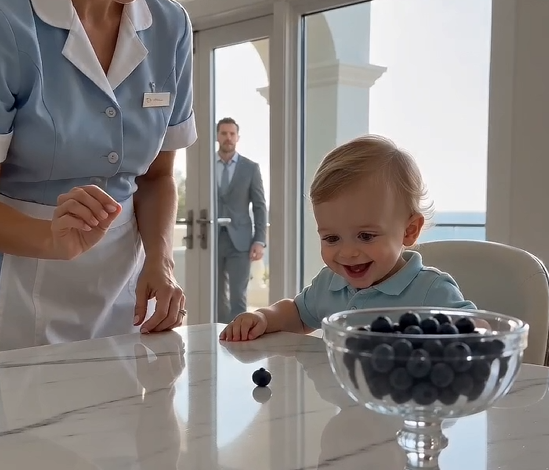
Miles Hawthorne stood in the kitchen with one hand still on his suitcase handle and watched his son cling to a temporary caregiver like she was the only stable thing in the room.
It should have looked absurd.Blueberry juice dotted the marble. One berry had rolled off the counter and burst near the sink. Oliver’s dinner shirt was wrinkled. Wren’s sleeve had a purple stain on it. Vanessa was furious. The house manager looked horrified. Through the glass wall of the dining room, the table waited under perfect lighting, every place setting untouched.
And yet that ugly little mess was the calmest Oliver had looked at dinnertime in almost a year.
“Oliver,” Vanessa said in the voice she used when she wanted staff to move faster and children to become decorative. “Let go. We do not eat like this.”
Oliver pressed his face harder into Wren’s side and made a raw, panicked sound.
Not anger. Fear.
Miles knew the difference. He just had not wanted to admit it.
For months, everyone around him had used polished words. Transition difficulty. Oppositional behavior. Sensory resistance. Pre-meal dysregulation. Every expensive expert had described the same thing in a different accent while his son kept breaking apart at six o’clock.
But standing there, Miles saw something brutally simple.
The child was starving before he was ever allowed to eat.
Not starving in the dramatic sense. Not neglected. The refrigerator was always full, the chef was always present, and the dining room looked like a magazine spread every night.
But Oliver was hungry in a house that had turned food into a performance.
“Mr. Hawthorne,” Vanessa said, sharp now, “this has to stop immediately. She’s encouraging chaos. He can’t learn that rules disappear because he screams.”
Wren finally looked up. Her face had gone pale, but she did not try to defend herself with fancy language.
“He wasn’t screaming to get out of rules,” she said quietly. “He was screaming because he needed to eat an hour ago.”
Nobody answered.
Oliver’s breathing slowed against her.
The old nanny, Elise, held out a folded napkin like a white flag from the wrong army. “If we reestablish the dinner routine now, we may still salvage the evening.”
Salvage the evening.
Miles looked through the glass at the long dining table, at the polished forks and water goblets and candles nobody needed. Suddenly it all looked insane. Six adults had been trying to salvage a meal while one small boy lost his mind in front of them.
Vanessa crossed her arms. “She rolled unwashed fruit across a counter by the sink. This is exactly why boundaries matter. If you let staff improvise, you get this.”
Wren’s jaw tightened at the word staff, but she kept one hand lightly on Oliver’s back. She did not hold him like property. She held him like someone steadying a child on ice.
Miles knelt until he was eye level with his son. “Ollie.”
Oliver did not look at him.
His eyes stayed on the last three blueberries in Wren’s palm.
“Do you want one more?” Wren asked softly.
Oliver nodded.
She placed one on the marble and rolled it only a few inches this time. Oliver caught it fast and ate it. No scream. No gagging. No fighting. Just a hungry child taking food.
Then he did something nobody in that house had seen in weeks.
He whispered.
“Again.”
Miles felt the word land in his chest like a blow.
Oliver had not spoken at dinner hour for so long that even two syllables felt impossible. Yet here he was, voice rough but real, asking not for escape, not for a toy, not to leave the room.
Again.
Wren rolled another berry.
Vanessa let out a cold laugh. “So now the dinner plan is chasing produce around a breakfast bar?”
Wren answered before Miles could. “No. The plan is that he eats before he falls apart.”
Vanessa turned to Miles. “If you keep her after this, you’re telling your son structure means nothing.”
Miles looked at Oliver.
Then he looked at the crystal dining room beyond him.
For the first time, he asked himself a question he should have asked months earlier: structure for whom?
For the child? Or for the adults who wanted to feel in control?
“Everyone out,” Miles said.
Silence.
Vanessa blinked. “Excuse me?”
“The dining room is done for tonight. Staff can leave the meal. Elise, thank you, but we won’t continue the routine. I need everyone out except Wren.”
Vanessa stared at him as if he had broken furniture with his bare hands. “You are making a terrible mistake over one random lucky moment.”
Oliver flinched at her voice.
Miles stood. “Out.”
It was the first time anyone in that house had interrupted Vanessa when she declared how a family should function. She went still, then colder. “Fine. But if he regresses again tonight, don’t pretend this little stunt was care.”
She walked out of the kitchen in controlled fury. The house manager followed. Elise hesitated, then set down the napkin and left too.
The house became quieter, but not the dead quiet it had before. This was the sound of something false being peeled away.
Wren stayed where she was. “I’m sorry,” she said. “I know I should’ve asked. It’s just… he kept staring at the blueberries like they were rescue boats.”
Miles almost laughed at the bluntness of it, but shame got there first.
“How long have you been seeing this?” he asked.
“Since yesterday.”
“Yesterday.”
Wren nodded. “He circles the kitchen before dinner. He watches the bread basket when nobody’s looking. He gets shaky around five. Then everybody starts correcting him. By the time he sits down, he’s done.”
Miles leaned against the counter and rubbed a hand over his mouth.
He had built whole hotels around guest comfort, studied service patterns, measured lighting, noise, guest flow, response timing. He knew exactly how to keep strangers calm in luxury spaces.
And yet in his own home, his son had been treated with less practical sense than a tired business traveler.
“Why didn’t anyone tell me?” he said.
Wren glanced at the glass dining room. “Maybe they did. Just not in a way you could hear.”
That should have offended him. Instead, it felt true.
Oliver had released Wren’s waist by then, but only because he had started standing on his own, one hip pressed against the breakfast bar. Wren took a slice of soft dinner roll from a side plate, tore off a small piece, and rolled that too.
He chased it.
A bite at a time, he ate half the roll.
No ceremony. No commands. No silverware lessons.
Just food, movement, breath.
Miles stayed and watched every second.
That night, he canceled the formal dining service for the child.
It was not a dramatic announcement. He simply told the kitchen that Oliver would no longer be required to wait through cocktails, adult pacing, seating order, or plated service. A small tray would be available at five with simple food he could touch, carry, and eat while moving if needed.
The resistance hit immediately.
Vanessa came to his study before nine o’clock wearing silk and anger. “You embarrassed me in front of the staff.”
“This isn’t about you.”
“It became about me the moment you let a temp undermine the whole house.”
“She fed my son.”
“She taught him to reject the table.”
Miles looked up from the untouched reports on his desk. “The table has been rejecting him for months.”
She laughed once, disbelieving. “You are overcorrecting because you feel guilty.”
Maybe he was. But guilt was not the reason Oliver had whispered again.
The next evening proved it.
At five-fifteen, Oliver started pacing. His hands fluttered at his shirt hem. Usually that was the beginning of the slide. Wren was at the sink rinsing strawberries and blueberries in a colander because Vanessa had made an ugly point the night before about cleanliness. Wren did not argue with the point. She just adapted without giving up the method.
“Want red or blue first?” she asked.
Oliver froze.
It was a real question. Not a test. Not a trap.
He stepped closer and touched a blueberry.
Wren set five blueberries in a row on the breakfast bar and nudged the first one. It rolled. Oliver grabbed it. Ate. Then another. Then she added cubes of cheese and little pieces of chicken, letting them slide and spin on the smooth stone. He moved after them, standing, shifting, leaning, choosing.
Miles watched from the kitchen doorway in his shirtsleeves, deliberately not entering too fast, afraid his presence might change the air.
It did not.
Because the point was not Wren herself in some magical sense.
The point was what she allowed.
Movement before stillness. Food before performance. Choice before correction.
When Oliver had enough in his stomach, he let Wren wipe his fingers. Then, astonishingly, he walked with her to the glass dining room and sat for seven whole minutes while she put a tiny plate in front of him. He did not eat much there. That was not the miracle. The miracle was that he did not arrive to the chair already in pieces.
Miles felt his old logic split.
All this time he had thought success meant making Oliver adapt to the room.
Wren was making the room adapt to Oliver.
Vanessa’s opposition only sharpened as the week went on.
She began with comments: “This creates dependency.” “He’ll only eat for her now.” “You’re rewarding bad habits.” But once she saw Miles listening, the comments became action.
On Friday she ordered the kitchen staff not to leave fruit on the breakfast bar between four and six.
Wren found the bowls gone and understood immediately.
She said nothing. She took grapes from the refrigerator drawer, cut a pear into little chunks, and used them instead.
Oliver ate.
On Saturday Vanessa instructed security to check temporary staff credentials at every reentry point. Wren arrived from her lunch break and found her pass blinking red.
The guard was embarrassed. “Ms. Vale told us your clearance was suspended pending review.”
Oliver was in the family lounge within sight of the front hall. He saw Wren stopped at the scanner and instantly dropped the toy car in his hand. His face changed. His chest started pulling air too fast.
The old pattern could still come back that quickly.
Vanessa appeared behind the guard in a cream sweater, calm as glass. “A household with a child this vulnerable cannot tolerate improvisation and sanitation risk.”
Wren stood there with a paper bag from the pharmacy and the same cheap sneakers she had worn on day one. She looked young, tired, and very close to being sent back to the life she had come from. A supermarket schedule. Her little brother’s texts asking if she could send money for field trip fees. Her sister needing rides. No cushion. No pedigree. No protected place in this kind of house.
Vanessa knew exactly what she was threatening.
Not just employment.
Erasure.
“You can’t do this in front of him,” Wren said quietly.
“I absolutely can,” Vanessa replied. “He needs consistency.”
Oliver ran forward before anyone could stop him. Not to Vanessa. Not to his father, who had just come down the stairs after hearing the raised voices.
To Wren.
He hit the scanner pedestal with his shoulder, wrapped both arms around Wren’s hip, and screamed, “No!”
It was loud enough to echo through the marble foyer.
Then he did one more impossible thing.
He turned toward Vanessa and shoved her hand away when she reached to pry him loose.
Every person in that entry hall froze.
Because Oliver had never defended a caregiver before. He had clung in panic, yes. He had resisted transitions, yes. But this was different. This was choice. Clear and unmistakable.
He was not choosing ownership. He was choosing the bridge that had helped him cross.
Vanessa looked shocked, then furious. “Miles, this is exactly what I warned you about. He is attached to a stranger.”
Wren, despite Oliver clinging to her, shook her head. “No. He’s attached to not being hungry and scared.”
Miles looked from his son’s white-knuckled grip to the deactivated access panel.
He thought of the leather dinner binder. The rotating specialists. The layers of outsourced care. The reports. The protocols. The adults protecting hierarchy while a child begged for relief in the only language left to him.
Something in him hardened.
“Turn her access back on,” he told the guard.
“Sir—” Vanessa began.
“Now.”
The green light came back.
Vanessa took a step toward him, lowering her voice. “If you let this continue, you are handing family order to a grocery clerk.”
Miles met her eyes. “No. I’m taking it back from people who mistook control for care.”
That was the beginning of the end for Vanessa.
She lasted another ten days in the house, though emotionally she was gone that afternoon. She could not tolerate a world where polished authority no longer outranked plain truth. Every compromise offended her. The breakfast bar being stocked with finger food. Oliver being allowed a stool by the sink. Dinner moving earlier for him than for adults. Staff speaking to him like a child instead of a trainee for a banquet.
She called it lowering standards.
Miles began to see it more clearly. It was not standards she cared about. It was power through standards.
The relationship ended without fireworks. She suggested they wanted different things. He agreed. She said he was building chaos. He said he was building a home.
When she left, the house did not feel emptier.
It felt breathable.
Wren tried to resign at the end of her scheduled week.
She stood in the kitchen at the same breakfast bar where the first blueberry had rolled and twisted the strap of her bag in her hands. “Your agency probably found somebody more qualified by now.”
Miles almost smiled at the word qualified.
Oliver was on the floor nearby pushing crackers across a tray to line them up for later. Not frantic. Not starving. Just playing near food the way children did when food was not a threat.
“I don’t want another team,” Miles said.
Wren blinked. “I’m not a career nanny.”
“I know.”
“I stock cereal and canned beans at Westlake Market.”
“I know that too.”
She hesitated. “Then what are you asking?”
The honest answer surprised them both.
“Teach me what you’re doing,” Miles said. “Not because I expect you to stay forever. Because I should have known it before now.”
Wren stared at him for a second, then looked away, uncomfortable with being taken seriously in a house that had spent days treating her like an accidental spill.
“It’s not complicated,” she said. “That’s kind of the point.”
But it was complicated to people who had hidden from simple things behind expensive systems.
So she taught him.
Not in a lecture. In little ordinary repetitions.
She showed him how Oliver’s shoulders rose when he needed food before he had words for hunger. How offering two tiny choices prevented a battle. How standing side by side at the breakfast bar worked better than facing him across a formal place setting. How movement could be part of eating instead of the enemy of it. How a child who had been corrected through every meal needed a few bites of success before he could tolerate a chair. How not every dependence was possession. Sometimes it was transition.
That became the lesson Miles held onto hardest.
At first Oliver wanted Wren for every pre-dinner step. Wren washed fruit, rolled bites, stood by the sink, handed him soft rolls torn into small pieces, sat on the stool while he leaned against her leg.
Vanessa would have pointed and said, See? Dependence.
Wren saw something else. She began stepping back in inches.
One night she had Miles roll the blueberries.
Oliver frowned at the substitution. Wren stayed beside them, not touching, just smiling. “Same game,” she said.
Oliver caught the first berry from his father’s hand. Then the second.
Another night Wren rinsed the fruit but had Miles set the line across the marble.
Another night she told Miles to stop talking so much and just breathe slower because Oliver was matching him.
Another night she left the room for ten seconds, then thirty, then two minutes, while Oliver kept eating with Miles at the breakfast bar and only glanced toward the doorway once.
Dependence was not a cage when it was used correctly.
It was a bridge that disappeared after someone had crossed.
Over the next two months, the glass dining room changed too.
Not physically at first. The same table remained, the same lighting, the same impossible shine. But the ritual lost its cruelty.
Oliver no longer had to arrive starving to prove he deserved a seat. He could eat some food before dinner. He could stand, perch, leave, return. He could use his fingers for berries and a fork for pasta and not have the whole room tense up like civilization was collapsing. If he was hungry at five, he ate at five. If he needed the stool by the sink first, he got it.
Miles also changed in ways the staff noticed before he did.
He came home earlier. He canceled calls during Oliver’s dinner window. He stopped outsourcing every hard part to rotating professionals with binders. He learned how to rinse fruit, tear bread, soften butter, and roll blueberries with exactly enough force to keep them moving but not flying off the edge.
The first time he did it right, Oliver laughed.
Not a huge movie laugh. Just one short burst through his nose. But in that quiet kitchen, it sounded bigger than the house.
By early fall, Oliver no longer screamed every evening.
Some days were still hard. If he was overtired, he cried. If guests came, he got rigid. If someone tried to rush him into the glass dining room before he had settled, he resisted.
Healing had not turned him into an easier child.
It had turned the adults into more responsive ones.
That mattered more.
Wren did not become a permanent ornament in the Hawthorne household, and she did not become some miracle mother figure replacing everyone else. She kept her life. She cut back hours at the grocery store, then eventually left when Miles paid for a child development certification program at the local college after discovering she had once wanted to study early education but had given it up to help at home.
She accepted only after making one thing clear.
“I’m not taking money because I fixed him,” she told Miles.
He shook his head. “You didn’t fix him.”
She looked toward the kitchen, where Oliver was pushing blueberries across the bar toward his father, who pretended to miss them on purpose.
“You showed me he never needed fixing,” Miles said. “He needed feeding. And he needed us to stop turning love into a procedure.”
Wren smiled then, small and embarrassed by praise, but she stayed long enough to make sure Miles could keep the rhythm without leaning on her for it the wrong way.
That was the final shape of what she gave them.
Not rescue. Not replacement. A transfer.
On her last regular evening in the house, Oliver stood at the breakfast bar in sock feet while the sunset turned the glass dining room gold. Wren washed a handful of blueberries and set them in a little white bowl.
Oliver looked at her, then at his father.
“Daddy roll,” he said.
Miles did.
One berry, then another, moving across the marble near the sink.
Oliver chased them with both hands, laughing softly. After the fourth one, he leaned against his father’s arm instead of Wren’s.
It was a tiny shift. So small most people would have missed it.
Wren saw it immediately.
So did Miles.
Oliver did not stop loving the person who had first reached him. He just no longer needed to use her as the only way across.
That night, after Oliver ate enough to sit calmly for part of dinner, he carried one last blueberry in his fist and pressed it into Wren’s palm like a gift he understood in his own child way.
Then he went back to the table on his own.
Wren closed her fingers around the fruit and looked out through the glass at the father and son sitting there. Not perfect. Not polished. Not performing. Just together.
The house was still beautiful.
But now it finally looked lived in.
And every evening after that, before the dining room lights came on, a man who had once trusted only rules stood by a sink with his son and rolled blueberries across marble until hunger stopped feeling like a crime.