Four Months of Him Walking Away and the Answer Was My Own Hands

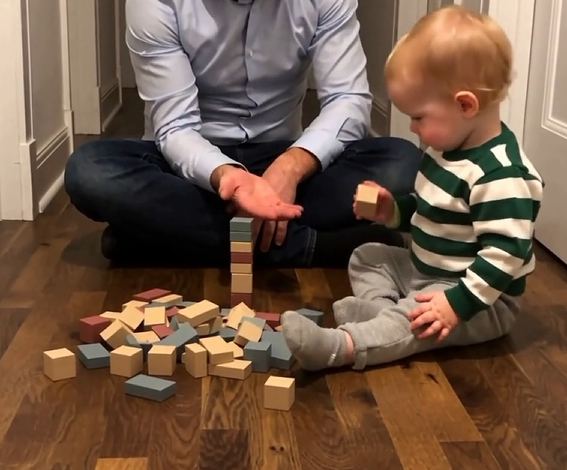
Here is what you have to understand about that, and it is not obvious from the video.
Freddie’s father was not a sitting-on-the-floor man.
Not from coldness. From the thing a lot of fathers of small children have, which is the conviction that their job is to be useful. He was good at bedtime, good at bath, excellent at logistics, a man who had read the manuals and installed the car seat correctly on the first attempt.
What he was bad at was doing nothing in the vicinity of his son.
If Freddie struggled with something, he fixed it. If Freddie dropped something, he picked it up. If Freddie built a tower, he straightened it — gently, helpfully, reflexively, the way you’d straighten a picture frame.
And for about four months, Freddie had been getting up and walking away from him.
Not dramatically. He just didn’t stay. He’d play on his own for twenty minutes and the second his father sat down to join in, he’d be off to another room inside ninety seconds, and his father had started to take this personally in a way he hadn’t admitted to anybody, including his wife, including himself at three in the morning.
She’d said once, mildly, from the kitchen: “You fix his stuff.”
He’d said, “I’m helping him.”
And she hadn’t pushed it, because she’s cleverer than that, and because some things you have to work out yourself while sitting in a hallway.
So he sat down.
He sat down on the floorboards cross-legged, about two feet from his son, and he did not touch the tower.
He wanted to. You can see it in the video if you know what you’re looking for — the hand comes up about three inches at one point, toward the lean, and then goes back down into his lap.
Instead he picked up one loose block off the floor and put it on the boards near Freddie’s hand.
And then he put both hands in his lap and left them there.
Freddie looked at the block.
Then he looked up at his father’s face — a proper look, a couple of seconds, checking something.
Then he picked it up and put it on the tower.
And he stayed.
He stayed forty minutes.
That is the actual event. Not the tower, which fell over eventually in the way all of them do, and not the laugh, which came when it did. The event is that a one-year-old who had been leaving the room for four months sat on a hallway floor with his father for forty minutes.
The rule, which was never stated out loud and which his father worked out that afternoon and has basically lived by ever since: you can hand him a block. You cannot place it.
It sounds like nothing. It’s the entire difference.
A block handed over is an offer. A block placed on the tower is a correction, and a one-year-old can feel the difference instantly even though he has no words for it, and the one makes him stay and the other makes him go and find something else to do.
The tower fell at 4:50pm.
It fell because Freddie knocked it over on purpose, which is what one-year-olds do with towers roughly eighty percent of the time, and which his father — in a development his wife observed from the kitchen doorway with great interest — did not say anything about.
They rebuilt it. Badly. Then Freddie knocked that one over too.
They did this eleven times.
He’s five now and extremely competitive at Jenga, which he plays with a seriousness that his family finds funny and he does not.
He beats his father about a third of the time, which is roughly an honest rate; nobody in that house lets anybody win, which is also a rule that came out of the hallway and was never written down.
The 1986 set is still in use. It’s got a block missing — went under a radiator in 2023 and was never recovered — so they play with fifty-three, which Freddie insists is the correct number and will argue about with anyone.
And his father, who still isn’t naturally a sitting-on-the-floor man, has a thing he does when his son is struggling with something. It took years to learn and it is physically uncomfortable every single time.
He puts his hands in his lap.