Fourteen Months, and He Let Go of the Table

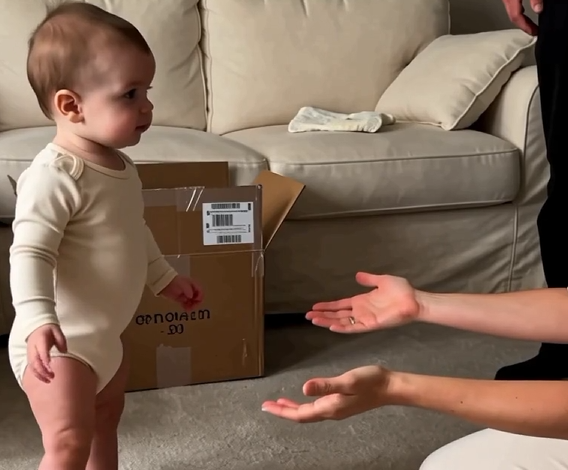
He didn’t walk.
That’s the part that gets left out when people tell this story back to her. He stood there grinning for maybe six seconds, and then he sat down on his bottom — not a fall, a decision — and crawled to her at speed.
The first steps came nine days later, in the kitchen, with nobody filming and nobody watching, from the dishwasher to the bin. Four of them. His father saw it from the hallway and shouted and he immediately sat down.
So the famous video, the forty-second one, is not of a baby walking.
It’s of a baby letting go.
And his mother has come to think that’s the better footage, for a reason she’s only ever managed to explain properly once.
She’d been told, over and over, that he’d walk when he was ready.
It’s the standard line. Every health visitor, every book, every forum. They do it when they’re ready. And she’d taken it the way most parents do, which is as a kind of soothing nothing — a thing people say to stop you worrying.
What she hadn’t understood until that Thursday is that it’s a literal description of a mechanical event.
He wasn’t failing to walk. He was declining to.
He could stand. He could balance. He’d had the physical equipment for weeks. What he didn’t have was whatever it is that makes a creature with no experience of its own abilities decide to remove its own safety.
And you cannot give someone that. You can’t coax it, train it, hold out your arms far enough, or want it hard enough on their behalf.
You can only be in the room.
She’s thought about it quite a lot since, because he’s seven now and it keeps coming round.
The swimming pool at four — three months of sitting on the step, and then one afternoon, in.
The bike at six — eleven weeks of refusing to let his father take the stabilisers off, and then one Saturday saying flatly, “Take them off,” and riding to the end of the road.
Reading, same. He wouldn’t attempt a word out loud for an entire school year. His teacher was kind about it and his mother was not calm about it, privately, at all. And then in one fortnight of February he went from nothing to reading road signs out of the car window.
Every time, the same shape. A long flat nothing, and then a hand coming off a table.
She’s stopped trying to speed it up. It took her about four years to stop. She still has to physically restrain herself, sometimes, the same way she did on that carpet with her arms out and a wobbling child four feet away who did not need to be caught.
The video gets shown at birthdays, which he finds mortifying in the way seven-year-olds find all of it.
He asked once, at five, why they keep that one when it’s “just me standing.”
She said, “Because you decided to.”
“Decided what?”
“To let go of the table.”
He thought about this and then said, with the devastating practicality of a five-year-old: “I had to, though. Otherwise I’d still be there.”
Which is, she concedes, also true.