THE BILLIONAIRE ORDERED ME TO STOP MY MESSY PAINT GAME WITH HIS SILENT SON, BUT AT THE CHRISTMAS GALA, THE BOY CHOSE ME OVER HIS OWN FAMILY

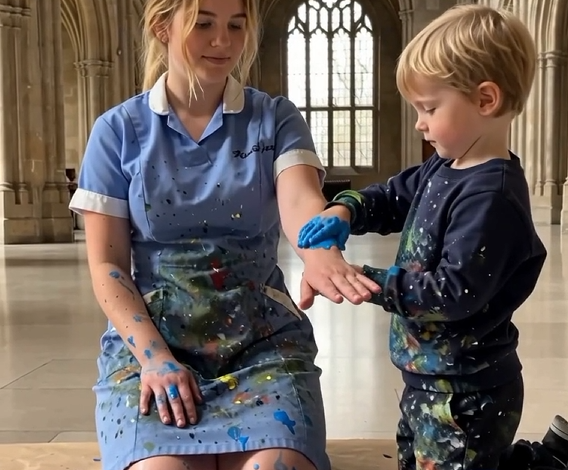
Seeing his son now, shaking against the knees of a twenty-four-year-old in a flannel shirt, Ethan understood that he had not been protecting Caleb at all. He had been laminating him. Sealing a hurt child under a layer of order so smooth and hard that nothing could get in — and nothing could get out either.
Eight months. He had counted it as progress that Caleb didn’t scream anymore.
He stepped inside and closed the door against the wind.
Avery looked up. She didn’t let go of the boy. “I’ll have him back in the house in ten minutes, Mr. Vance. Then I’ll go.”
“Don’t,” Ethan said.
She waited.
“Don’t take him back.” He heard his own voice come out wrong, scraped thin. “There are forty people in my conservatory and I don’t—” He stopped. Started again. “He put the cup on the floor. In front of all of them. What was that?”
Avery stroked the back of Caleb’s head, once. “He was giving it to you.”
“It’s a cup.”
“It’s the thing he chose this afternoon,” she said. “It’s the first thing in eight months he picked up because he wanted it instead of pointing at it until somebody fetched it. He carried it in his suit pocket to your party.” She said it without any heat at all, which made it worse. “He was trying to show you.”
Ethan stood in the middle of the carriage house in a snow-dusted tuxedo and felt something in his chest give way along a seam.
He looked at the floor. Then he sat down on it.
Not on the iron bed. Not on the chair. He lowered himself onto the braided rug in four thousand dollars of black tie, with his back against the leg of the dresser, and put his hands flat on his knees.
Caleb’s sobbing hitched.
“I’m not going to pick you up,” Ethan said. “I’m just going to be down here.”
The boy didn’t turn around. But his shoulders stopped shaking quite so hard.
Avery met Ethan’s eyes over the top of Caleb’s head, and she gave him the smallest nod — not approval, exactly. More like a signal. Now wait.
He waited.
It took, he estimated afterward, somewhere between four and six minutes. It was the longest stretch of time he had ever lived through. Through the frosted window he could hear the string quartet still sawing away at Pachelbel, could see the glow of the unlit tree’s floodlights, could picture Victoria managing the room with her teeth clenched behind a smile.
He didn’t move.
Eventually Caleb’s grip on Avery’s waist loosened. He turned his head, still pressed against her, and looked at his father sitting on the floor in a tuxedo with snow melting in his hair.
Ethan didn’t hold out his arms. He’d watched Avery long enough this week — through the kitchen doorway, pretending to check his phone — to know better than that.
He put one hand palm-up on the rug beside him and left it there.
Caleb looked at it for a long time.
Then he let go of Avery, crossed three feet of braided rug, and sat down in the gap between his father’s knee and the dresser. Not in his lap. Beside him. Close enough that his shoulder pressed against Ethan’s arm.
Ethan closed his hand slowly around his son’s small cold fingers, and discovered he couldn’t see anything, and discovered he didn’t care.
The conservatory door opened eleven minutes later.
“Ethan.” Victoria’s voice could have cut glass. She was standing in the doorway of the carriage house in emerald satin and ruined heels, snow in her hair, forty guests and one governor and one press photographer abandoned behind her. “The toast. The tree. The Bentley people are asking where you went.”
Ethan didn’t get up. “Tell them we’ll light it in the morning.”
“In the morning—”
“Caleb’s going to help me do it. When there’s nobody here.”
Victoria stared at him. “Do you have any idea what this looks like?”
“Yes,” Ethan said. “I’ve spent eight months knowing exactly what everything looks like. It’s the only thing I’ve been any good at.”
Something moved across Victoria’s face — and it wasn’t malice. That was the thing that struck him later, when he was fairer about it. It was fear. She’d walked into a house full of catastrophe eleven months ago and been handed a wrecked man and a silent child, and she’d done the only competent thing she knew: she’d made it all look correct. She had genuinely believed that was the same as making it better.
“I was helping,” she said.
“I know you were,” Ethan said. “I asked you to. That was my mistake, not yours.”
She stood there a moment longer. Then she looked down at the boy sitting on the floor holding his father’s hand, and she said, quietly, “He hasn’t done that since the funeral,” and turned and walked back across the terrace toward the lights.
Avery did not stay because she was begged to. She stayed because Ethan handed her back the brass room key at seven the next morning and said, badly, having rehearsed it and then forgotten all of it, “I don’t know how to do this and you do.”
“I don’t, actually,” she said. “I just don’t rush him.”
“Then teach me not to rush him.”
She turned the key over in her hand. “I’ll stay if the rules change.”
“Which rules.”
“All of them,” Avery said. “No pointing-as-communication being accepted — he can do more and we both know it, we just have to wait him out. No schedule for when he’s allowed to be upset. No suits. And the floors are going to get ruined, Mr. Vance. Not once. Continuously.”
Ethan looked around the entrance hall of a house his grandfather had built, at the limestone she’d scrubbed clean of blue tempera at midnight.
“They’re floors,” he said.
The tree got lit at nine o’clock that morning, in daylight, which is a stupid time to light a Christmas tree.
There were four people present: Ethan, Caleb, Avery, and a bewildered estate manager named Doyle. There was no string quartet. The conservatory still smelled of last night’s champagne and forty people’s perfume.
Caleb pressed the remote himself. He did not smile. He looked at the tree for a long while with an expression nobody could read.
Then he walked into the kitchen, came back with a bowl of popcorn from the catering leftovers, and held it out to his father.
Ethan didn’t understand. He looked at Avery, helpless.
Avery’s eyes had gone bright. “She used to string it,” she said. “Didn’t she.”
And Ethan — who had not been able to say his wife’s name out loud since March, who had removed every photograph of her from the ground floor because he could not walk past them — knelt down on the conservatory marble and said, “Yeah. Your mom did that. She used to do it in her socks and she’d eat half of it.”
Caleb nodded once.
It took them two hours and the garland was lumpy and the thread kept snapping and the boy still did not speak. But at some point in the second hour, when Ethan dropped an entire handful on the floor and swore, Caleb made a small sound — a huff of air through his nose.
A laugh.
The first one in eight months.
The first word came in February, nearly three months later, and it wasn’t Dad and it wasn’t his mother’s name.
It was “more,” said flatly to Avery at the kitchen counter, holding out the battered blue cup.
Avery nearly dropped the carton and had the presence of mind not to make a single sound about it. She filled the cup. She handed it back. She said, “Okay,” and went on unloading the dishwasher, and waited until the boy had left the room before she sat down on the kitchen floor and cried into a dish towel.
She told Ethan that evening. He asked, carefully, whether they should do something — call someone, mark it.
“No,” Avery said. “The whole point is that nothing happens when he talks. Same as nothing happened when he spilled the paint. He’s testing whether the world stays normal.”
So nothing happened. For weeks, every single time Caleb said a word, absolutely nothing happened, and that was the thing that let the words keep coming.
The house changed by subtraction, mostly.
The laminated daily schedule came off the mudroom wall. The camera Ethan had installed in the playroom came out of the ceiling. The two “quiet hours” vanished. Doyle stopped instructing the staff to speak in the hall-of-a-sick-person murmur they’d all fallen into, and the house slowly began to sound like somewhere people lived rather than somewhere someone had died.
A child psychologist came in the spring — a good one this time, recommended by a pediatrician rather than by a board member’s wife. She spent her entire first visit on the playroom floor doing very little, and at the end she told Ethan: “He’s not fragile. He’s braced. You’ve been treating the wrong condition since March.”
He wrote the sentence down. It’s in the drawer of his desk, folded, with a photograph of a lumpy popcorn garland.
He got it wrong constantly. He moved too fast. He filled silences. He kept catching himself trying to manage his son’s grief like an asset under threat, and Avery never once corrected him in front of the boy — she’d just wait, and let Caleb’s reaction do the teaching, and then afterward, in the kitchen, say something like he’d already turned toward you, you just didn’t give him the second.
And Ethan Vance, who had not accepted correction from anyone in a decade, would nod, and try again the next day.
Avery stayed a little over three years.
She was not a saint and would have hated this version of the story. She was late most Mondays. She left muddy boot prints across the limestone all winter. She once let Caleb eat cereal for dinner four nights running because the sound of the spoon in the bowl was the only thing that was working that week.
She left for an early childhood development program in Portland. Ethan paid for it, under an arrangement she made him rewrite twice until it said, in plain and unmistakable language, that it required nothing of her: no return, no further employment, no obligation of any kind, and that Caleb was not a condition of any part of it.
She came back most Decembers anyway. Caleb would hear the car on the gravel and come down the main staircase far too fast.
The following December, the foundation dinner happened again. Forty guests, a governor, a photographer, a twenty-foot Douglas fir.
The only change Ethan made was that the tree went up bare, and a folding table went up beside it with bowls of popcorn and cranberries and four needles and a spool of thread.
Most of the guests had no idea what to do with that. A few stood near it holding champagne and looking vaguely alarmed.
But at some point during the evening, a seven-year-old boy in a sweater and no shoes climbed onto a chair beside the table and started threading popcorn, slowly and badly, and said, out loud, to the governor of the state:
“You can help if you want. It doesn’t have to be straight.”