THE FRONT COUNTER GIRL THEY TRIED TO THROW OUT

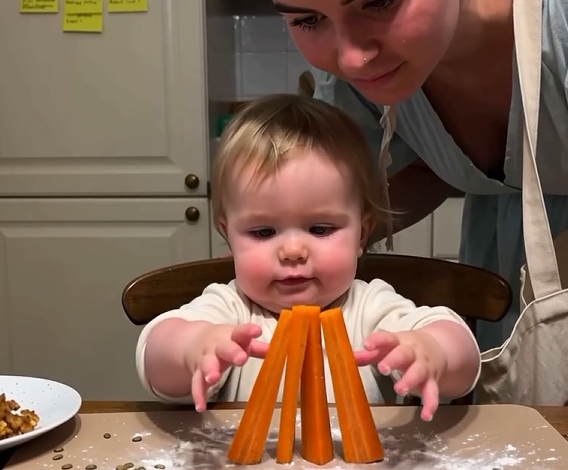
Her name was Nell Abbott, and she did not believe him.
That was the part nobody in the kitchen understood that night, Damian least of all. She had heard men like him make generous decisions before. They made them in the exact minute the guilt was loudest, and they meant every word, and then the guilt faded on an ordinary Tuesday and the decision quietly stopped existing.
So she finished the last bridge with Owen. She watched him eat four green beans and half a slice of bread without crying. And when he fell asleep at eight, she carried the suitcase back up to the room over the garage and did not unpack it.
Marla came back on Thursday.
She came back reasonable, which was worse. She brought a folder of her own: printouts on pediatric feeding disorders, a letter from the discharged nutritionist, a schedule drawn up in three colors.
“I’m not here to fight,” she said in the study. “I’m here because you made an emotional decision in front of a screaming child, and that is the worst possible condition for making one.”
“Probably true,” Damian said.
“Then look at this. Eleven weeks of professional intervention. Weight stabilized. Caloric intake tracked daily.” She set the pages on his desk. “And then one girl with no qualifications tells him he doesn’t have to finish his plate, and you think that’s a breakthrough instead of what it actually is, which is surrender.”
Damian looked at the pages for a while.
“He gained the weight,” he said.
“Yes.”
“How?”
Marla’s chin came up. “By eating.”
“No.” He pulled the old chart from the drawer and laid it beside hers. The crossed-out times. The circled portions. The column someone had labeled resistance and filled, day after day, with a single tally mark for every meal that had required two adults. “By being held down. Four months of it. He’s three, Marla. He’s three and he flinches when a spoon comes near his face.”
“He flinches because that girl has taught him it’s optional.”
“He flinches,” Damian said, “because for four months the people who loved him were the people who hurt him, and I signed off on every page of it.”
Marla didn’t answer that.
“You weren’t wrong to come,” he said, more quietly. “After Rosa died, I couldn’t — someone had to run this house. You did. I know what that cost you.” He closed the folder. “But somewhere in there you stopped asking whether it was working, and started defending that it should.”
She looked at him for a long moment. “And her?”
“She asked him what he wanted. That’s the entire difference. There isn’t a secret.”
Nell didn’t stop working. Nobody had told her to, and she wasn’t going to be the one to raise it.
She came down at six-thirty every morning the way she had since the agency sent her. She set out the tray. She wrote in the log. She stood exactly where she’d stood the first week — two steps back from the table, close enough to be reached, far enough to not be reaching.
The bridge changed shape as Owen got braver with it. It became a tower, then a fence, then a long low wall of carrot sticks he called “the road,” down which he drove, with great seriousness, single green beans.
The rule never changed, and it was the only rule: Owen decides what goes on the bridge, and Owen decides whether it gets eaten.
Most nights, most of it got eaten.
The nights it didn’t, Nell wrote it in the log without a comment, and nobody cleared the tray in front of him, and nobody said just three more bites, and the next morning he came back to the table on his own feet instead of being carried to it.
That was the thing the old chart had never had a column for. Not how much. Whether he came.
Damian started being in the kitchen at six-thirty.
The first week he was dreadful at it. He hovered. He narrated. He said good boy so often that Owen stopped responding to it entirely, the way a word goes dead if you repeat it enough.
Nell didn’t correct him in front of the child. She waited until the boy was down, and then said, at the sink, “He’d already picked the bean up. You said ‘good boy’ before he put it down. Now he’s watching your face instead of the bridge.”
Damian stood with a dish towel in his hands, a man who had not been told he was doing something wrong by a twenty-two-year-old in six years, or possibly ever.
“So I should say nothing.”
“You should say it after. Or not at all. He’s not doing it for you.”
He thought about that one for three days.
By the second week he had learned to sit down. By the fourth he had learned to shut up. The first time Owen put a bean on the bridge and then slid a second one across the tray toward his father’s hand — you do one — Damian had to get up and go stand in the pantry for a minute.
She enrolled in September.
He paid it exactly the way he’d said: tuition, books, the parking pass, in one transaction, with no paperwork for her to sign and no mention of it afterward. When she tried to thank him properly he was so visibly uncomfortable that she gave up halfway through, which she suspected was the point.
What she had not expected was the conversation three days before classes started.
“Your schedule,” he said. “Tuesday and Thursday mornings, and the Wednesday night lab.”
“I’ll get the early bus. I can still do breakfast Monday, Wednesday, Friday—”
“Nell.” He put down the folder. “If you arrange your degree around my son’s meals, then in two years you will not have a degree and he will not have learned anything except that the world rearranges itself for him when he’s frightened.”
She stared at him.
“You’re the one who said it,” he added. “He does better when nobody crowds him. That has to include me, and it has to include you.”
So they built it the other way around. Her classes first. His mornings second. And on the three mornings a week she wasn’t there, Owen’s father set out the tray himself, badly, and wrote in the log in handwriting markedly worse than hers.
Tues. Ate most. Two beans on road, one in hair. Did not cry. Asked for you.
Thurs. Bad one. Ate nothing after 7:10. Did not push. Came back at 7:40 on his own and had the bread.
Weds. Good. He drove the road. I was the tunnel.
The high chair went out with the recycling the first week, and that was easy.
The rest took two years.
There were weeks it went backward. There was a stomach bug in January that set him back nearly to the beginning, three days of nothing but milk and the awful tightening in everyone’s chest, and a specialist — a good one this time, recommended by a pediatrician rather than hired off a referral — who looked at the whole history and said:
“He doesn’t have a feeding disorder. He has a fear of being fed. Those are different problems, and you’ve been treating the wrong one for a year.”
Damian wrote the sentence down. It’s still in the desk.
Marla did not vanish in disgrace, because this is not that kind of story. She stayed in the family’s life; she came at Christmas; she and Nell never did become friendly, exactly. But in March she turned up with a bag of oversized plastic construction blocks and set them down on the counter without explanation, and when Owen built a bridge out of them and put a strawberry on it, she said, “That’s a good bridge,” and nothing else, and left the room before anyone could make it into a moment.
It was, in its way, the largest thing she had ever conceded.
Nell stayed two and a half years, and then she left, which was always the plan.
She finished the degree, and then she took a job at a children’s therapeutic feeding clinic forty minutes away, where she was the junior person in a building full of people with letters after their names, and where she was very good at the single thing nobody there could teach: sitting two steps back from the table and waiting out a three-year-old without flinching first.
She did not disappear. She came for birthdays. Owen sent her a photograph of every bridge he built for about a year, taken at an unusable angle, mostly of his own thumb.
The last one came the week he started school.
It was a drawing, not a photograph. A long wobbly line of orange sticks with green circles on top, and underneath, in the enormous unsteady capitals of a child who has just learned that letters mean something:
I DO IT MYSELF NOW. COME ANYWAY.