THE LITTLE BREAD TRAIN THAT STOPPED A RICH MAN’S HOUSE FROM BREAKING HIS SON

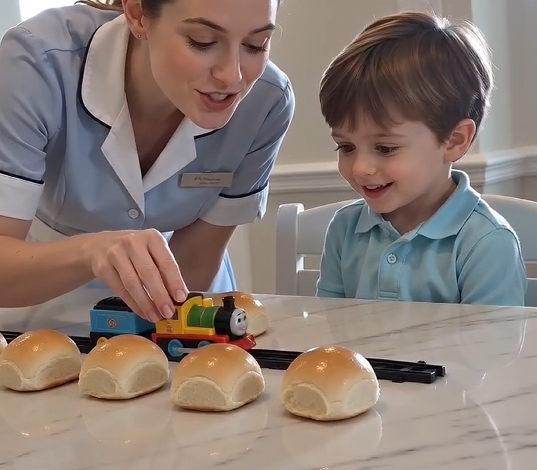
He Ethan did not leave for the airport that night.
stood in the kitchen doorway while Lily kept the bread train moving down the marble counter, one torn piece at a time. Owen ate all four “cars” without a single scream. Not fast. Not neatly. But he ate.
Each bite landed in the room like an accusation.
The house manager, Celia, still held the folded linen napkin she had meant to place in Owen’s lap. Vanessa had one hand on the back of a dining chair, her face tight and bright in that polished way people get when they are furious but trying to stay elegant.
Lily finally looked up.
She saw the expensive suit, the dropped phone, the stunned father.
“I’m sorry,” she said automatically. “He looked too hungry to make it to the table first.”
It should not have sounded brave. It should have sounded like a girl afraid of losing a job she badly needed.
But in that house, it landed like a rebellion.
Ethan looked at his son.
Owen had reached the end of the bread line and was licking butter from his thumb. His shoulders, usually up around his ears by this point in the evening, had fallen. His breathing had slowed. His eyes were still wet, but they were clear. He was not trapped inside himself anymore.
“Did he ask for more?” Ethan said.
Nobody answered at first because nobody in that kitchen was used to being asked what Owen wanted.
Then Owen did something even stranger.
He touched Lily’s sleeve and pointed at the basket.
“More cars,” he said.
Celia actually inhaled.
Vanessa recovered first. “This cannot become a habit.”
Lily glanced at Ethan like she expected him to agree.
Instead he said, “Give him more.”
Vanessa turned to him. “Ethan, no. We’ve spent months trying to establish a proper evening structure.”
He did not even look at her. “And how is that going?”
Silence.
Lily made six more little bread cars.
This time Owen helped line them up. His fingers were still clumsy from hunger and nerves, but he did it carefully, murmuring the order under his breath. Engine. Blue car. Dog car. Sleep car. Snow car. Last car. He invented each one as he went. After the third bite, Lily added slices of turkey between two pieces and called it the strong car. He ate that too.
By the time dinner was served in the glass room, Owen had already stopped shaking.
For the first time in months, he entered without screaming.
Not because he was cured. Not because he had suddenly learned manners. Because he was no longer starving and terrified at the same time.
That should have been obvious to every adult in his life.
It had not been.
At the table, Owen still would not touch the silverware at first. He sat sideways. He kept one hand wrapped in Lily’s cuff because she had followed him in, standing a step back from the chair as if ready to leave the second somebody told her to. Ethan noticed that too. She did not act like a savior. She acted like a worker who knew she could be blamed at any second.
Owen ate three bites of mashed sweet potato with his fingers.
Vanessa shut her eyes briefly.
Ethan said, “Let him.”
That was the first crack anyone heard.
The next evening, Vanessa tried to get ahead of it.
She arrived in the kitchen early in a silk blouse and hard little smile and announced that dinner would return to normal procedure. Celia laid out the visual schedule the consultants had prepared. A laminated card showed the sequence: wash hands, enter dining room, sit, napkin, wait, pray, then eat.
Owen saw the card and instantly went stiff.
His lower lip trembled. His breath shortened. He backed toward the sink.
Lily had just come in from the service entrance, hair still damp from the cold outside. She took one look at Owen and one look at the card and understood something the others kept refusing to understand: by dinner time, he was already running on fumes. Then they asked him to perform.
It was not really about bread. It was about permission.
Permission to be hungry before he was proper. Permission to touch food before he was corrected. Permission to enter dinner like a child instead of a guest at his own table.
Vanessa said, “Do not start that train nonsense again.”
Owen made a sound deep in his throat.
Lily crossed to the bread basket anyway.
Vanessa stepped in front of it. “I said no.”
The sound in Owen’s throat turned into panic. He hit the cabinet with both palms, eyes wide and glassy. Celia moved toward him with the practiced calm voice that never helped. “Owen, let’s regulate our bodies.”
He screamed.
Not a tantrum scream. A raw, frightened one that cut through the kitchen and reached the glass dining room beyond it.
Lily did the only thing nobody else in that house ever did when adults started fighting over him.
She got low.
Not on a designer chair. On the floor. Right there by the sink.
She sat cross-legged on the tile and tore one little piece from a roll in her lap.
“Train got stuck,” she said softly, speaking to the bread, not to Owen. “Track trouble. Big problem. Might need a mechanic.”
Owen’s scream broke. Just for a second.
That second was enough.
He dropped to the floor across from her, sobbing hard, and slammed both hands over the roll in her palm like he was rescuing something alive. She let him. He took the bread, tore off a piece, shoved it in his mouth, and cried while he chewed.
Vanessa stared in disbelief. “This is completely unacceptable.”
It might have gone back to the old pattern if Ethan had not walked in right then.
This time he had made sure to be home before dinner.
He took in the scene at once: his son on the floor by the sink, cheeks wet, eating bread in jagged little bites; Lily sitting on the tile in her cheap black work shoes; Vanessa standing over them like a museum guard protecting the furniture.
He did not ask for an explanation.
He asked, very quietly, “How many nights has he been this hungry before dinner?”
Celia tried to answer in professional language. “Children with regulation difficulties often resist structured meals—”
Ethan cut across her. “That is not what I asked.”
No one spoke.
Because they all knew the truth.
Owen was hungry every night. Everyone knew it. And everyone had agreed that arriving at the table correctly mattered more than feeding him sooner.
Ethan looked sick.
That night, he moved the bread basket himself.
He set it by the sink.
“Start the train,” he told Lily.
Vanessa laughed once, short and disbelieving. “You are reorganizing the entire household around a childish gimmick.”
Ethan turned to her. “He is a child.”
The third night, Owen waited by the counter before anyone called him.
The fourth night, he built the train himself.
The fifth night, he added cucumber slices as passengers.
The sixth night, he asked, “Can the train go to the table?”
Lily did not rush him. She put a small plate at the far end of the counter and said, “Only if the bridge is safe.”
Owen carried the final bread car there with both hands and placed it on the plate. Then he climbed into his chair and ate from the same plate he had just delivered.
Celia watched like she had witnessed magic. It was not magic. It was sequence. Feed first enough to calm the panic. Then ask for the rest.
But that truth made the old system look cruel, and wealthy people do not like simple truths when they expose expensive failures.
Vanessa took it personally.
She had entered Ethan’s life after Owen’s mother died, when the house was all corners and silence. At first, Ethan had mistaken her love of order for strength. She booked specialists, color-coded schedules, arranged the flowers, managed the calendar, and spoke about “stability” in a voice that made everyone else feel underqualified. She was never openly cruel to Owen. In some ways that made it worse. She did not hate the child. She hated anything messy enough to rearrange her control.
Lily was messy.
Not dirty. Not careless. Just alive in ways the house had stopped allowing.
She hummed while wiping counters. She let the kitchen smell like warm bread instead of lemon disinfectant. She tucked an apple into her coat pocket for later and remembered to text her brother about homework during her break. She did not glide. She moved with purpose. When Owen dropped a spoon, she picked it up and handed it back instead of giving him a lecture about grip.
And Owen began to watch for her.
He ate more when she worked. He cried less before dinner. Once, he even laughed when she pretended the peas were rude passengers trying to jump off the train.
Ethan noticed all of it.
So did Vanessa.
Three days later, Vanessa called what she named an emergency family alignment meeting.
At four-thirty that afternoon, Ethan came downstairs to find the breakfast room turned into a boardroom. Celia was there with a tablet. A child consultant had been summoned on video. A nutrition coach sat with a folder open. Vanessa stood at the end of the table in cream-colored silk, as if she were about to lead a fundraiser instead of a household ambush.
Lily had been pulled off vegetable prep and told to sit for an “assessment.”
She looked miserable.
Her hands were folded tight in her lap. There was flour still caught in one sleeve seam from her bakery shift. She had clearly not expected this. Owen, who had been building a train out of clothespins on the floor nearby, looked from face to face and understood only one thing: the adults were circling Lily.
Vanessa began smoothly.
“We all appreciate the temporary reduction in pre-dinner distress. However, we need to evaluate whether the caregiver’s methods are developmentally appropriate, hygienic, and aligned with the standards of this home.”
Lily’s ears turned pink.
The consultant on the screen asked, “Can you explain why you encourage food play before formal mealtime?”
Lily swallowed. “I wasn’t trying to do food play.”
“Then what were you doing?”
She looked at Owen, then at her own hands. “He was hungry.”
The room went still.
The nutrition coach jumped in. “Children often present resistance behaviors that should not be reinforced by grazing patterns.”
Lily did not have fancy words. “He wasn’t grazing. He was panicking.”
Vanessa’s smile thinned. “And yet you sit on kitchen floors, use your hands, and undermine the household routine.”
Owen rose to his feet so fast his clothespins scattered.
“Don’t,” he said.
Nobody listened because adults in that house had a bad habit of missing the first warning.
Vanessa continued, “If she stays, she must be trained into a more consistent protocol.”
Owen rushed across the room and threw himself against Lily’s side, both arms around her waist. Not a cute hug. A hard, protective lock.
“No,” he said louder. “No meeting. No bad Lily.”
Every adult froze.
Vanessa’s face emptied.
Celia took one step forward, probably to soothe him, but Owen twisted away and clung tighter. His breathing had gone thin and fast again, but this time he did not turn toward the old routine. He buried his face in Lily’s shirt and shouted, “No card. No table first. Train first.”
The consultant on the screen started saying something about attachment transfer.
Ethan reached over and closed the laptop.
Then he looked at the table full of experts, charts, standards, and imported concern, and for the first time he saw what his money had built: not care, but a machine for managing appearances.
He spoke to Celia first because she had been there longest.
“How long has he been melting down before dinner?”
She hesitated. “Since his mother’s funeral, the difficulty increased, but—”
“Increased?” Ethan’s voice was flat. “Try again.”
Celia lowered her eyes. “Since then, evenings became highly sensitive.”
“And the answer was what? More rules?”
No one said yes. They did not need to.
Ethan looked at Vanessa. “You set this up without asking me.”
“I am trying to protect this family.”
“No,” he said. “You are trying to define it.”
That landed.
Vanessa went white with anger. “I am the only person in this house besides you who has tried to create order.”
Lily still had both arms around Owen, not possessive, just steady. She did not speak. She knew this was the kind of rich-people fight that could throw a working girl out the door in ten minutes.
But Owen spoke for her.
“Lily feeds train,” he said into her shirt, crying again now from the stress of all eyes on him. “Lily waits. Lily doesn’t make me be fancy.”
Ethan shut his eyes for one second.
When he opened them, something had changed.
He was a man used to solving everything with invoices, speed, and other people’s expertise. But a little boy with butter on his cuff and tears on his face had just explained his whole failure in one sentence.
He turned back to Vanessa. “This meeting is over.”
She stared at him. “You cannot be serious.”
“I am.”
“You’re choosing a part-time bakery girl over an entire support team.”
He looked at Owen. Then at the laminated dinner card still lying on the table. Then at Lily, who had never once claimed to know better, only acted when the child in front of her was falling apart.
“I’m choosing what works,” he said.
Vanessa left that evening.
Not in a dramatic storm. In the clipped, silent way people leave when they understand they have lost the right kind of power. She took her garment bags, her skincare case, and her talent for making every room look finished while nobody inside it felt safe.
Celia stayed, but the house changed under her.
The visual dinner card disappeared. The bread basket moved permanently to the counter by the sink. Dinner started ten minutes earlier. No one corrected Owen’s grip in the first five minutes. No one talked about posture before he swallowed actual food.
And because the pressure dropped, the child changed.
Not all at once.
He still had bad evenings. He still cried when overly tired. Some nights he only managed two bread cars and had to eat the rest on Lily’s lap on the window seat near the kitchen. Some nights he walked into the glass dining room and then backed right out again.
But now when he backed out, no one called it failure.
They waited. They fed him. Then they tried again.
That was the rhythm Lily brought, and Ethan was smart enough at last not to confuse rhythm with weakness.
He began coming home earlier when he could. At first he only stood nearby, awkward in his suit, watching the bread train leave the station. Then one night Lily handed him a roll and said, “You forgot the cargo car.”
He blinked. “I have a cargo car?”
“You do if you want one.”
Owen looked up at him, uncertain.
Ethan tore the bread too big. Owen frowned. Lily quietly broke it smaller. Ethan tried again. The second piece was clumsy but right enough. Owen took it from his hand.
That moment hit Ethan harder than any boardroom victory he had ever had.
Because his son did not need a financier of care. He needed a father willing to look foolish in his own kitchen.
After that, Ethan learned the sequence.
Engine first. Then another. Then the calm came. Then the chair. Then the plate.
He stopped scheduling calls through dinner. He fired two consultants. He kept Celia, but her role changed from enforcing ritual to supporting the child actually in front of her. The dining room stayed beautiful, but it no longer felt like a test site.
And Lily?
Lily did not become some transformed lady of the house. She did not turn into a miracle expert. She still took the bus. Still worked bakery nights twice a week. Still sent money for her brother’s tuition and checked on his grades during breaks. She belonged to her own life, and she never let the marble counters fool her about that.
By early spring, Owen could usually make it to the table after his little bread train at the sink. Sometimes he even laughed before dinner. Once he lined up rolls for Ethan too and declared, “Dad’s train late again.”
It became a family joke, but Ethan never treated it lightly.
He knew exactly what that train had done.
It had exposed that his house had confused obedience with peace. It had shown him that a hungry child could not eat elegance. It had taught him that rules might keep a room quiet while still leaving it cold.
One Friday, Lily gave her notice.
Only two weeks, written carefully on plain paper.
Ethan found her by the sink after Owen had gone to bed, rinsing out a small bowl.
“Is this because of Vanessa?” he asked.
“No,” Lily said. “That was already over.”
“Then why leave?”
She dried her hands on a dish towel and looked embarrassed. “My brother got the scholarship. Full tuition for next year. I can drop the extra house hours and go back to daytime classes.”
He stared at her for a second, then nodded slowly.
It was not the answer some part of him had selfishly hoped for. Not because he thought she owed them, but because people who bring warmth into broken houses are easy to cling to.
“You should do that,” he said.
Her relief showed all over her face. “I want to.”
When they told Owen, he went quiet.
Not the shut-down quiet from before. A sad, thinking quiet.
“Who will do the train?” he finally asked.
Lily crouched in front of him. “Who knows how?”
Owen sniffed and pointed at himself. Then at Ethan.
She smiled. “Exactly.”
On her last evening, Owen insisted on a very serious train ceremony. He arranged six rolls by the sink. One for him. One for Dad. One for Lily. One for Mom in heaven, because he had begun to say that sometimes now without collapsing. One for “no more bad card.” And one for “home.”
He ate the first two. He handed the third to Lily. Then he pushed the fourth toward the window and left it there a moment in silence.
Ethan had to look away.
Before she left, he gave Lily an envelope. Inside was a check large enough to cover her first year back in school without night shifts, plus enough to keep her brother steady. She tried to refuse. Of course she did.
“It isn’t charity,” Ethan said. “It’s gratitude. And tuition should never depend on whether my house falls apart.”
She laughed at that, then cried a little, then took it.
After Lily left, the house did not go back.
That was the real ending.
The bread basket stayed by the sink.
Dinner never began with correction again.
If Owen needed three bites standing up before he could sit, he got three bites standing up. If he wanted to line up rolls like train cars at age seven, then seven and a half, then nearly eight, nobody rushed him to outgrow the thing that had given him his way back.
The glass dining room still shone at sunset. The flowers still got changed. The plates still matched.
But now there were sometimes crumbs on the counter first. Sometimes laughter near the sink. Sometimes Ethan in shirtsleeves making terrible little bread cars while Owen corrected the order.
The expensive house remained expensive.
It just finally became livable.
And in a place where everyone once thought rules could replace presence, a bakery girl with tired feet and flour on her sleeve left behind the one thing money had failed to buy:
a family rhythm that fed the child before it judged him.