THE NIGHT THREE RICH KIDS SCREAMED AT A BATH TOWEL UNTIL THE NEW NANNY STEPPED INTO A RAIN PUDDLE AND CHANGED THE WHOLE HOUSE

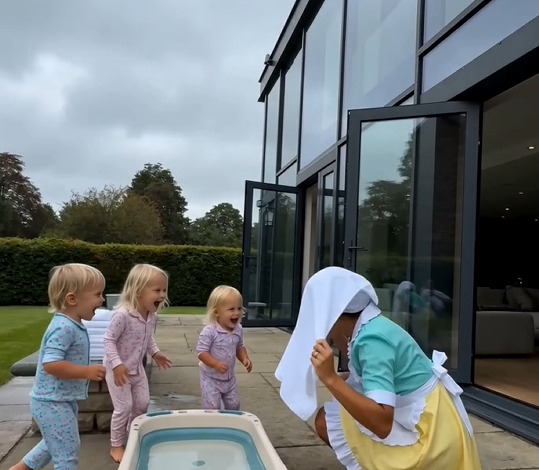
Grant Mercer stood in the hallway with his car keys still in one hand and his passport case in the other, watching his three children breathe like children instead of trapped animals.
The terrace door was open. Cool damp air moved through the overheated hallway outside the bathroom. Water darkened the stone floor where Tessa’s socks had left tracks. The folded towels sat abandoned on a chair like evidence.Milo was still holding her hand.
June had crouched near the puddle and was poking the water with one finger, then pulling back, then touching it again.
Evan had not stepped fully in, but he was no longer sobbing. He was standing close enough that one splash hit his ankle. He looked startled, then curious.
Nobody in that house had seen curiosity at bath time in months.
Vanessa recovered first. “This ends now.”
Her voice cracked through the terrace like a whip. One of the housekeepers instantly reached for the towels again.
Milo screamed before the cloth even lifted.
Not the earlier building panic. This was immediate. Direct. Protective.
He dropped Tessa’s hand only to throw both arms around her leg.
June stood up and moved in front of the towel cart as if she could block it with her own body.
Evan backed into the doorframe and started shaking.
Grant looked from the children to the towels to his wife. “Put them down.”
The housekeeper froze.
Vanessa turned to him, stunned more by the interruption than the words. “Grant, this is exactly the problem. She is teaching them to avoid hygiene with a game.”
Tessa opened her mouth, probably to apologize. Grant could see it on her face. This was the moment people like her got blamed inside houses like his. She was young, broke, replaceable, and standing on imported stone in wet socks in front of his second wife.
Instead, before Tessa could say anything, June made a sound none of them expected.
“Don’t.”
It was small. Hoarse. But clear.
Grant looked at his daughter so fast it almost hurt.
June had not said a full word during evening care in eleven weeks.
Vanessa heard it too and shifted tactics immediately. “Sweetheart, no one is upset. We just have to do this properly.”
Properly.
That word did something sharp inside Grant, because suddenly he saw the whole arrangement the way an outsider would. The lined-up towels. The timed bath. The bright lights. The staff changing hands mid-routine so no one ran late. Children being lifted while crying because “stopping would reinforce avoidance.” Vanessa smoothing every scene into language that sounded reasonable in daylight and cruel at night.
He had paid for order and called it care because order was what he understood.
Tessa carefully lowered herself onto the wet terrace, right there on the stone, so Milo would not have to cling upward. She did not make a speech. She did not act like she had a method. She just said, “Nobody’s making you do the next part yet.”
The triplets folded around that sentence like starving kids around food.
That was what the old system had never allowed: yet.
No pause. No waiting. No chance to come back on their own.
Vanessa saw Grant seeing it, and that was when her fear showed up plain. “If staff start inventing routines, there is no structure in this house. Tomorrow they’ll refuse everything. Meals. School. Sleep. This is what happens when boundaries collapse.”
Tessa finally spoke, still quiet. “They aren’t scared of getting clean.”
Nobody answered.
She looked at the bathroom, then the laundry room, then the stacked towels. “They’re scared of being rushed from one step to the next after they already panic. Once it starts, no one lets them stop feeling scared before touching them again.”
Grant felt his jaw tighten because it was painfully simple, and because he had never stood still long enough to notice.
Vanessa turned on Tessa at once. “You were hired to assist, not diagnose. If you want to keep this job, stop pretending splashing in dirty rainwater is professional childcare.”
Then she stepped closer and lowered her voice enough that only the adults should have heard. “Say this was a mistake, and maybe I don’t dock your pay for this.”
Tessa went pale. For a second she looked exactly what she was: a laid-off motel clerk who needed every dollar. She glanced toward Grant, then away, as if she already knew rich families closed ranks when pushed.
Before she could answer, Evan did something none of them had seen him do in months.
He crossed the threshold himself.
He walked around the towel cart, around Vanessa, and went straight to Tessa. Then he pressed his small body into her side and hid his face there.
No one had touched him. No one had led him. He chose.
Vanessa actually stepped back.
Grant said, very evenly, “No one is docking her pay.”
The house went silent.
That night ended differently from every other bath night.
No towels in sight. No bright overhead lights. No team. No forcing.
At Tessa’s suggestion, they left the terrace door cracked open and moved the children one step at a time. First just standing near the bathroom with dry feet. Then turning on the warm water and letting them listen. Then Tessa wetting a washcloth and dabbing her own arm. Then letting Milo do the same to a toy boat from the bath shelf. June copied him. Evan watched.
They never got all the way through a full bath.
For the first time, nobody called that failure.
The next evening, Grant canceled his dinner in the city and came home before sunset.
He said it was to review a contractor dispute on a call. That was a lie so thin even he knew it.
He came home to watch.
Tessa did not repeat the puddle scene like a trick. That was another thing Grant noticed. She was not performing for him. She was following the children. Rain had not come that day, so she made space another way. She sat with the triplets outside the bathroom on the laundry room floor and rolled three towels into tight logs like sleeping bags, then tucked a toy duck under one and let Milo “find” it. June took the second towel and wrapped it around a stuffed rabbit herself. Evan touched the edge of the third towel and flinched, but did not run.
The old care team had treated the towel as a neutral object. Tessa understood that the towel was the warning bell.
She let it become play before anyone tried to make it become procedure.
Within four days, the order of the children became clear.
Milo always moved first. He was the one whose panic was loudest, but he was also the first to test a new path.
June came second, cautious and watchful, making sure the world did not punish Milo for trying.
Evan came last, not because he was stubborn, but because he needed proof twice before his body believed anything.
Tessa somehow learned their rhythm without reading a chart.
On the fifth night, Milo took a towel and draped it over Tessa’s shoulders like a cape, laughing.
June took another and put it on her own head, then peeked out from under it.
Evan reached for the smallest folded cloth and held it against his chest for a full three seconds.
Grant had seen grown executives fail to deliver results after months of planning. This girl, with no resume that fit his world, had changed the temperature of his home in less than a week by doing one thing none of them had done.
She stopped trying to win against the fear.
She made room around it until the children could move.
That should have settled it.
It didn’t.
Because Vanessa had not built her place in that house through softness. She built it through management. Through improvement. Through making Grant believe that every problem could be solved by enough order applied firmly enough. The triplets’ progress under Tessa did not just challenge a bedtime routine. It challenged Vanessa’s authority to define what this family was.
So the resistance got colder.
A revised staff memo went out the next morning: no unscheduled play near the bathroom. No outside water brought indoors. No interruption of evening hygiene sequence. All child-facing staff to route concerns through Mrs. Mercer.
Tessa found the printed sheet on the kitchen counter beside her coffee mug.
By lunch, her hours had been cut the following week “pending review.”
By afternoon, Vanessa informed payroll that one broken floor lamp in the nursery lounge had been “possibly caused during unstructured activity,” which was another way of building a file.
Tessa did not complain. Grant only knew because his old house manager, Mrs. Bell, quietly left the memo on his desk in the study and said, “The children are calmer with the new girl.”
That was the closest anyone in staff came to taking a side out loud.
That evening, storm clouds gathered again.
At seven-thirty, Milo saw the bath towel cart and froze. The memo had already changed the room. The old pressure had come back in through posture alone.
Tessa stood near the laundry door, saying nothing.
Vanessa folded her arms. “Let’s do this normally tonight.”
Normally.
Grant, who had stayed home on purpose again, looked at his son and saw the boy begin to disappear inside himself.
It happened fast. Eyes unfocused. Shoulders up. Breath gone shallow.