THE WINDOW CHILD AND THE CLOTHES THAT MADE A DOOR

She took her complaint to Owen’s father that night. She said the young woman was encouraging dependency, spoiling a child who already controlled too much of the household, and making the family look careless before the staff. She did not mention the way Owen had chosen the nanny’s side of the room. That detail made her argument weaker.
Owen’s father listened in his office, where invoices for specialists and caregivers filled a drawer he rarely opened. “The trial is not over,” he said.
“Then end it early.”
He turned a pen between his fingers. “Not yet.”
For the next three days, the nanny built nothing grand. She took old shirts from the donation box only after asking the housekeeper which ones were truly unwanted. She made a fox tail from a strip of brown fabric, a soft crown from a folded newspaper, and a tiny shoulder cape from the sleeve of an old sweater.
Owen did not speak, but he began to bring her pieces himself. A single mitten. A blue tie with a coffee stain. One of his father’s discarded white shirts, dragged behind him across the rug.
When she held up the shirt, he touched the cuff, then pointed toward the window.
“Should it be a cloud?” she asked.
He blinked at her.
She laid the shirt across two chairs and clipped the sleeves together with clothespins from her bag. It became a narrow, crooked tent with a view of the lawn. Owen crawled beneath it, stopped, and waited.
The nanny stayed outside until he reached through the opening and caught the hem of her sweater.
Then she went in.
His father came home early that afternoon, intending to speak to the nanny about limits. He had received another message from his wife, sharper this time, saying Owen had appeared in a photograph sent by the aunt with thread on his sleeve and a scarf around his neck. She called the image humiliating.
He walked past the silent gallery, past the spotless formal dining room, and heard a faint brushing sound from the playroom. He expected disorder. What he found was stranger to him.
Owen sat beneath the white-shirt tent, carefully pressing a broad paintbrush over paper spread on the floor. The nanny had put washable paint in shallow bowls: yellow, green, red, and blue. Her own fingers were stained green. The expensive easel in the corner remained untouched.
Each time Owen made a mark, she made one beside it. Not the same mark, not a correction, only an answer.
He painted a blue line across the page. She added a smaller blue line beneath it. He looked at it, then dipped two fingers into yellow and pushed them across the paper.
The paint made a wet, soft sound.
Owen looked down at his yellow fingertips. His face changed before his father could understand why. He pressed both hands into the paper, then onto the nanny’s open palm.
A laugh burst out of him, clearer than the first one, and he did it again.
His father stood frozen in the doorway, exactly where he had been on the first day. The boy who would not meet a hand, who turned rigid when anyone tried to guide him, had placed paint on the nanny’s skin and waited for her response. She pressed her painted hand to the paper beside his.
Two handprints bloomed there, uneven and bright.
Owen’s aunt appeared behind his father, summoned by the noise. She saw the paint first, the old shirt tent second, and Owen’s laughter last.
“This has gone far enough,” she said.
Owen’s hands stopped in the air.
The nanny wiped one paint streak from her wrist with a rag. “It washes.”
“I am not talking about the paint. You have turned a playroom into a craft closet, and now he expects everyone to perform around him.”
Owen began to fold inward. His father saw it happen: the lowered head, the fingers searching blindly for the scarf, the way he stopped breathing freely when an adult’s voice hardened. He had seen those movements for years and called them difficult behavior because it was easier than asking what caused them.
The nanny found the scarf and placed it within Owen’s reach. She did not tell the aunt to leave. She only resumed painting a thin green line next to the blue one.
Owen watched her. After a long moment, he put his paint-covered hand on her sleeve and leaned his forehead against her shoulder.
His father felt the proof land in him before he had words for it.
His aunt said, “You cannot let a temporary employee decide the atmosphere of this home.”
“No,” he said, still watching Owen. “But I can stop letting this home decide everything for him.”
It was not a speech he had prepared. It startled him as much as it startled her.
His aunt left the room with a clipped promise that she would speak to his wife. Owen did not look up until the hallway was quiet. Then he let the nanny rinse his fingers in a bowl of warm water, one at a time, while he held the scarf under his chin.
That night, Owen’s father stood outside his son’s bedroom after the nanny had finished the usual routine. He had never been part of it. Someone else bathed Owen, someone else read the approved book, someone else sat by the door until the house was quiet enough for sleep.
The nanny emerged carrying the folded denim shirt. “He is awake,” she said.
His father looked past her. Owen sat in bed with the scarf and the small cloth fox tail beside him. For several seconds, father and son only looked at each other.
Then Owen lifted the fox tail toward him.
His father did not know what it meant. The old habit in him was to ask the nanny for translation, to let her take the next step. Instead, he crouched at the doorway and held out his hand, palm up, the way he had seen her do.
Owen did not come right away. His father stayed where he was until Owen placed the fox tail in his palm.
“Thank you,” his father said, awkwardly but plainly.
Owen pulled the scarf over his shoulder and lay down. It was not an embrace. It was not a cure. But his father remained by the door until Owen slept, and when he left, he carried the fox tail carefully instead of setting it on the nightstand.
The following morning, Owen’s stepmother returned. She walked into the breakfast room, saw a faint smear of yellow paint under one of Owen’s fingernails, and asked why the nanny had allowed him to arrive at the table unpresentable.
Owen’s father answered before the nanny could. “He painted yesterday.”
His wife set down her bag. “That is precisely the issue. He needs consistency.”
“He needs us to notice him.”
The sentence made the room still. Owen did not react to the adults’ words, but he was sitting in the open doorway of the playroom instead of at the window. The nanny had placed a basket of old fabric beside him, and he was winding a red strip around the arm of a wooden horse.
His wife looked toward the aunt, expecting support. The aunt gave none. She had seen enough to know that removing the nanny now would no longer look like protecting Owen. It would look like taking something from him.
The stepmother tried a different argument. She said the nanny was blurring boundaries, creating rituals that could not last, and making Owen dependent on a person hired for only two weeks. There was truth in the last part, which was why Owen’s father did not dismiss it.
He asked the nanny to meet him in the library after breakfast. She arrived with a tiny thread bracelet Owen had made by twisting two scraps together. He looked at it in her hand and understood that the question was no longer whether she had helped. The question was whether the adults would use her success as another service they could purchase and manage.
“I cannot promise he will be the same tomorrow,” she said before he asked. “I cannot promise he will want me every day. But when he goes still, no one should punish him for it.”
His father looked down at the bracelet. “What should we do?”
She seemed surprised by the question. “Start by not making him perform being okay for you.”
He nodded once. It was a small answer to a large failure, but it required something he had avoided: time. He canceled his late meeting that afternoon and told the household staff that the playroom rule was removed. The brass plaque came down before dinner.
His wife objected in private. She said he was tearing apart the order she had maintained when he had refused to be present. He did not deny it. He told her that order had kept the floors clean and their calendar full, but it had not reached Owen.
She left the house for the weekend after saying she would not participate in chaos. The aunt stayed, but she stopped entering the playroom without knocking. Neither woman softened into the new rhythm. They simply lost the power to call it misbehavior whenever Owen chose closeness over obedience.
On the last morning of the nanny’s trial, her canvas bag waited by the foyer stairs. She had packed the sewing tin, her rain jacket, and the small clothes she had brought from the donation box. Owen had spent the night uneasy, returning again and again to the window with the scarf clenched in his fist.
His father had intended to offer a longer arrangement after breakfast. He wanted to do it properly, with paperwork, hours, and a salary that sounded respectful. But the nanny’s bus came at nine, and he delayed the conversation while taking a call he told himself could not wait.
When he returned, the bag was in her hand.
Owen stood in the playroom doorway wearing the repaired denim shirt. He had not cried. He had gone very quiet, staring at the hall where she was leaving. The nanny knelt down a few feet away and did not tell him to be brave or promise anything she had not been given the right to promise.
“I have to go now,” she said softly.
Owen looked at the faded scarf around his neck. Then he pulled it free.
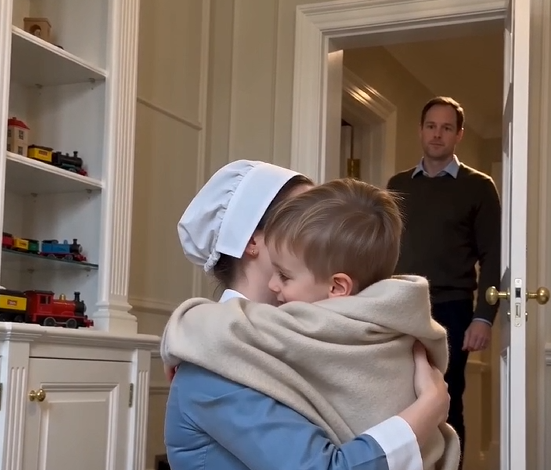
For a moment, his father thought Owen would hand it to her as a goodbye. Instead, Owen walked across the floor, unsteady but determined, and wrapped the scarf around the nanny’s wrist. He pressed both hands over it. When she stood, he clung to her leg and buried his face in the old denim shirt she had repaired.
The nanny’s eyes filled, but she did not pick him up until he lifted both arms.
Then she held him.
Owen settled against her without flinching, his cheek against her shoulder, while his father watched the child make the truth impossible to postpone. This was not a tantrum and not a performance. Owen had found a person who had entered his small world without trying to own it, and he was terrified of losing her.
His father ended the call still ringing in his hand. He asked the nanny to stay, but not as another person who would carry all the work while he disappeared. He told her he would change his schedule, learn the routines she had begun, and make room for her judgment instead of issuing rules from another room.
She did not answer immediately. “He cannot be handed from one adult to another whenever the house gets uncomfortable,” she said.
“He will not be,” Owen’s father replied. “Not again.”
The nanny agreed to extend the trial one month, not forever. The condition came from her, and the father accepted it. The aunt said nothing as the canvas bag returned to its hook by the stairs.
That evening, the playroom floor was covered with a sheet to protect the rug, though no one called it a rule. Owen sat on it with his father and the nanny, arranging old fabric into a lopsided red-and-blue cape. His father struggled with the needle, pricked his finger once, and laughed at himself before Owen could decide whether it was safe.
Owen studied him, then took the blue strip and laid it across his father’s open palm.
The nanny threaded the needle. Owen held the scarf between them. And beneath the window where he had once disappeared for hours, the three of them began making something that was not finished yet.