THE BILLIONAIRE FOUND HIS BROKEN DAUGHTER UNDER THE TABLE DOING SOMETHING SHE HAD NEVER DONE BEFORE

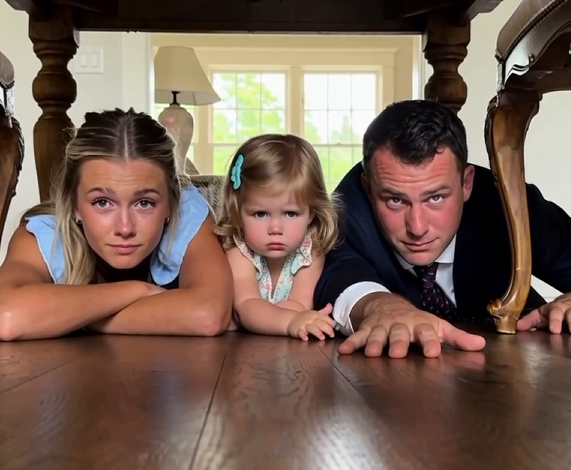
“They closed her world off to prove a point,” Claire said. She didn’t look up. “She’d been walking in daylight for a day and a half. Now she won’t let me touch her hand.”
Michael stood in the doorway of the nursery and looked at his daughter lying flat in a two-thousand-dollar crib, eyes open, staring at the ceiling, cheeks blazing.
“Julian did this.”
“Julian thinks he saved you from embarrassment.”
Michael went down the stairs so fast he missed the last two.
He found the butler in the service pantry, polishing a tray he had already polished, because a man who has made a decision he is unsure about will always find something to do with his hands at one in the morning.
“Take the drapes off the table.”
Julian set the tray down carefully. “Sir, with respect, the assessors arrive at nine. If they walk into this house and find a three-year-old living under furniture—”
“Take them off.”
“—they will write it in the report. Every one of them. Child sheltering beneath dining table, unsupervised floor-level feeding, caregiver without clinical credentials.” Julian’s voice shook slightly, which was the only sign that this cost him anything. “I have served this family for twenty-six years. I served your father. I will not stand in that salon tomorrow and watch strangers decide that the Sterling heir is being raised like a stray.”
“She hasn’t been raised at all for eight months,” Michael said. “She’s been managed. By me.”
“I was protecting her.”
“You sealed off the only three square meters of this house she wasn’t frightened of.” Michael’s voice had gone very quiet, which anyone who had worked for him knew was far worse than shouting. “She walked, Julian. Thursday morning. Five steps, on her own feet, into the sun. She laughed. And tonight she is lying upstairs with a fever, not blinking.”
Julian opened his mouth and nothing came out.
“The drapes. Now. And the blocks.”
It took the two of them forty minutes, because Michael did it himself, which Julian clearly found more disturbing than anything else that had happened. The velvet came down in heavy folds. The chairs came out. The plastic bins came down from the top shelf of the cedar closet and the blocks went back onto the floorboards in roughly the pattern Claire’s log said Mia had left them.
The bleach smell was the problem. They opened every window in the east wing and ran fans until three in the morning and it still hung there, flat and chemical, in a room that was supposed to smell like oatmeal and old wood.
At some point Michael stopped and stood in the middle of his own dining room at four a.m. in a suit he’d been wearing for twenty hours, looking at the dark gap under the table.
Then he got down on his hands and knees, and he crawled under it.
It was exactly as Claire had said. The ceiling was two feet high. The legs of the chairs made walls. From down there you could not see any of the twelve-foot windows or the chandelier or the portrait of his grandfather. You could see floorboards, and the underside of a table, and a small rectangle of doorway.
It was the first place in that entire house that was not trying to impress anyone.
Michael Sterling sat under his own dining table and understood, eight months late, that he had spent a fortune building his daughter a fortress and never once asked her whether she wanted a fortress or a den.
The St. Jude team arrived at nine.
Four of them, led by a Dr. Reyes who had flown in from Chicago, all of them perfectly pleasant, all of them carrying the quiet authority of people whose assessments decide things.
Julian had laid out the formal reception salon exactly as instructed weeks earlier: the small upholstered chair, the observation table, the three adult chairs arranged in a loose arc facing it.
“We’ll be in the dining room,” Michael said.
Dr. Reyes glanced up from her bag. “I’m sorry?”
“The assessment. It’ll be in the dining room. On the floor.” He heard how it sounded and kept going anyway. “She won’t engage in that salon. She’s never engaged in that salon. You’d be assessing how she copes with being cornered, and I can tell you the answer already, because I’ve paid four other teams to find it out.”
A pause. One of the junior assessors looked at Reyes.
“And where exactly will the child be?” Reyes asked.
“Under the table,” Michael said. “Probably.”
He expected the worst. What he got was Dr. Reyes looking at him for a long moment with an expression he couldn’t read, and then saying, mildly, “Mr. Sterling, I have been doing this for nineteen years and no parent has ever suggested that to me. Lead the way.”
Mia did not come out for the first forty minutes.
She lay under the table with her back to the room and did not move, and Claire sat cross-legged a few feet away at the edge of the shadow, not reaching, not talking, and the four assessors sat down on the floorboards in their good clothes because there was nowhere else to sit.
Reyes watched. She did not write much.
At forty-five minutes, Claire took the thermos out of her bag, poured oatmeal into two bowls, ate a spoonful herself, and tapped the wooden spoon twice against the floor.
Tap. Tap.
Nothing.
She ate another spoonful. Tapped twice.
The junior assessor shifted and Reyes put out a hand without looking at him.
At fifty-two minutes, a small hand came out of the dark and pulled the second bowl in.
Nobody in that room made a sound.
At an hour and ten, Michael — who had been sitting on the floor against the wainscoting the entire time, saying nothing, doing nothing, having been given one instruction by Claire that morning and following it with the discipline of a man who has finally found a protocol he believes in — took the bubble wand out of his jacket pocket.
He had practiced. He was still bad at it. The first batch came out as a single enormous bubble that burst immediately on his own knee.
From under the table came a sound.
It was not a laugh. It was smaller than that — a huff of breath through the nose, the kind of noise a person makes when something is stupid.
Michael tried again. Three bubbles drifted sideways into the dark.
And Mia came out.
Not running. Not into his arms — nothing so neat. She crawled to the edge of the table, sat on the boundary between shadow and light with her feet still underneath, and watched the bubbles with her chin on her hands. When one landed near her she poked it with a finger and it popped and she pulled her hand back and looked, hard, at her father’s face to see what would happen.
He did nothing. He just blew another one.
After the third time, she stopped checking his face.
Dr. Reyes’s report ran to eleven pages. Michael read it four times.
The sentence he kept going back to was in the summary, and it was not the one about Mia.
The child’s profile is consistent with acute grief response and environmental overwhelm rather than global developmental delay. Previous assessments were conducted in conditions that were themselves a significant stressor; it is likely that several of them measured the stressor rather than the child.
Underneath, in the recommendations:
Continue current arrangement. The present caregiver’s approach — low-position, non-directive, child-led, with consistent daily rhythm — is well-matched to this child’s needs and should not be altered to conform to institutional convention.
Reyes added one line by hand at the bottom, not typed, after the signature.
Whoever told you to get on the floor was right. Keep them.
Julian resigned on Monday morning. He had written the letter over the weekend, in fountain pen, on estate stationery, and it was two paragraphs of impeccable formality that did not once contain the word sorry.
Michael did not accept it.
“I need you to run this house,” he said. “What I don’t need is for you to run my daughter. Those were never the same job. I just never told you where the line was, because I didn’t know either.”
Julian stood holding his own resignation letter.
“The drapes were a cruelty, sir.”
“Yes.”
“I did not intend it as one.”
“I know. That’s the part that kept me up.” Michael handed the letter back. “Stay. But the dining room isn’t yours anymore. Nothing in it gets moved, cleaned, straightened, or improved without Claire’s say-so. The blocks stay on the floor. If the Mitchells come to dinner and ask why there’s a child’s den under the table, I’ll tell them.”
Julian looked at the letter in his hands for a long moment.
“Very good, sir,” he said.
He was, four months later, the one who quietly had a carpenter cut and fit a soft wool rug to the exact dimensions of the underside of that table, and who never mentioned it to anyone, and who was deeply embarrassed when Claire figured out it was him.
It did not become easy.
That is the part people leave out.
There were weeks of regression. There was an evening in November when a smoke alarm went off and Mia went down flat on the hallway floor and stayed there forty minutes while her father lay on the boards beside her — not touching, just there, breathing loudly enough for her to hear — until her hands came away from her head.
The first word came in February. It was not Daddy, and it was not her mother’s name. It was “more,” said flatly to Claire at the kitchen counter, holding out an empty bowl.
Claire nearly dropped the thermos and had the enormous presence of mind not to react at all. She filled the bowl. She handed it back. She said “okay” and went on with what she was doing, and waited until the child had left the room before she sat down on the floor of the pantry and cried into a dish towel.
She told Michael that evening. He asked, carefully, whether they ought to do something — mark it, call someone.
“No,” Claire said. “The whole point is that nothing happens when she talks. Same as nothing happens when she spills. She’s checking whether the world stays ordinary.”
So nothing happened. Every time Mia said a word, for weeks, absolutely nothing happened.
Which is why the words kept coming.
Michael got it wrong constantly.
He moved too fast. He filled silences. He kept catching himself trying to manage his daughter’s grief the way he managed a hostile acquisition — identify, contain, resolve by Q3.
Claire never corrected him in front of the child. She’d wait until the evening and then say, at the sink, something like: She’d already turned toward you. You just didn’t give her the second.
And Michael Sterling, who had not taken correction from anyone in nine years, would nod, and try again the next morning.
The table stayed. Long after she stopped needing it, it stayed — rug underneath, blocks in the corner, no drapes, chairs pushed out.
Claire left in the third year, for a developmental psychology program in Boulder that Michael paid for under an agreement she made him rewrite twice until it stated in plain language that it required nothing of her: no return, no further employment, no obligation of any kind, and that Mia was not a condition of any part of it.
She came back most summers anyway. Mia would hear the car on the gravel and come down the big staircase far too fast, on her own two feet, holding the rail with one hand like any other six-year-old in a hurry.
The last time the dining room came up in conversation was at a dinner party, years later, when a guest bent to retrieve a dropped napkin and noticed, with visible confusion, that there was a child-sized wool rug and a wooden block fitted neatly under the end of a two-hundred-year-old mahogany table.
“What on earth is that?”
Michael Sterling looked down the length of the table at his daughter, who was nine, and loud, and currently arguing about dessert.
“That’s where she learned it was safe to come out,” he said, and passed the bread.